Seoul 6,500 Households and 25,000 Households in the Metropolitan Area... Supply Cliff Until June
Concerns Over Base Effect from Last Year's Concentrated Move-ins Stirring the Jeonse and Monthly Rent Market Again
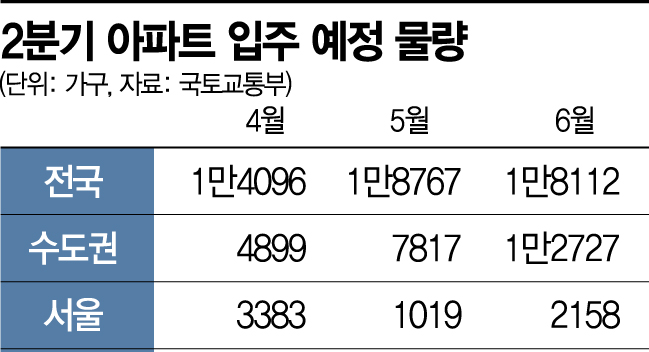
[Asia Economy Reporter Kangwook Cho] The supply of apartments in the Seoul metropolitan area scheduled for occupancy in the second quarter is expected to plummet to half the level of last year. There are concerns that the rental market, which had somewhat stabilized due to the supply shortage, may become volatile again.
According to the Ministry of Land, Infrastructure and Transport on the 16th, the total number of apartments scheduled for occupancy nationwide from this month through June is estimated at 50,975 units. Among these, the supply in the Seoul metropolitan area is expected to be 25,443 units, which is only 50.3% of the same period last year. In Seoul itself, the number of apartments available for occupancy is only 6,560 units, shrinking to half the level of the previous year.
The Ministry explained that the decrease in second-quarter occupancy is due to a base effect from the high supply volume last year. They expect the supply to recover from the third quarter onward, maintaining the overall annual supply at an average level. The Ministry estimates the total apartment supply this year to be 340,000 units nationwide, including 200,000 units in the Seoul metropolitan area and 42,000 units in Seoul.
However, industry insiders believe that short-term supply instability could stimulate the rental market prices, which have recently shown signs of stabilization. In particular, delays in Seoul’s reconstruction and redevelopment projects due to successive regulations such as the reconstruction excess profit recovery system and mandatory residence for union members, along with the introduction of mandatory occupancy rules for newly sold apartments, are expected to reduce the volume of rental units available in the market. Additionally, with official property prices soaring, landlords facing increased property tax burdens may pass these costs onto tenants.
Yoon Jihae, senior researcher at Real Estate 114, said, "Since the number of apartments available for occupancy in Seoul in the second quarter will be about half of that in the first quarter, it could act as a destabilizing factor in the rental market. There are also not many new apartments that can relieve tenants, so it will be insufficient to stabilize the rental market."
© The Asia Business Daily(www.asiae.co.kr). All rights reserved.
![Clutching a Stolen Dior Bag, Saying "I Hate Being Poor but Real"... The Grotesque Con of a "Human Knockoff" [Slate]](https://cwcontent.asiae.co.kr/asiaresize/183/2026021902243444107_1771435474.jpg)















