Traffic-Focused Roads Like the 2nd Ring Road Maintain Speeds of 60~90 km/h
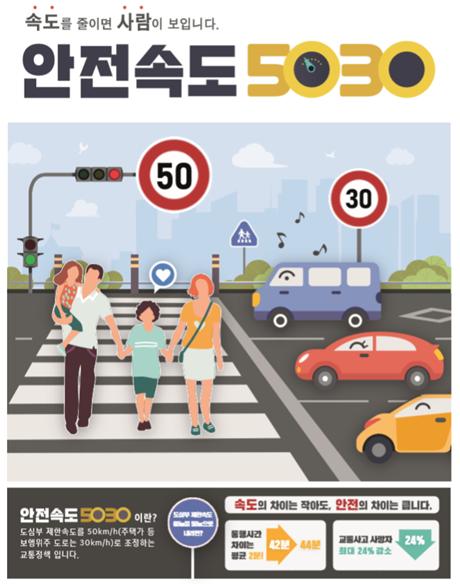
[Asia Economy Honam Reporting Headquarters Reporter Park Seon-gang] Gwangju Metropolitan City and Gwangju Police Agency announced on the 15th that they have completed the installation of traffic facilities such as speed limit reduction signs and road markings on 1,466 km out of the total 1,866 km of urban roads in the city ahead of the implementation of the ‘Safe Speed 5030 Policy’.
The ‘Safe Speed 5030’ is a nationwide safety policy that adjusts the speed limits of urban roads according to their use and situation to protect pedestrians on the road and reduce fatalities in traffic accidents. The speed limit is set to 50 km/h (60 km/h if necessary) on general roads and 30 km/h or less on residential and other side roads.
Additionally, the speed limits in all protection zones within Gwangju city (588 for children, 52 for the elderly, and 11 for the disabled) have been lowered to within 30 km/h, thereby strengthening the protection of vulnerable road users.
To promote this policy, the Enforcement Rules of the Road Traffic Act were promulgated on April 17, 2019, and the policy will be fully implemented from the 17th, marking two years after the promulgation to ensure stable project execution by local governments.
Gwangju City and Gwangju Police Agency have conducted basic and detailed design services following the legal amendment to ensure the smooth implementation of the Safe Speed 5030 traffic safety project. Speed limits have been lowered to within 50 km/h on 103 sections totaling 187 km, including major roads such as Sicheong-ro with four or more lanes, and to within 30 km/h on 323 sections totaling 245 km with three or fewer lanes, with corresponding guide signs and road markings installed.
Furthermore, traffic facilities have been installed to inform about the new speed limits of within 30 km/h on 145 residential alleyway zones totaling 797 km, which previously had no speed limit regulations (single-lane roads without center lines).
Prior to the legal amendment, Gwangju City had designated 237 km of roads as 5030 zones and installed traffic facilities accordingly.
As a result, from the 17th, 1,466 km, accounting for 79% of the total 1,866 km of roads in Gwangju city, will operate at speeds within 50 km/h.
However, to minimize inconvenience to citizens, the existing speed limits of 60 to 90 km/h will remain on 29 major arterial road sections totaling 141.9 km, such as Sangmu-daero, where traffic flow is emphasized.
Gwangju City will actively promote the Safe Speed 5030 policy and enhance its effectiveness by cooperating with the Gwangju Police Agency to install banners at 100 major intersections, display promotional videos on three large outdoor electronic billboards, and broadcast 5030 promotional videos in elevators of the city and district offices.
Park Gap-su, head of the Traffic Policy Division of Gwangju City, said, “The implementation of Safe Speed 5030 will be an opportunity to shift from vehicle-centered traffic policies to pedestrian-centered policies. Since this project is being promoted for the safety of both pedestrians and drivers, we ask for the active cooperation of citizens.”
Meanwhile, a pilot project to reduce speed limits to 5030 in Yeongdo-gu, Busan, showed a reduction effect of 24.2% in total fatal accidents and 37.5% in pedestrian fatal accidents.
© The Asia Business Daily(www.asiae.co.kr). All rights reserved.
![Clutching a Stolen Dior Bag, Saying "I Hate Being Poor but Real"... The Grotesque Con of a "Human Knockoff" [Slate]](https://cwcontent.asiae.co.kr/asiaresize/183/2026021902243444107_1771435474.jpg)















