Mayor Lee Yong-seop: "I hope you present a path forward through in-depth discussions and consensus"
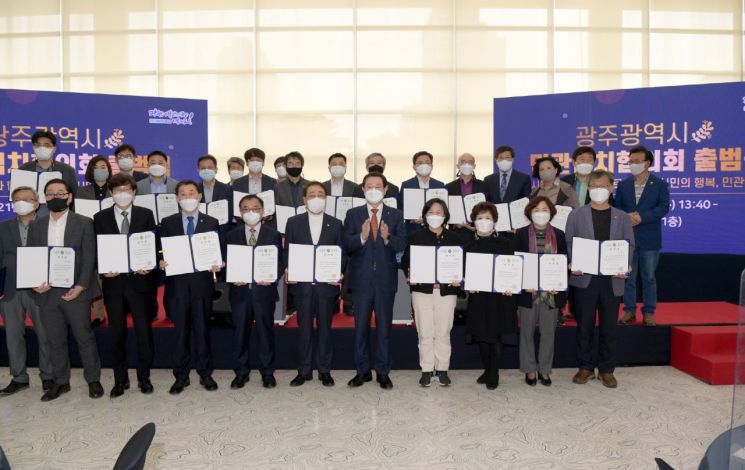 On the afternoon of the 15th, Lee Yong-seop, Mayor of Gwangju Metropolitan City, attended the launch ceremony of the Public-Private Cooperation Council held at the City Hall Citizen Hall, where he presented appointment letters to the council members and subcommittee chairpersons and then took a commemorative photo. Photo by Gwangju Metropolitan City
[Asia Economy Honam Reporting Headquarters Reporter Park Seon-gang] The ‘Gwangju Metropolitan City Public-Private Cooperation Council’ has officially launched to resolve various innovation agendas in Gwangju Metropolitan City through collaborative governance.
On the 15th, Gwangju Metropolitan City held the launch ceremony of the ‘Gwangju Metropolitan City Public-Private Cooperation Council’ at the City Hall Citizen Hall, attended by Mayor Lee Yong-seop and about 100 public-private cooperation committee members.
The launch ceremony proceeded with the presentation of appointment letters to council members by Mayor Lee Yong-seop, a greeting speech, a report on the progress of public-private cooperation, sharing of agendas discussed in nine subcommittees, and the reading of the joint declaration on public-private cooperation.
The Public-Private Cooperation Council operates under a co-chair system with Mayor Lee Yong-seop and a citizen representative, with Ryu Han-ho, Chairman of the Gwangju NGO Citizens Foundation, being appointed as the co-chair representing citizens.
In the joint declaration adopted on the day, the council emphasized, “Now is the time for Gwangju to find wise solutions befitting a city of democracy and human rights,” and stated, “We must do our best through public-private cooperation to make Gwangju a city where citizens’ lives are happy and take the lead in creating a sustainable Gwangju community.”
According to the ‘Basic Ordinance on the Activation of Public-Private Cooperation in Gwangju Metropolitan City’ enacted in July last year, the city formed a public-private cooperation task force team with various civic groups to implement a Gwangju-type cooperation model to resolve innovation agendas in various fields through collaborative governance. After 11 meetings, the groundwork was laid for the formation of subcommittees and the launch of the Public-Private Cooperation Council.
The Gwangju Public-Private Cooperation Council consists of 49 members, including the mayor, heads of relevant departments and bureaus, city council members, representatives of civic groups and professional/united organizations, district recommendations, general citizens, and nine subcommittee heads, and will operate for the next two years.
The nine subcommittees are composed of Environment, Welfare, Social Economy, Autonomy & Village Communities, Women, Youth, Culture, Human Rights Education, and Adolescents.
The Public-Private Cooperation Council will be operated through regular meetings held four times a year and extraordinary meetings, reaching consensus on agendas regarding city administration issues and visions and directions for regional development.
Along with operating the council, the city plans to establish the Basic Plan for Activating Public-Private Cooperation in Gwangju Metropolitan City in July, operate a public-private cooperation opinion gathering group, and hold a large public-private cooperation forum to accelerate the activation of the Gwangju-type public-private cooperation.
Ryu Han-ho, the citizen co-chair, said, “I hope the newly launched Public-Private Cooperation Council will gather wisdom through cooperation between citizens and administration, find solutions to various demands and conflicts, and truly practice the Gwangju spirit.”
Mayor Lee Yong-seop said, “The more difficult the problem, the more democratic and optimal it is to make decisions by gathering the will of the majority of citizens rather than the decision of a single outstanding leader,” and added, “I hope the Public-Private Cooperation Council will present the path for Gwangju through in-depth discussions and consensus in promoting major city administration issues and agendas.”
© The Asia Business Daily(www.asiae.co.kr). All rights reserved.
![Clutching a Stolen Dior Bag, Saying "I Hate Being Poor but Real"... The Grotesque Con of a "Human Knockoff" [Slate]](https://cwcontent.asiae.co.kr/asiaresize/183/2026021902243444107_1771435474.jpg)















