Establishing a Safety Management System Utilizing Drones, AI, and Big Data
106.1 Billion KRW Support through the 'Korean New Deal'
Underwater inspections previously reliant on non-expert divers → Expert analysis of drone footage
Supplementing risks and limitations of existing methods
Enhanced monitoring with GPS
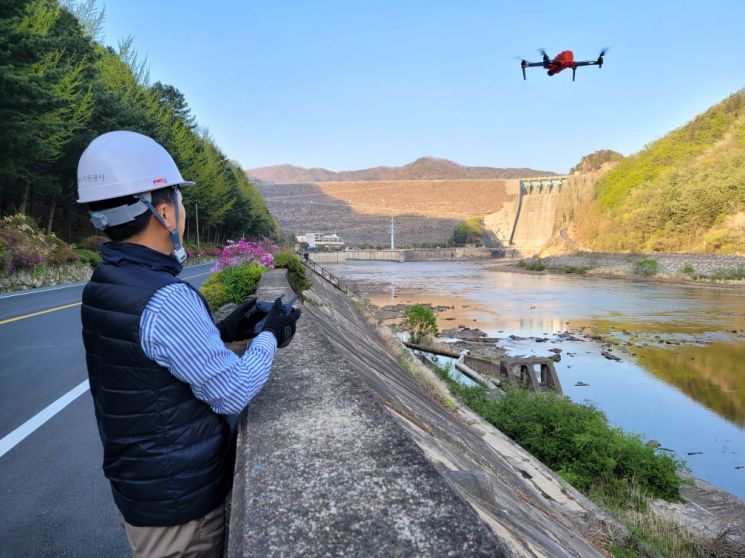 On the 15th, an employee of the Korea Water Resources Corporation is conducting a safety inspection of Soyanggang Dam located in Chuncheon, Gangwon, using a drone.
[Sejong=Asia Economy Reporter Joo Sang-don] Korea Water Resources Corporation (K-water) has introduced smart technologies such as artificial intelligence (AI) and big data analytics systems based on the 4th industrial revolution as part of the Korean New Deal to dam management. This technological enhancement places greater emphasis on dam safety.
According to K-water on the 16th, the core of dam safety is seen as proactive maintenance reinforcement and performance improvement, and advanced technologies capable of realizing this are being introduced. By utilizing drones, AI, and big data analytics systems, they aim to strengthen the safety of aging dams and establish a safety management system that allows long-term management and use. This project is reflected in the government’s Korean New Deal and is expected to receive 106.1 billion KRW in national funding by 2025.
K-water expects safety to improve significantly through the introduction of advanced technologies. Until now, inspections centered on manpower required personnel to descend the dam structure using work ropes and conduct visual inspections, which posed high risks and had limitations in inspecting hard-to-reach locations. The lower parts of dams are submerged underwater, so inspections relied on non-expert divers. However, with aerial and underwater drones capturing footage, experts can analyze non-contact 3D images. This means the objectivity and accuracy of safety inspection results are greatly enhanced. In fact, after introducing drone-based safety inspections at some dams, inspection time per dam was reduced from 10 days to 3 days, and inspection costs dropped from 180 million KRW to 40 million KRW, a 78% reduction.
Real-time monitoring is also being strengthened. Previously, optical wave devices that calculate the speed of light reflection were used to measure the deformation of dam structures. However, this method has limitations such as measurement failure or errors due to weather conditions like surrounding trees and fog. K-water has pilot-introduced advanced GPS equipment at An-gye Dam in Gyeongju, Gyeongbuk Province, and Jangheung Dam in Jeonnam Province, significantly reducing errors. K-water plans to expand GPS adoption to all dams by 2024.
They are also working on building a safety management platform. Using big data and AI, they plan to enable precise and systematic safety inspections through a ‘digital twin system’ (a virtual environment identical to the real world) that replicates real-world machinery and equipment in a computer-generated virtual world. Based on the technology for building a smart dam safety management platform for the 37 dams under their management, K-water intends to apply this method to dams managed by local governments or other institutions, promoting it as a hub for dam safety management technology.
Interest in dam safety is gradually increasing. Some dams constructed domestically are over 40 years old, and the damage caused by accidents is unpredictably large. In particular, dam-related disasters and safety accidents worldwide highlight the importance of dam safety management. In May last year, Michigan in the United States experienced the largest concentrated rainfall in 500 years, causing massive flooding and the collapse of the aging Edenville and Sanford dams. Approximately 10,000 people were urgently evacuated, the city was submerged, and property damage was estimated at 2 billion USD. Earlier, in January 2019, heavy rainfall in Brazil caused the collapse of a mining tailings dam, with the resulting mudflow covering work sites and villages, causing 58 deaths and at least 300 missing, resulting in fatal casualties.
A K-water official said, "The water-related industry is the sector that best fits the character of the Korean New Deal," adding, "Water is closely connected to all elements of climate change such as atmospheric and environmental systems, and is essential for economic and industrial activities. We will strive to create safe dams against all disasters caused by the climate crisis."
© The Asia Business Daily(www.asiae.co.kr). All rights reserved.
![Clutching a Stolen Dior Bag, Saying "I Hate Being Poor but Real"... The Grotesque Con of a "Human Knockoff" [Slate]](https://cwcontent.asiae.co.kr/asiaresize/183/2026021902243444107_1771435474.jpg)















