Bank of Korea Monetary Policy Committee Holds Base Interest Rate at 0.50%
Growth Rate Expected in Mid-3% Range, Inflation Forecasted to Rise Around 2% for the Time Being
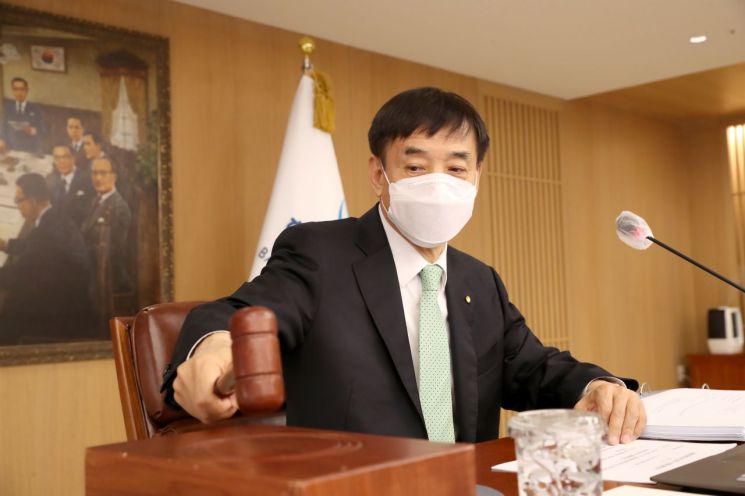 On the morning of the 15th, Lee Ju-yeol, Governor of the Bank of Korea, presided over the Financial Monetary Policy Committee plenary meeting held at the Bank of Korea in Jung-gu, Seoul, and struck the gavel.
[Asia Economy Reporter Kim Eunbyeol] The Bank of Korea indicated that it will simultaneously revise upward its economic growth rate and inflation forecasts, while keeping the base interest rate unchanged. It stated that achieving a growth rate in the mid-3% range this year is possible, and inflation is expected to rise around 2% for the time being, reaching the mid-to-high 1% range on an annual basis.
Despite revising both growth and inflation forecasts upward, the Bank clearly stated its intention to keep the base interest rate steady for the time being. This is due to significant uncertainties surrounding the progression of COVID-19 and vaccine rollouts. While mindful of side effects such as the surge in household debt, the Bank expressed that it is still difficult to say that the economic recovery has firmly taken hold.
Governor Lee Ju-yeol emphasized at an online press conference following the monetary policy meeting held on the 15th at the Bank of Korea headquarters in Jung-gu, Seoul, "Looking at the movements over the past few months after the first quarter of this year, a mid-3% growth rate is definitely achievable." He added, "This is mainly due to improvements in external conditions such as the large-scale U.S. economic stimulus and the resulting acceleration in global economic growth. The IT sector is also strengthening, leading to an expansion in our exports and facility investment growth beyond initial forecasts." Furthermore, Governor Lee said, "Domestically, social distancing measures have been eased, reviving consumer sentiment, and the supplementary budget implemented since the end of last month is expected to contribute to stimulating domestic demand to some extent."
However, Governor Lee added, "It is indeed somewhat concerning that the COVID-19 resurgence is not calming down easily and that the vaccination rate remains in the 2% range." He explained, "Although the current spread is not subsiding easily, it is expected not to worsen significantly from the current situation, and considering the government's multifaceted efforts despite the low vaccination rate."
He also conveyed the intention to continue accommodative policies. He said, "As the domestic economic recovery strengthens and inflation rises, opinions may emerge that interest rates should be raised preemptively to alleviate financial imbalances such as household debt increases and housing price rises," but added, "There is still considerable uncertainty affecting our economy, including the progression of COVID-19 and vaccine rollouts, and it is difficult to be confident that the recent recovery trend has firmly taken hold." He emphasized, "At this stage, it is too early to consider a shift in policy stance."
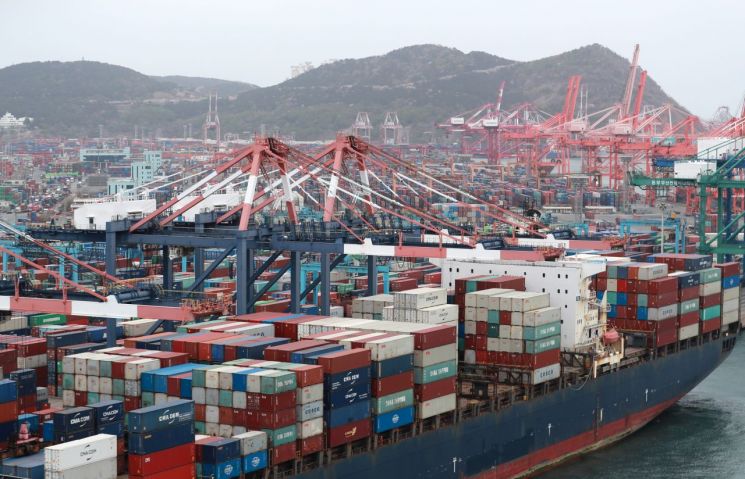
Rapid Recovery from the U.S., Strong Exports... Private Consumption Weakness Eases, Employment Partially Improves
The Bank of Korea's Monetary Policy Committee stated in the monetary policy meeting decision document, "This year's growth rate is expected to exceed the 3.0% forecast made in February," adding, "Exports continued to perform well, facility investment maintained a steady recovery, and private consumption weakness eased, leading to a somewhat expanded recovery in the domestic economy." Regarding employment, it evaluated, "There were signs of partial improvement, such as a turnaround to an increase in the number of employed persons." Governor Lee also said at the post-meeting press conference, "A mid-3% growth rate is definitely achievable." The Bank plans to release a detailed growth forecast for this year next month.
The forecast that South Korea's growth rate will reach around the mid-3% range this year is becoming a given. The International Monetary Fund (IMF) recently raised South Korea's growth forecast from 3.1% to 3.6%, and the Organization for Economic Cooperation and Development (OECD) forecast is 3.3%. The government expects 3.2%, and the Korea Development Institute (KDI) projects 3.1% growth. LG Economic Research Institute has a positive outlook, expecting a 4.0% growth rate this year, and the average forecast from foreign investment banks (IBs) is 3.8%.
The rapid rebound in growth is influenced by the U.S. economy's recovery, supported by continuous monetary easing and rapid vaccine rollout. Given South Korea's economic structure with a high export ratio, it is heavily affected by the global economy. However, it remains to be seen how much the domestic economy will revive. While there are forecasts that revenge consumption sentiment is growing and the domestic economy is stretching its legs, contrasting views exist due to South Korea's low vaccination rate of 2.3% and slow employment recovery, suggesting a slow internal economic recovery.
Professor Ahn Dong-hyun of Seoul National University's Department of Economics said, "Both external (exports) and internal (consumption) factors contribute to the positive growth outlook," adding, "Not only exports but also revenge consumption is increasing, and people tired of quarantine rules are engaging in outdoor activities, improving consumption." However, Professor Ahn noted, "Given South Korea's very low vaccination rate, there is a variable in that when other countries achieve herd immunity, we may not return to pre-COVID-19 production activities and thus may not participate in the global economic recovery."
Raised Growth and Inflation Forecasts... But Interest Rate Held Steady
The Bank of Korea also raised its inflation forecast that day. Governor Lee said, "Consumer price inflation will exceed the February forecast path, fluctuating around 2% for the time being before somewhat declining." He added, "In the second quarter, inflation will fluctuate around 2%, then decline somewhat in the second half, with the annual inflation rate expected to be in the mid-to-high 1% range." Earlier in February, the Bank had projected this year's inflation rate at 1.3%, indicating it will be higher. Already, March's consumer price inflation rose to 1.5% year-on-year, up from 1.1% the previous month. The general public's expected inflation rate also rose to the low 2% range. The Monetary Policy Committee expects core inflation to gradually rise to the 1% range.
Despite the rapid rise in growth and inflation and the surge in household debt amid prolonged ultra-low interest rates, it is difficult to raise interest rates hastily. Increasing the burden on existing borrowers could rather hamper the economic recovery. Professor Sung Tae-yoon of Yonsei University's Department of Economics said, "Since face-to-face consumption is delayed, there is a burden in touching the current interest rate." The Monetary Policy Committee stated, "Although the domestic economic recovery is expected to gradually expand, uncertainty remains high, and demand-side inflationary pressures are not expected to be significant," and "We will maintain an accommodative monetary policy stance."
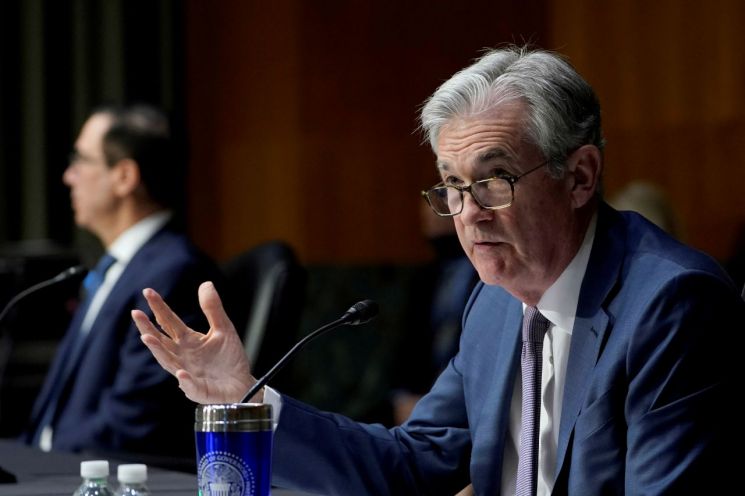
Regarding the timing of future base interest rate hikes, the consensus is that the rise in market interest rates due to U.S. economic overheating and the Federal Reserve's (Fed) response will be crucial. The Fed has clearly stated its intention to keep the base interest rate unchanged until the end of 2023 and to maintain asset purchases until confirming significant economic recovery progress. However, if the economy recovers faster than expected and market interest rates rise first, it is seen as difficult for the Fed to hold out until 2023. Professor Ahn Dong-hyun explained, "Although the Fed has announced a zero interest rate policy until 2023, the U.S. market expects the timing to be brought forward to late 2022 or early 2023," adding, "There is a sufficient possibility that our interest rate hike timing will also be advanced." Professor Sung Tae-yoon advised, "It is necessary to prepare for how to respond if U.S. market interest rates rise rapidly."
© The Asia Business Daily(www.asiae.co.kr). All rights reserved.
![Clutching a Stolen Dior Bag, Saying "I Hate Being Poor but Real"... The Grotesque Con of a "Human Knockoff" [Slate]](https://cwcontent.asiae.co.kr/asiaresize/183/2026021902243444107_1771435474.jpg)

















