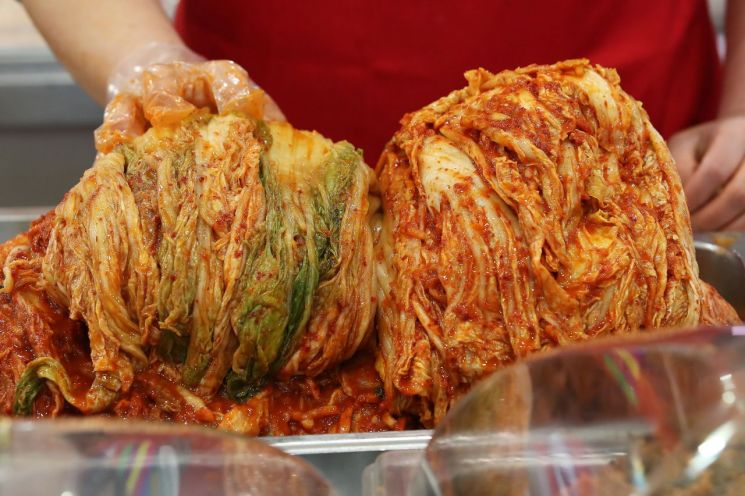
[Asia Economy Reporter Lee Chun-hee] The government has prepared measures to dispel concerns about imported kimchi following the controversy over a video showing Chinese-made salted napa cabbage. Hygiene measures will be strengthened across all stages from manufacturing to distribution, including on-site inspections of overseas kimchi manufacturing facilities.
On the morning of the 15th, the Ministry of Food and Drug Safety (MFDS) announced the "Imported Kimchi Safety and Assurance Measures" containing these details. Kim Yu-mi, Director of the Imported Food Safety Policy Bureau at MFDS, explained the purpose of the measures, saying, "Following the report of an unhygienic salted napa cabbage video in March, we have prepared safety and assurance measures for imported kimchi to alleviate the heightened public concerns and anxiety. We have focused on tightening the triple safety management system covering manufacturing, customs clearance, and distribution of imported kimchi, and on transparently delivering related information."
Through these measures, MFDS plans to promote ▲ on-site inspections of all overseas kimchi manufacturing facilities ▲ revision of subordinate regulations such as the Enforcement Rules of the Imported Food Act for HACCP application ▲ strengthening of inspection order system for importers ▲ promotion of consumer participation in imported kimchi safety management ▲ provision of imported kimchi factory information based on an online world map.
First, at the manufacturing stage, on-site inspections of manufacturing facilities will be conducted alongside the promotion of HACCP application. As of last month, on-site inspections will be carried out for 109 overseas kimchi manufacturing facilities registered as processing and producing kimchi imported into Korea. MFDS plans to prioritize on-site inspections this year for 26 facilities that were non-compliant at the customs clearance stage last year and newly registered manufacturing facilities, and to inspect 20 facilities annually from next year through 2025.
To apply HACCP, subordinate regulations such as the Enforcement Rules of the Imported Food Act will be promptly revised, and detailed matters related to HACCP certification procedures and methods will be continuously discussed with exporting countries’ governments to ensure smooth application of the HACCP system.
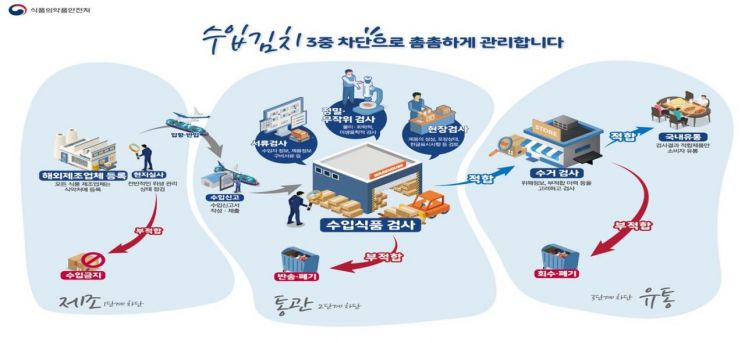 'Imported Kimchi Safety and Security Measures' Infographic (Provided by the Ministry of Food and Drug Safety)
Customs inspections will also be strengthened. The current "inspection order system," which operates targeting hazardous substances such as krill oil, will be expanded to include importers of kimchi manufactured by companies with a high frequency of non-compliance. Through this, the government aims to actively encourage businesses to import only safe products on their own.
In the distribution sector, hygiene supervisors will conduct hygiene management surveys on 1,000 businesses distributing and selling imported kimchi and raw materials such as minced garlic, salted seafood, and red pepper powder in cooperation with consumer groups. They will also directly purchase kimchi and raw materials and request testing from professional inspection agencies to directly verify safety.
Furthermore, starting from July, this information will be made available at a glance through the "Import Statistics Service," which is based on an online world map, allowing users to view information such as imported kimchi manufacturing facilities and import status. The public will also be able to easily check information related to imported kimchi through services like the Imported Food Information Maru.
© The Asia Business Daily(www.asiae.co.kr). All rights reserved.
![Clutching a Stolen Dior Bag, Saying "I Hate Being Poor but Real"... The Grotesque Con of a "Human Knockoff" [Slate]](https://cwcontent.asiae.co.kr/asiaresize/183/2026021902243444107_1771435474.jpg)

















