Operating Losses Due to Sharp Drop in Index from COVID-19
Increased Burden of Additional Margin Payments
[Asia Economy Reporter Minji Lee] It has been revealed that small and medium-sized securities firms have reduced their own hedge ratios to mitigate risks arising from the issuance of equity-linked securities (ELS). This is due to the increased burden of operational losses from self-hedging caused by the sharp decline in stock indices due to COVID-19 in the first quarter of last year.
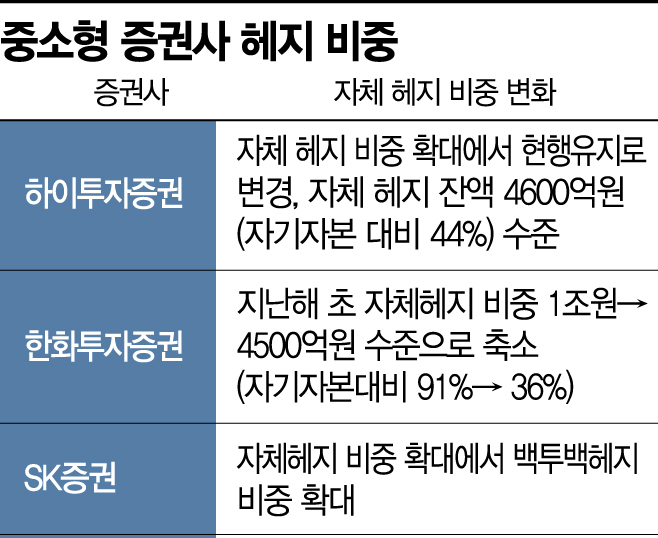
According to the financial investment industry on the 15th, Hanwha Investment & Securities held 1.1 trillion won in self-hedging at the beginning of last year, which was about 91% of its equity capital, but now it has significantly lowered the ratio to about 450 billion won, or 36% of its equity capital. This is due to a loss of 24.1 billion won recorded in the equity derivatives division without fully recovering last year's ELS operational losses. SK Securities, which posted a performance in the proprietary trading division that shrank by about 84% compared to the previous year due to ELS hedge operational losses last year, also plans to drastically reduce its own hedge ratio and increase the proportion of 'back-to-back hedge.'
Hi Investment & Securities had set an internal goal to gradually increase the proportion of ELS self-hedging last year, but when the scale of operational losses increased due to the sharp decline in stock indices caused by COVID-19 in the first quarter, it decided to maintain the self-hedge ratio. As of the end of last year, Hi Investment & Securities holds a self-hedge balance of 463.9 billion won (44% of equity capital).
ELS is generally a medium-risk, medium-return product that can yield an annual profit of 6-10%, based on stock indices or individual stocks as underlying assets, and determines returns according to price movements. Securities firms hedge to provide returns to investors, and depending on the hedging method, it is divided into 'self-hedge' and 'back-to-back hedge.' Self-hedging means that the securities firm issuing the ELS invests in bonds, stock index futures, and other derivatives to directly manage the hedge, while back-to-back hedging means contracting with foreign investment banks (IBs) to transfer losses or profits to those institutions.
When adopting the self-hedge method, securities firms can generate more profits depending on their operational capabilities. However, whether they incur losses or gains, all belong to the securities firm, so when external environments change rapidly, the firm's profits and losses inevitably suffer negative impacts. For example, when global stock indices plunged due to the spread of COVID-19 in February last year, the margin call burden increased on derivatives purchased by securities firms for self-hedging, leading to larger operational losses. Securities firms hurried to purchase US dollars and issue commercial paper (CP) to pay margin calls, but all costs incurred for payment were recorded as losses, significantly lowering profits in the proprietary trading division and causing poor performance.
An industry insider said, "Since securities firms' operational profits are fixed when engaging in back-to-back hedging, it will be difficult to pursue as much profit as before," adding, "During last year's index plunge, large securities firms lacked means to settle additional margin calls, causing a 'margin call crisis' and raising concerns about ELS operational losses. This likely became a burden for small and medium-sized securities firms with smaller ELS scales." Among small and medium-sized securities firms, Kiwoom Securities, Shinhan Financial Investment, Eugene Investment & Securities, and Daishin Securities have long focused on operational stability rather than profitability by expanding the proportion of back-to-back hedging without self-hedging.
© The Asia Business Daily(www.asiae.co.kr). All rights reserved.
![Clutching a Stolen Dior Bag, Saying "I Hate Being Poor but Real"... The Grotesque Con of a "Human Knockoff" [Slate]](https://cwcontent.asiae.co.kr/asiaresize/183/2026021902243444107_1771435474.jpg)















