농진청장 "Urges Prevention of Cold Damage During Cold Wave Warnings"
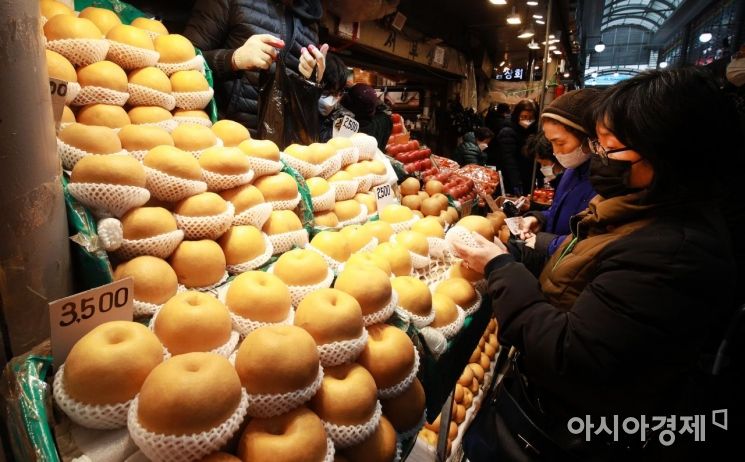 On February 10, one day before the Lunar New Year holiday, citizens are seen purchasing ritual items and other goods at Gyeongdong Market in Dongdaemun-gu, Seoul. Photo by Kim Hyun-min kimhyun81@
[Sejong=Asia Economy Reporter Moon Chaeseok] On the 14th, the Rural Development Administration announced that it will operate an emergency technical support team as cold wave warnings were issued in some areas such as Gyeonggi and Gangwon in April, an unusual time for cold waves. The Rural Development Administration urged farmers to focus on preventing cold damage to crops such as fruit trees.
From this day until the 15th, cold wave warnings were issued as the minimum temperature in some areas dropped below freezing. April is the blooming season, and if cold damage occurs due to the cold wave, it can lead to reduced production and quality deterioration. Naturally, fruit prices will rise.
The Korea Meteorological Administration forecasted that on the 14th and 15th, temperatures in inland areas such as northern Gyeonggi, mountainous areas of Gangwon, northeastern mountainous areas of Gyeongbuk, and eastern Jeonbuk will drop below freezing, causing frost and ice formation. From the 17th to the 19th, temperatures near the surface are expected to fall below freezing mainly in central inland areas, eastern Jeonbuk, and inland Gyeongbuk, with a high possibility of frost.
Accordingly, the Rural Development Administration decided to organize and operate an emergency on-site technical support team from the 14th to the 15th to minimize cold damage to crops. The support team will operate jointly with provincial agricultural technology centers and city/county agricultural technology centers. In areas where cold wave warnings have been issued, they are inspecting cold damage prevention facilities for major crops such as fruit trees, sending text messages to farmers, and broadcasting village announcements.
Administrator Heo said, "With minimum temperatures dropping below freezing on the 14th and 15th, there is concern about cold damage such as the withering of fruit tree flowers whose blooming period has advanced," and added, "We will strengthen on-site guidance to minimize cold damage to farms."
The Rural Development Administration explained methods to minimize cold damage that fruit farmers can refer to. First, fruit farmers should check weather information and operate wind machines (air blowing facilities) and micro-sprinkler devices (fog spraying devices) before the minimum temperature drops below freezing. Burning combustible materials to raise the temperature inside the orchard is also a way to reduce damage.
Farmers without cold damage prevention facilities should organize stored materials that obstruct air flow inside the orchard and remove weeds or covers on the orchard floor. Also, fences should be installed where cold air enters the orchard to reduce damage.
If cold damage has occurred, artificial pollination should be performed to increase fruit set rates. It is advisable to delay the fruit thinning period and check whether fruits are set before thinning. In cases of severe cold damage such as flower withering, measures should be taken to allow fruit to set on late-blooming flowers, and the amount of nitrogen fertilizer should be reduced to stabilize tree vigor.
© The Asia Business Daily(www.asiae.co.kr). All rights reserved.
![Clutching a Stolen Dior Bag, Saying "I Hate Being Poor but Real"... The Grotesque Con of a "Human Knockoff" [Slate]](https://cwcontent.asiae.co.kr/asiaresize/183/2026021902243444107_1771435474.jpg)
















