[The Turbulent Korean Semiconductor Industry] US Considers Additional Equipment Sanctions on China
Monitoring Impact on Korean Semiconductor Companies in China
Global Top Equipment Firms Dominated by US... Japan and EU May Join Sanctions
[Asia Economy Reporter Su-yeon Woo] As the trade war between the U.S. and China expands into a semiconductor hegemony war among global powers, the competition for related equipment is intensifying. The U.S. has begun to consider an additional card of sanctions on semiconductor equipment imports to China, while China is rapidly stockpiling used semiconductor equipment in preparation for further sanctions. As the two countries engage in an uncompromising war over the semiconductor industry, the concerns of Korean semiconductor companies such as Samsung Electronics and SK Hynix, caught in the 'nutcracker' situation, have deepened.
According to the industry on the 14th, the U.S. National Security Council's Artificial Intelligence (AI) Committee recently recommended "strengthening the approval process for EUV (Extreme Ultraviolet) and ArF DUV (Argon Fluoride Deep Ultraviolet) equipment exported to China in cooperation with the governments of the Netherlands and Japan," stating that "this will delay China's development of 7nm or 5nm semiconductor production and limit production capacity for semiconductors below 16nm, which are highly applicable in the AI field."

◆ Difficulties in Advanced Facility Investment at Chinese Semiconductor Plants= The U.S. has already placed China's semiconductor company SMIC on the regulatory blacklist during the Trump administration, broadly sanctioning exports of advanced semiconductor equipment, materials, and software, including EUV equipment.
Originally, China aimed to develop 10nm processes this year and 7nm processes by 2023, but U.S. sanctions have delayed investment in advanced equipment facilities, causing setbacks in overall plans. The problem is that these sanctions could affect not only Chinese semiconductor companies but also Korean semiconductor companies such as Samsung Electronics and SK Hynix, which have factories in China.
Samsung Electronics operates semiconductor plants in Xi'an and Suzhou, China, while SK Hynix operates plants in Wuxi and Chongqing, China. The industry believes that advanced equipment such as EUV equipment, currently subject to sanctions, is unlikely to be introduced to Chinese plants in the near term, so immediate problems are not expected. However, concerns remain that if the need for advanced facilities at Chinese plants arises in the mid-to-long term or if the U.S. expands sanctions to include older equipment, it could pose potential risks to the operation of Chinese plants.
An industry official said, "Semiconductor technology evolves rapidly, and semiconductor equipment typically depreciates over a short cycle of 3 to 4 years, so periodic complementary investments such as new equipment introduction are essential. If the U.S. expands sanctions, companies will inevitably face burdens in expanding production capacity in China."
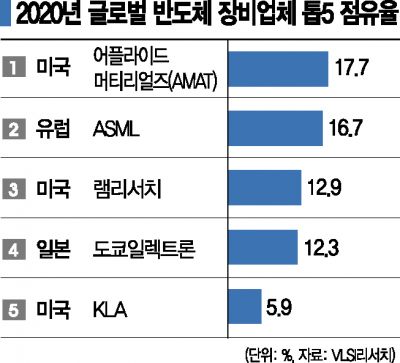
Another risk is the significant influence of the U.S. in the global semiconductor equipment market. Based on last year's sales, the top global semiconductor equipment company is U.S.-based Applied Materials (17.7%), and the third-ranked U.S. company Lam Research (12.9%) together hold over 30% market share. Among the top five global companies, three are U.S. firms, followed by European and Japanese companies.
The equipment technology owned by U.S. companies exerts considerable influence across the semiconductor industry, and there is a possibility that the U.S. may demand restrictions on the export of semiconductor materials, equipment, and parts containing U.S. intellectual property rights to China. If the U.S., which holds technological leadership, demands strong sanctions, traditional allies such as Japan and Europe are unlikely to ignore them.
◆ Record High Semiconductor Facility Investment... Equipment War Intensifies= As major countries worldwide call for semiconductor self-reliance and pour out various support policies, global semiconductor facility investment is expected to reach a record high of $125 billion this year.
Securing semiconductor equipment is essential for building new or expanding semiconductor plants. Especially for advanced equipment like EUV machines, production capacity is limited, which could escalate into a shortage of equipment supply as well as semiconductors. The lead time for new equipment orders, which used to be 4 to 6 months, has recently extended to 12 months, and due to concerns over U.S. sanctions, prices for used semiconductor equipment exported from Japan to China have surged by more than 20%. This phenomenon could affect not only China and Japan but also domestic semiconductor and equipment companies.
Kyunghee Kwon, a senior researcher at the Korea Institute for Industrial Economics and Trade, emphasized, "A thorough analysis of the structure of our semiconductor industry connected to China is necessary. Based on this, scenario-based response plans regarding the scope and intensity of U.S. sanctions must be established."
© The Asia Business Daily(www.asiae.co.kr). All rights reserved.
![Clutching a Stolen Dior Bag, Saying "I Hate Being Poor but Real"... The Grotesque Con of a "Human Knockoff" [Slate]](https://cwcontent.asiae.co.kr/asiaresize/183/2026021902243444107_1771435474.jpg)

















