[Asia Economy Reporter Kim Heung-soon] Regarding the Serious Accident Punishment Act passed by the National Assembly last January, it has been identified that about 6 out of 10 companies believe that amendments are necessary before its enforcement in January next year.
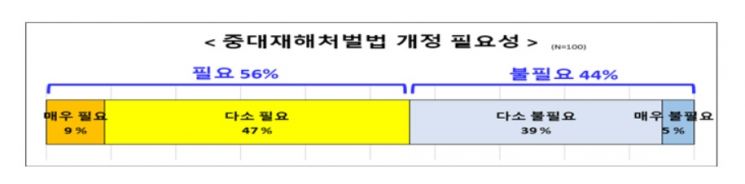
The Korea Economic Research Institute (KERI) under the Federation of Korean Industries commissioned the public opinion research firm Mono Research to conduct a survey titled 'Impact of the Serious Accident Punishment Act and Opinions on Amendments' targeting the top 1,000 non-financial companies by sales. As a result, it was revealed on the 14th that 56% of the 100 respondent companies answered that amendments are necessary before the enforcement of the Serious Accident Punishment Act.
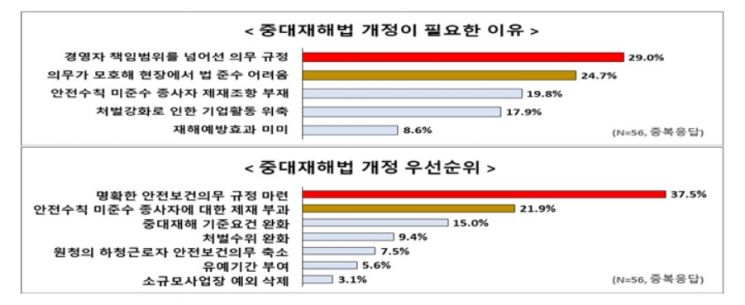
The main reason cited for the need to amend the Serious Accident Punishment Act was that the regulations impose obligations "beyond the scope of responsibility of business owners and management officials," accounting for 29.0%. This was followed by "ambiguity in obligations making compliance difficult on site" (24.7%), "lack of sanctions against workers who do not comply with safety rules" (19.8%), and "contraction of corporate activities due to strengthened penalties" (17.9%).
Regarding the content that should be amended first, "establishment of clear safety and health obligation regulations" was the most frequent response at 37.5%, followed by "imposition of sanctions on workers who do not comply with safety rules" (21.9%), "relaxation of serious accident criteria" (15.0%), and "mitigation of penalties" (9.4%).
"Serious Accident Punishment Act has no effect on reducing industrial accidents" 63%
"Contraction of corporate activities" 52%
Regarding the impact of the Serious Accident Punishment Act on reducing industrial accidents, 37% responded positively, while 63% of companies responded either that it has no significant effect (45%) or a negative effect (18%), indicating that the majority of companies have a negative view of the Act's effectiveness in reducing industrial accidents.
The reasons for negative responses included "lack of sanctions against workers who do not comply with safety rules" (31.7%), "increased confusion on site due to ambiguous and broad obligations" (27.3%), "lack of effect of strong penalties under the current Industrial Safety and Health Act" (22.4%), and "absence of an effective industrial safety system" (10.9%).
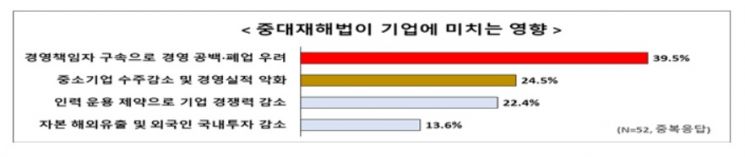
On the other hand, 52% (39% somewhat contraction, 13% significant contraction) responded that the Serious Accident Punishment Act would contract corporate management activities. The most concerning impact on corporate activities was "concerns about management gaps and business closures due to detention of business owners and management officials," accounting for 39.5%. This was followed by "reduction in orders and deterioration of business performance for small and medium enterprises due to downsizing of subcontracting and outsourcing" (24.5%), "decreased corporate competitiveness due to workforce operation restrictions" (22.4%), and "outflow of domestic capital overseas and decrease in foreign investment in Korea" (13.6%).
"Sanctions needed for workers not complying with safety rules" 92%
Regarding the criteria for serious accidents related to the law amendment, many opinions favored limiting the death criteria to "repeated deaths within a certain period" (49.6%) or "occurrence of two or more deaths" (15.4%), or relaxing or deleting "serious accidents other than deaths (injuries and illnesses)" (25.0%).
Regarding the definition of the obligation to ensure safety and health, the survey showed "reduction of safety and health obligation provisions" (44.5%), "stipulation of the obligation to ensure safety and health in law" (28.0%), and "introduction of a positive list approach for the obligation to ensure safety and health" (23.6%) in order.
Regarding the obligations of the primary contractor in cases of subcontracting or external consignment, responses were "narrowing the scope of contractual relationships expressed as subcontracting, outsourcing, consignment, etc." (35.2%), "limiting to cases where subcontracted workers work at the primary contractor's workplace" (34.8%), and "excluding instructions for work behavior to subcontracted workers suspected of illegal dispatch" (25.4%).
Additionally, 92% (40% very necessary, 52% somewhat necessary) responded that sanction regulations are needed for workers violating safety rules, and 60% believed that the lower limit of imprisonment (at least one year) for business owners and management officials in fatal accidents should be deleted.
Choo Kwang-ho, Director of Economic Policy at KERI, emphasized, "Industrial accidents are difficult to prevent solely through strengthened penalties like the Serious Accident Punishment Act," adding, "It is necessary to focus on prevention by improving industrial safety systems while revising the Serious Accident Punishment Act, which raises concerns about contraction of corporate activities, to prevent confusion in industrial sites."
© The Asia Business Daily(www.asiae.co.kr). All rights reserved.
![Clutching a Stolen Dior Bag, Saying "I Hate Being Poor but Real"... The Grotesque Con of a "Human Knockoff" [Slate]](https://cwcontent.asiae.co.kr/asiaresize/183/2026021902243444107_1771435474.jpg)

















