KAIST Research Team Led by Hong Seungbeom Develops Nanometer-Level Quantitative Measurement Method Using Electrochemical Displacement Microscopy
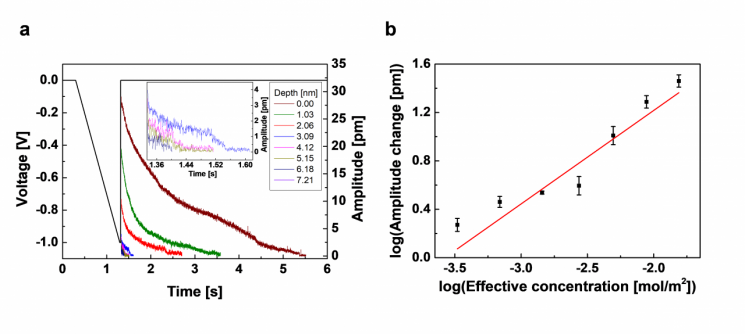 Electrochemical displacement microscopy results immediately after triangular DC pulses applied according to sample depth and pulse termination. Image courtesy of KAIST
[Asia Economy Reporter Kim Bong-su] The research team led by Professor Hong Seung-beom of the Department of Materials Science and Engineering at the Korea Advanced Institute of Science and Technology (KAIST) announced on the 13th that they have developed a method to quantitatively measure ion migration characteristics inside lithium-ion battery materials at the nanometer scale using Electrochemical Strain Microscopy (ESM), a mode of Atomic Force Microscopy (AFM).
Electrochemical Strain Microscopy is a technique that measures the displacement of the sample surface caused by ion migration when a voltage is applied to a nanoscale probe. This displacement indirectly helps measure the amount of ions causing the deformation and their mobility.
The research team quantitatively calculated the ion distribution according to the depth of solid electrolyte samples using Time-of-Flight Secondary Ion Mass Spectroscopy (ToF-SIMS) and Inductively Coupled Plasma Optical Emission Spectrometer (ICP-OES). They succeeded in calibrating the results of Electrochemical Strain Microscopy with these measurements.
Subsequently, the researchers devised a direct current voltage pulse applied according to the sample depth and visualized ions that moved to the surface due to the electric field and then diffused back inside using Electrochemical Strain Microscopy. During the pulse design process, they pointed out errors in the conventional use of Electrochemical Strain Microscopy and provided guidance on improved usage methods. The team succeeded in visualizing the ion migration process as a function of time and distance, and quantitatively demonstrated the diffusion coefficient values that vary depending on depth and ion concentration using these results.
Professor Hong Seung-beom stated, "This methodology, which allows quantitative observation of ion movement at the nanometer scale, will contribute to elucidating the mechanisms of various ion behaviors," and added, "We plan to conduct follow-up research applying this methodology under conditions simulating various real device operating environments."
Lithium-ion batteries are essential energy storage media used in portable electronic devices, electric vehicles, and various other means of transportation. In response to explosive demand, research to improve the electrochemical properties of lithium-ion batteries, such as energy capacity and charging speed, is accelerating.
However, existing electrochemical property evaluation methods focus on measuring average values of material or device characteristics. They are insufficient to understand phenomena occurring in the microscopic world at the nanometer scale. Therefore, the development of analytical techniques with spatial resolution at the microscopic level is essential for an integrated understanding of electrochemical properties.
This research was recently published in the international academic journal ‘ACS Applied Energy Materials.’
© The Asia Business Daily(www.asiae.co.kr). All rights reserved.
![Clutching a Stolen Dior Bag, Saying "I Hate Being Poor but Real"... The Grotesque Con of a "Human Knockoff" [Slate]](https://cwcontent.asiae.co.kr/asiaresize/183/2026021902243444107_1771435474.jpg)















