Government Intensifies Pressure Including Verification of Wu's Official Land Prices
Opposition Coordination Moves... Ruling Party Also Prepares Supplementary Measures
Real Estate to Decide Next Year's Presidential Election? Rising Sense of Crisis
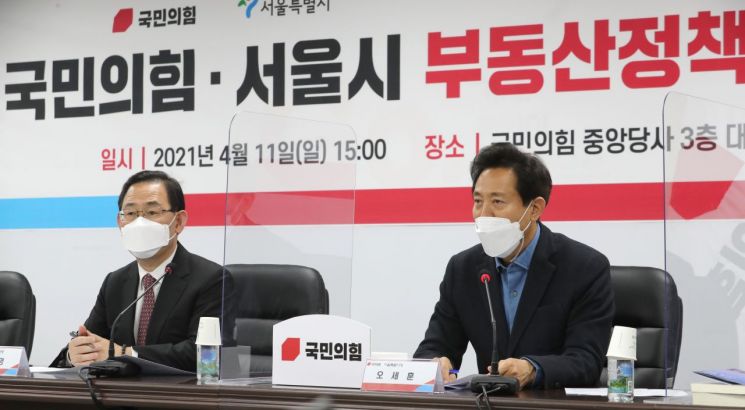
[Asia Economy Reporters Chae-eun Koo and Hye-min Kim] Real estate appears to be becoming a black hole that shakes the political landscape not only of the Moon Jae-in administration, which has just over a year left in its term, but also of next year's presidential and local elections.
Seoul Mayor Oh Se-hoon has strengthened his offensive against the government's real estate policies, such as verifying the official prices of apartment complexes, since the beginning of his term, effectively visualizing an independent policy line. Meanwhile, the opposition People Power Party has begun to actively cooperate with Mayor Oh. The ruling party is also maintaining the broad framework of existing real estate policies while preparing supplementary measures, creating an atmosphere of distancing from the government. This reflects a sense of crisis that the outcome of both the March presidential election and the June local elections next year will ultimately be decided by real estate policies.
According to the government, political circles, and Seoul city officials on the 12th, the opposition People Power Party held a 'Seoul City Real Estate Policy Council' with Mayor Oh the day before and began cooperating on real estate policies such as adjusting official prices. This is interpreted as a determination to seize policy leadership until the presidential election by putting Mayor Oh at the forefront. On that day, both sides discussed adjusting official prices, revitalizing redevelopment and reconstruction, and easing the tax burden on real estate. The People Power Party plans to push forward real estate deregulation laws currently pending in the National Assembly, such as a maximum 50% reduction in property tax for single-homeowners with official prices under 900 million KRW (amendment to the Local Tax Act) and temporary non-application of capital gains tax surcharges (amendment to the Restriction of Special Taxation Act).
However, both Mayor Oh and the People Power Party are cautious about concrete actions. Excessive deregulation could stimulate housing prices and backfire. Mayor Oh's first real estate policy after taking office, which was to lower official prices, is also seen as reflecting this concern. Political commentator Park Sang-byeong said, "Bringing up official prices first is a very good strategy," adding, "Among the pledges, deregulation of redevelopment and reconstruction is difficult to achieve alone and could raise housing prices, potentially causing backlash, but there is little disagreement about the criticism that official prices are not detailed enough."
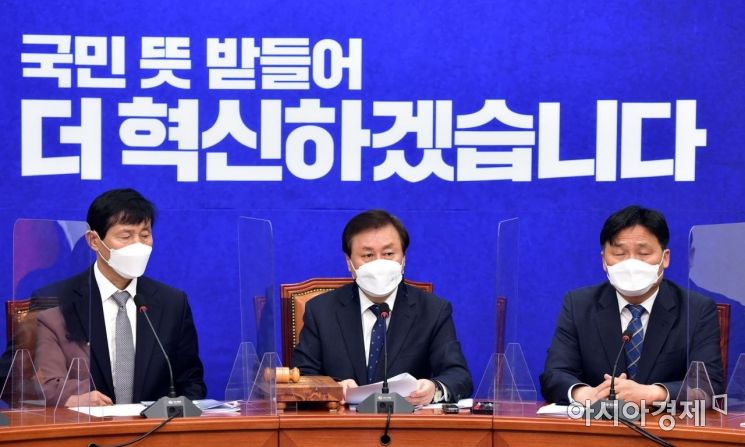 Do Jong-hwan, Emergency Response Committee Chairman of the Democratic Party of Korea, is attending the Emergency Response Committee meeting held at the National Assembly on the 12th and delivering opening remarks. Photo by Yoon Dong-joo doso7@
The ruling Democratic Party's situation is more complicated. While maintaining the broad framework of government policy, it is moving to prepare supplementary measures to reduce the side effects of real estate measures on its own. This means somewhat distancing itself from the government. In fact, within the party, there is a consensus that policy revisions such as adjusting official land prices and raising the Loan-to-Value (LTV) ratio and Debt-to-Income (DTI) ratio are inevitable, as the 4.7 by-elections confirmed public dissatisfaction stemming from real estate issues. However, Democratic Party lawmaker Hong Young-pyo said on the radio that day, "Regarding real estate, I believe the market has entered a stable phase through the 2.4 supply plan," adding, "But if all reconstruction regulations are lifted after the election, there could be cases where reconstruction prices rise by billions of won, like the New Town project in 2006."
The problem is that as the political calculations surrounding real estate become more complicated, the government's policy momentum, led by Deputy Prime Minister and Minister of Economy and Finance Hong Nam-ki as the control tower, is losing strength. Moreover, with expectations that Deputy Prime Minister Hong and Minister of Land, Infrastructure and Transport Byun Chang-heum will be replaced in the upcoming cabinet reshuffle next week, there are forecasts that a gap in government real estate policy will occur for the time being.
© The Asia Business Daily(www.asiae.co.kr). All rights reserved.
![Clutching a Stolen Dior Bag, Saying "I Hate Being Poor but Real"... The Grotesque Con of a "Human Knockoff" [Slate]](https://cwcontent.asiae.co.kr/asiaresize/183/2026021902243444107_1771435474.jpg)
















