Prime Minister Jeong Sye-gyun and Jahan Giri, Iran's First Vice President, Hold Local Talks
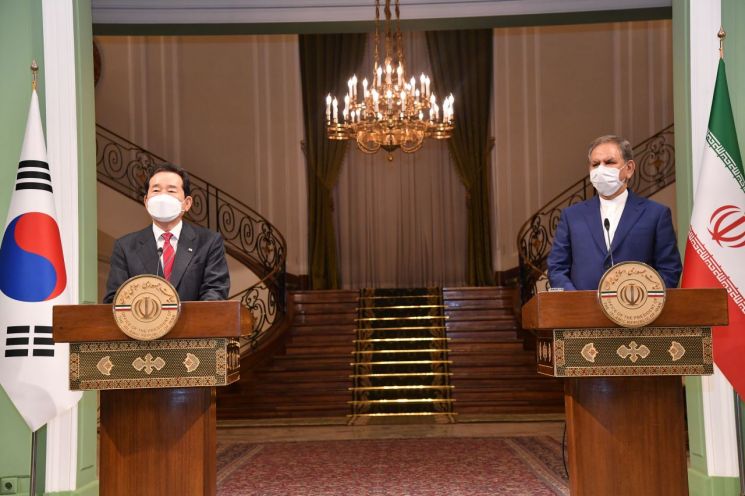
[Sejong=Asia Economy Reporter Son Seon-hee] Prime Minister Chung Sye-kyun, who is visiting Iran, stated on the 11th (local time), "We are willing to provide side support for constructive progress in dialogue among the parties involved in the Iran nuclear deal (JCPOA - Joint Comprehensive Plan of Action), and we will also strengthen possible cooperation with related countries, including Iran, to resolve the issue of Iran's won-denominated funds."
On the same day, Prime Minister Chung held a bilateral meeting with First Vice President Eshaq Jahangiri for about 1 hour and 30 minutes as his first schedule in Iran, and made these remarks at a joint press conference.
According to local media, First Vice President Jahangiri also said, "Relations between the two countries (Korea and Iran) have fallen into stagnation as Korea joined the illegal sanctions by the United States, which lack international legitimacy," and reportedly requested, "Please resolve the issue of Iran's frozen assets in Korea as soon as possible."
The funds of Iran frozen in Korean banks (Woori Bank and IBK Industrial Bank) amount to 7 billion USD (approximately 7.7 trillion KRW). These funds were used for purposes such as attracting payment for Iranian crude oil imports and paying local export companies through the Korea-Iran won settlement system. However, since May 2019, when the Donald Trump administration withdrew from the Iran nuclear deal and imposed economic sanctions against Iran, the funds have been frozen for nearly two years. This issue was also cited as a background for Iran's detention of the Korean chemical tanker Korea Chemihos.
This issue is intertwined with negotiations to restore agreements among related countries including the United States, the United Kingdom, France, and Germany, so the Korean government has limited room to intervene independently. However, Prime Minister Chung appears to have expressed his willingness to persuade related countries to resolve the issue of frozen funds in Korea. Regarding the detention of the Korea Chemihos, he emphasized the Korean government's position that "the stability and peace of the Strait of Hormuz are crucial for navigation safety and energy security, and freedom of navigation in the strait must be guaranteed."
The two countries agreed to expand humanitarian cooperation that can be pursued regardless of U.S. sanctions against Iran. Prime Minister Chung proposed to further activate exports of humanitarian items such as pharmaceuticals and medical devices from Korea through the Korea-Iran Humanitarian Trade Working Group. Vice President Jahangiri responded by welcoming this proposal, agreeing on the necessity of cooperation related to COVID-19.
In particular, Prime Minister Chung and Vice President Jahangiri agreed to activate the "Korea-Iran Economic Cooperation Review Consultative Body" so that economic cooperation can begin immediately if conditions such as the restoration of the Iran nuclear deal change.
Meanwhile, on the second day of his visit to Iran, the 12th, Prime Minister Chung will hold successive meetings with Mohammad Bagher Ghalibaf, Speaker of the Parliament, and Ali Larijani, advisor to Iran's Supreme Leader Ayatollah Seyed Ali Khamenei. He also plans to hold a meeting with Korean companies operating locally, such as Samsung Electronics and LG Electronics. Afterwards, he will return home, stopping over in Uzbekistan for refueling, and arrive at Seoul Airport on the 13th.
© The Asia Business Daily(www.asiae.co.kr). All rights reserved.
![Clutching a Stolen Dior Bag, Saying "I Hate Being Poor but Real"... The Grotesque Con of a "Human Knockoff" [Slate]](https://cwcontent.asiae.co.kr/asiaresize/183/2026021902243444107_1771435474.jpg)
















