'Reflecting on the Cho Kuk Incident' Ruling Party Freshman Breaks Taboo, Opposition Party Freshman Targets 'Factional Politics'
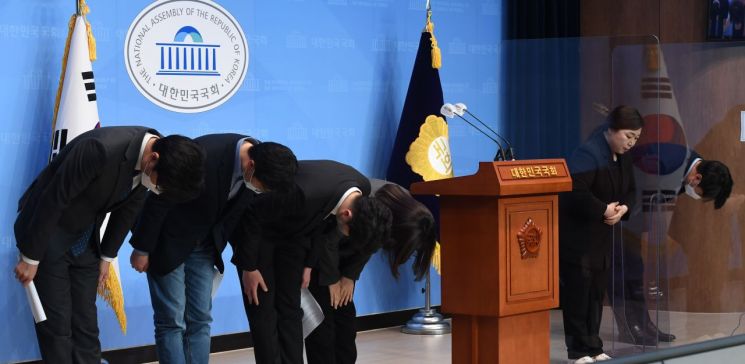 First-term lawmakers Jeon Yong-gi, Oh Young-hwan, Lee So-young, Jang Kyung-tae, and Jang Cheol-min of the Democratic Party of Korea greet each other ahead of the announcement of the "Democratic Party of Korea 2030 Lawmakers' Statement" held at the National Assembly Communication Hall in Yeouido, Seoul, on the morning of the 9th. [Image source=Yonhap News]
[Asia Economy Reporter Park Jun-yi] In the aftermath of the April 7 by-elections, a political aftershock is sweeping through the political sphere as first-term lawmakers from both ruling and opposition parties have stepped forward to call for party reform. First-term lawmakers from the ruling party pointed to failures in intergenerational communication by referencing incidents such as the 'Cho Kuk scandal' and the 'Incheon International Airport Corporation (IIAC) incident,' while opposition lawmakers emphasized the need for innovation and called for overcoming traditional factional politics. With the party convention to elect new leadership approaching, attention is focused on whether these lawmakers can become a catalyst for change within their parties.
On the 9th, about 50 first-term lawmakers from the Democratic Party of Korea issued a joint statement emphasizing, "We, the first-term lawmakers, will change first. We will lead the innovation of the Democratic Party. We will become the agents of party reform." They criticized, "The Democratic Party should not have nominated candidates in this by-election. We pushed for amendments to the party constitution and regulations without public consensus, nominated candidates, and then closed our ears," and reflected on their failure to participate actively in the decision-making process as first-term lawmakers.
They also mentioned controversies over fairness involving the government and ruling party, such as the 'Cho Kuk (former Minister of Justice) scandal' and the 'regularization of non-regular workers at Incheon International Airport Corporation.' Regarding the Cho Kuk scandal, they said, "We are willing to apologize if the public demands it," and added, "The so-called 'IIAC issue,' which angered many young people, was partly due to our failure to properly understand the reasons behind the youth's anger and our arrogance in trying to teach the values we uphold to them, which led to a breakdown in communication between the youth and the Democratic Party."
The outspoken remarks of these first-term lawmakers have sparked backlash from hardline supporters and party members, who have labeled them as the 'Five Traitors of the First-Term Lawmakers' and reportedly bombarded them with 'text message attacks.'
Figures within the ruling party have moved to contain the internal division. Park Young-sun, former Minister of SMEs and Startups and Democratic Party candidate for Seoul mayor, appealed for unity among party members on Facebook on the 10th, saying, "After a defeat, various stories may arise," and "Opinions may differ," but emphasized, "What is most important before us is to refrain from blaming each other." On the 9th, Democratic Party lawmaker Jung Cheong-rae also wrote on Facebook, "What is more important is the state of division," and warned, "Confusion is the most dangerous toxin to be wary of right now." He added, "It is important to reduce individual voices as much as possible and emphasize the unified voice of the party."
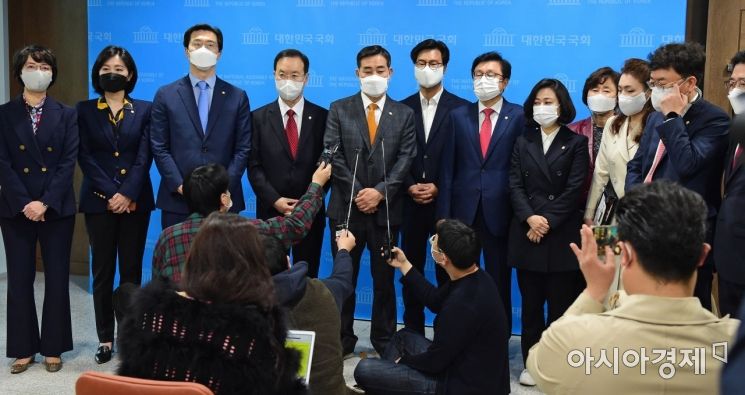 People's Power Party first-term lawmakers are answering questions from reporters after holding a press conference at the National Assembly Communication Hall on the 8th. On this day, the first-term lawmakers stated, "We will not be intoxicated by victory and will continue to reform the party." Photo by Yoon Dong-joo doso7@
First-term lawmakers from the opposition, who gained momentum in this election, also raised their voices. On the 8th, the day after the election, 56 first-term lawmakers from the People Power Party held a press conference at the National Assembly, stating, "We are well aware that this victory was not achieved because our party did well," and pledged, "We will lead the effort to straighten out the People Power Party and undergo a thorough innovation so that the great will of the people who gave us this opportunity does not turn into disappointment again." They criticized, "We will overcome the criticism and limitations of being a party unpopular with youth and a regional party," and declared, "We will firmly reject factional politics, which have become relics of the old era, and become one team that looks only to the people."
In response to these remarks, party leadership defended that regionalism and factional politics no longer exist within the party. On the 9th, Joo Ho-young, acting leader of the People Power Party, said in an interview with KBS Radio's 'Choi Kyung-young's Strong Current Affairs,' "We all agree that the party's leadership needs to become younger and renewed," but added, "Terms like PK party or TK party are from the past; they no longer have any substance." He pointed out, "There is no situation where TK or PK holds vested interests that control party operations, so it is better to be cautious in using terms that limit ourselves."
After a meeting of the party's floor leadership, he also told reporters, "I don't understand what the limitations of our party as a Yeongnam party are," and said, "Let's become a party that strengthens regions where our party is weak, such as Honam, to be like the Yeongnam region, and become a genuine nationwide party."
© The Asia Business Daily(www.asiae.co.kr). All rights reserved.
![Clutching a Stolen Dior Bag, Saying "I Hate Being Poor but Real"... The Grotesque Con of a "Human Knockoff" [Slate]](https://cwcontent.asiae.co.kr/asiaresize/183/2026021902243444107_1771435474.jpg)
















