Experts Point Out 'No Plan for Debt Reduction'
April National Assembly Discussions Also Unlikely Due to COVID-19
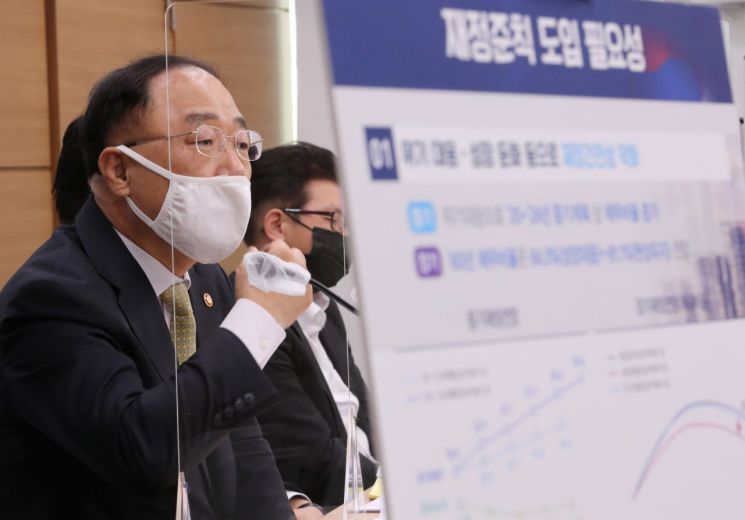 Deputy Prime Minister and Minister of Economy and Finance Hong Nam-ki briefing on October 5 last year at the Government Complex Sejong regarding the plan to promote the introduction of Korean-style fiscal rules to maintain fiscal sustainability. (Photo by Yonhap News)
[Sejong=Asia Economy Reporter Moon Chaeseok] As the government implements expansive fiscal policies to respond to COVID-19, increasing the national debt that the government must repay, it has been revealed that the government's bill to introduce fiscal rules has been left untouched for four months since its submission.
According to the National Assembly and the government on the 11th, the amendment to the National Finance Act for the introduction of the "Korean-style fiscal rules," submitted by the Ministry of Economy and Finance at the end of December last year, has been pending for four months in the National Assembly's Planning and Finance Committee. The fiscal rules announced by the Ministry of Economy and Finance aim to control the national debt ratio to within 60% of the Gross Domestic Product (GDP) and the integrated fiscal balance to within -3% of GDP annually from 2025, considering the rapid increase in national debt and medium- to long-term fiscal conditions.
However, the ruling and opposition parties are divided, with some saying the introduction is premature and others arguing for stricter rules than the government's proposal. The senior expert of the Planning and Finance Committee also pointed out in the bill review opinion that "it can enhance the effectiveness of fiscal soundness," but "it may make it difficult for the national finances to respond flexibly to changing circumstances such as economic downturns caused by population aging and COVID-19."
With the COVID-19 quarantine situation not improving, many expect discussions in the April extraordinary session of the National Assembly to be unlikely. A Planning and Finance Committee official said, "Due to the COVID-19 situation, it is not the right timing to discuss this in the April National Assembly."
Amid the stalled discussions on fiscal rules, concerns about fiscal soundness are growing. According to the Ministry of Economy and Finance's "2020 Fiscal Year National Settlement," as of the end of last year, the national debt (D1), which the central government and local governments are obligated to repay, stood at 846.9 trillion won. This is about 44.0% of GDP. Due to the COVID-19 crisis, the issuance of government bonds for active fiscal management, including four supplementary budgets, and the issuance of national housing bonds due to increased real estate transactions, increased the debt by 123.7 trillion won compared to a year earlier. Dividing the national debt by the estimated population by Statistics Korea last year (51.78 million), the national debt per capita is 16.35 million won, an increase of 2.26 million won from the previous year.
The Ministry of Economy and Finance explains that despite the increase in national debt due to expansive fiscal policy, Korea's fiscal soundness remains relatively good compared to major countries. As of 2019, Korea's general government debt (D2, D1 plus non-profit public institution debt) ratio to GDP was 42.2%, lower than the United States (108.4%), Germany (68.1%), and the OECD average (110.0%). Based on the International Monetary Fund (IMF)'s forecast from last January, the ministry emphasized that the fiscal deficit (-3.1%) and debt (D2) ratio increase (6.2 percentage points) due to the COVID-19 crisis last year were also lower than those of major countries.
Experts caution against optimism given the rapid increase in national debt. Professor Yeom Myung-bae of Chungnam National University said, "Korea's fiscal expansion has been very rapid even before COVID-19," adding, "While countries around the world are planning fiscal normalization to reduce the debt increased by COVID-19 after the crisis ends, Korea has no debt reduction plan."
Park Hyung-soo, director of the K-Policy Platform, also cited the IMF's Fiscal Monitor Reports released on the 7th, stating, "Unlike other countries, Korea significantly increased welfare spending such as raising the basic pension and strengthening health insurance coverage under the name of COVID-19 response, so fiscal deterioration will continue even after COVID-19," and warned, "Without extraordinary fiscal soundness measures, Korea's fiscal deterioration is expected to worsen."
The IMF projected that Korea's general government debt (D2) ratio to GDP will increase from 48.7% last year to 69.7% in 2026. If this happens, Korea will rise from 24th to 19th among 35 advanced countries in five years.
© The Asia Business Daily(www.asiae.co.kr). All rights reserved.
![Clutching a Stolen Dior Bag, Saying "I Hate Being Poor but Real"... The Grotesque Con of a "Human Knockoff" [Slate]](https://cwcontent.asiae.co.kr/asiaresize/183/2026021902243444107_1771435474.jpg)















