Last year's sales reached 113.5 billion KRW... 397% increase compared to 2018
Exclusive supplier of Hyundai Motor's hydrogen tanks... IPO planned within the second half
"Realizing a corporate value of 1.6 trillion KRW possible"... Company sales have not yet fully started
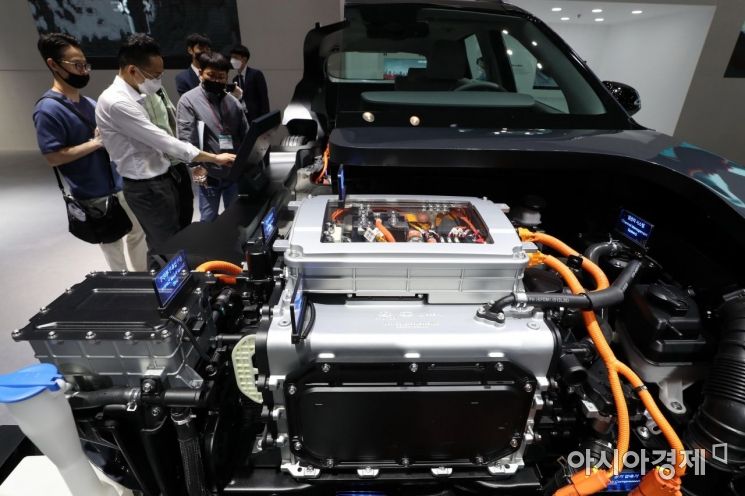 Visitors attending the 2020 Hydrogen Mobility+ Show held last year at KINTEX in Goyang, Gyeonggi Province, are examining a cross-section of the Hyundai hydrogen electric vehicle Nexo. Photo by Kim Hyun-min, Goyang kimhyun81@
[Asia Economy Reporter Lee Jun-hyung] Hydrogen tank manufacturer Iljin Composite Materials is thriving thanks to the growing popularity of eco-friendly vehicles. As the company accelerates its performance by supplying hydrogen tanks to Hyundai Motor Company and others, it is also pursuing an initial public offering (IPO). Experts predict that "due to the technical limitations of electric vehicles, the hydrogen car market will continue to expand steadily," and they highly value Iljin Composite Materials' corporate value.
Iljin Composite Materials' performance over the past three years is noteworthy. Last year's sales reached 113.5 billion KRW, a 397% increase compared to 28.6 billion KRW in 2018. During the same period, operating profit soared about 25 times from 600 million KRW to 15.2 billion KRW. The growth potential is expected to be even greater in the future. NH Investment & Securities forecasts that Iljin Composite Materials' sales will increase from 350 billion KRW in 2023 to 860 billion KRW by 2030.
The Only Domestic Producer of 'Type 4' Hydrogen Tanks... Exclusive Supplier to Hyundai Motor Company
The driving force behind this growth is 'technology.' Iljin Composite Materials produces compressed natural gas (CNG) tanks and vehicle hydrogen tanks. It is the only company in Korea capable of manufacturing the most advanced hydrogen tank model currently available, the ‘Type 4.’ Besides Iljin Composite Materials, the only other company mass-producing Type 4 tanks is Toyota in Japan.
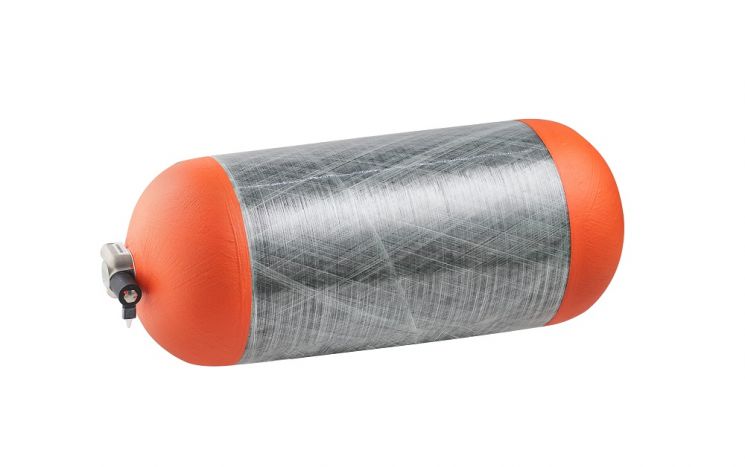
The main customer is Hyundai Motor Company. Since 2014, starting with the Tucson hydrogen electric vehicle, Iljin Composite Materials has been the exclusive supplier of vehicle hydrogen tanks to Hyundai Motor Company. Iljin Composite Materials' hydrogen tanks are also installed in the Nexo. The volume of deliveries is expected to steadily increase. Hyundai Motor Company plans to secure production capacity to mass-produce 500,000 hydrogen vehicles by 2030, ensuring a solid future.
Revenue growth related to hydrogen buses is also anticipated. Last year, the Seoul Metropolitan Government signed a memorandum of understanding (MOU) with Hyundai Motor Company to promote the spread of hydrogen electric vehicles and agreed to increase the number of hydrogen buses to around 1,000 by 2025.
IPO Scheduled for the Second Half of This Year... Corporate Value Estimated at 1.6 Trillion KRW
Riding the wave of eco-friendliness, the IPO process is progressing smoothly. Iljin Composite Materials filed for preliminary review with the Korea Exchange on the 7th. The review typically takes about two months. A representative from Iljin Group stated, "Listing could be possible as early as July," adding, "Although there may be changes during document review, listing within the second half of this year is highly likely."
The corporate value has been estimated at 1.6 trillion KRW. Although the rapid growth might seem overvalued considering last year's sales were still in the 100 billion KRW range, experts have assessed that "the likelihood of realizing this corporate value is high" based on the company's growth potential.
Professor Lee Ho-geun of Daeduk College's Department of Automotive Engineering analyzed, "Hyundai Motor Company is expected to hold more than 25% market share in the future hydrogen car market," and added, "Considering Iljin Composite Materials is a major supplier to Hyundai Motor Company and the company's vision, this is the anticipated corporate value in 5 to 10 years."
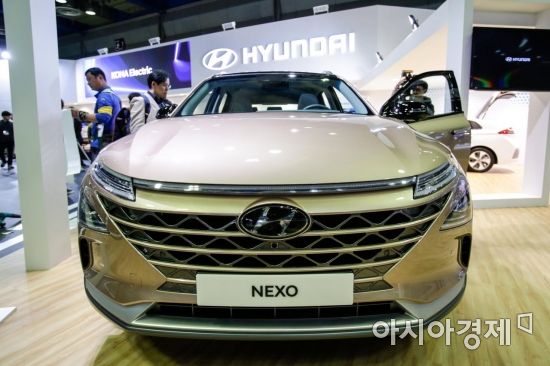 At 'EV Trend Korea 2018' held at COEX in Gangnam-gu, Seoul in 2018, Hyundai's hydrogen electric vehicle Nexo is being unveiled. Photo by Jinhyung Kang aymsdream@
The hydrogen car market is still in its early stages, so the company's sales have not yet fully materialized. The Korea Eximbank Overseas Economic Research Institute expects the initial hydrogen car market to form by 2025. Due to active support policies centered on the European Union (EU), hydrogen car adoption is projected to reach 1 million units by 2030, and by 2050, about 20% of all vehicles worldwide are expected to be hydrogen cars.
One of the reasons for the expansion of hydrogen car adoption is the technical limitations of electric vehicles. Without significant innovation in electric vehicle batteries, it is difficult to greatly increase driving range compared to current levels.
Professor Lee explained, "To build an electric vehicle like the Nexo that can travel over 600 km on a single charge, the battery weight must exceed 800 kg, whereas the Nexo's hydrogen tank weighs only 150 kg," adding, "For long-distance travel exceeding 500 km or for large vehicles, hydrogen cars are more efficient."
© The Asia Business Daily(www.asiae.co.kr). All rights reserved.

![User Who Sold Erroneously Deposited Bitcoins to Repay Debt and Fund Entertainment... What Did the Supreme Court Decide in 2021? [Legal Issue Check]](https://cwcontent.asiae.co.kr/asiaresize/183/2026020910431234020_1770601391.png)