China: "It's Just a Mosquito Bite"
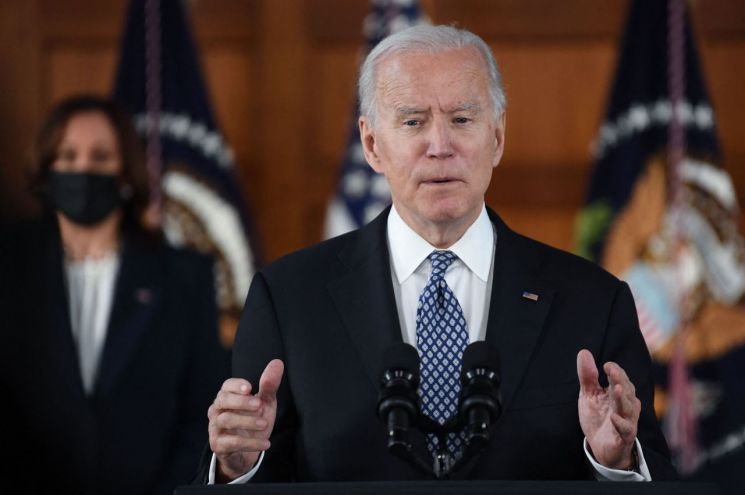
[Asia Economy Reporter Park Byung-hee] On the 8th (local time), the U.S. government added seven Chinese supercomputing-related companies to its blacklist, citing national security threats. This is the first blacklist under U.S. President Joe Biden. Although President Biden has adopted policies different from former President Donald Trump in many respects, he continues a tough stance on China similar to Trump’s approach. China downplayed the move, saying it was "just like being bitten by a mosquito."
According to CNBC, the blacklist presented by the U.S. Department of Commerce on that day included seven companies: Tianjin Phytium Information Technology, Sunway Microelectronics, Shanghai High-Performance Integrated Circuit Design Center, and the National Supercomputing Centers in Jinan, Shenzhen, Wuxi, and Zhengzhou.
Among them, Tianjin Phytium Information Technology was previously identified by The Washington Post (WP) as a company involved in China’s hypersonic weapons research. WP explained that supercomputers are used in the development of hypersonic weapons, and Phytium’s semiconductors are used in these supercomputers.
Hypersonic missiles can reach speeds from five times to over twenty times the speed of sound, making them weapons capable of neutralizing missile defense systems worldwide. WP explained that Phytium, which manufactures semiconductors used in supercomputers for hypersonic weapons development, receives technology supplies from companies such as Cadence and Synopsys located in Silicon Valley, USA.
The Department of Commerce stated that all seven companies on the blacklist manufacture supercomputers used by the Chinese People's Liberation Army. U.S. Secretary of Commerce Gina Raimondo said in a statement, "Supercomputers are essential for new weapons such as nuclear weapons and hypersonic weapons, as well as modern national security systems," adding, "The Department of Commerce will use all available authorities to prevent China from modernizing its weapons and military using U.S. technology."
The Department of Commerce also announced that U.S. companies will not be allowed to conduct business with these Chinese companies on the blacklist in the future.
Following the news of the U.S. blacklist, Chinese media such as Huanqiu.com dismissed it as merely a mosquito bite, saying it only serves to motivate domestic research and development. These media pointed out that the U.S. sanctions on Chinese supercomputing companies demonstrate that the U.S. leadership’s ideology of protecting itself in competition with China remains unchanged.
Mei Xinyu, a researcher at the International Trade and Economic Cooperation Research Institute of the Ministry of Commerce, said, "The U.S. has imposed many restrictions on Chinese technology that can be used by the military, including computers," adding, "This measure is not new but merely an enhancement of existing sanctions." Researcher Mei claimed, "The U.S. sanctions are like a mosquito biting us," and "The U.S. has been bothering us like this for years, so one more bite is not a problem."
Previously, former President Donald Trump also placed dozens of Chinese companies, including smartphone manufacturer Huawei, semiconductor manufacturer SMIC, and drone manufacturer SZ DJI Technology, on the blacklist citing threats to U.S. national security.
© The Asia Business Daily(www.asiae.co.kr). All rights reserved.
![Clutching a Stolen Dior Bag, Saying "I Hate Being Poor but Real"... The Grotesque Con of a "Human Knockoff" [Slate]](https://cwcontent.asiae.co.kr/asiaresize/183/2026021902243444107_1771435474.jpg)















