Collaboration Among Various Institutions to Form and Operate the 'Gwangju Metropolitan City University Development Cooperation Group'
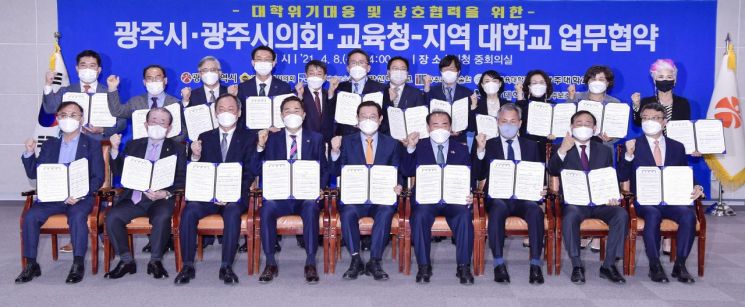 On the afternoon of the 8th, Lee Yong-seop, Mayor of Gwangju Metropolitan City, took a commemorative photo after signing a business agreement for mutual cooperation in crisis response and university development with Kim Yong-jip, Chairman of the Gwangju City Council, Jang Hwi-guk, Superintendent of Gwangju Metropolitan Office of Education, and presidents of 17 universities in the Gwangju area at the city hall's medium conference room. Photo by Gwangju Metropolitan City
[Asia Economy Honam Reporting Headquarters Reporter Park Seon-gang] Gwangju Metropolitan City has taken action to respond to the crisis faced by local universities in collaboration with the city council, the city education office, and 17 universities in the region.
On the 8th, Gwangju Metropolitan City announced that it signed a memorandum of understanding (MOU) for mutual cooperation in crisis response and university development with the Gwangju City Council, Gwangju City Office of Education, and universities in the Gwangju area at the city hall’s mid-sized conference room.
The participating universities in the agreement include Kwangshin University, Gwangju Institute of Science and Technology, Gwangju National University of Education, Gwangju University, Gwangju Women’s University, Nambu University, Songwon University, Chonnam National University, Chosun University, Honam University, Gwangju Health University, Christian Nursing University, Donggang University, Seoyoung University, Chosun Nursing University, Chosun Polytechnic University, and Korea Polytechnic University, totaling 17 universities.
They collectively recognized that local universities are facing a serious crisis due to a surge in under-enrollment caused by low birth rates and a decline in the school-age population, as well as the ongoing outflow of local talent to metropolitan universities driven by population, economic, and cultural infrastructure concentration in the metropolitan area.
They also stated, “Considering the significant impact universities have on the local economy, industry, and talent development, the Gwangju community perceives the crisis of local universities as a crisis of the region itself and intends to include the issue of local universities within the scope of local autonomy to take joint responsibility and resolve it together.”
They added, “Universities will contribute to talent development and regional progress, and as youth employment expands locally, we will jointly respond to create a virtuous cycle where outstanding talent is attracted to the region.”
Through the MOU, each institution agreed to mutually cooperate in responding to the crisis of local universities and promoting university development, and decided to form the ‘Gwangju Metropolitan City University Development Cooperation Group’ for joint response.
The overall operation of the University Development Cooperation Group will be managed by Gwangju City to ensure efficient coordination with central government ministries and related organizations, while the city education office and local universities will dispatch and support working-level personnel.
Each institution will actively cooperate to enable universities to cultivate specialized personnel with sustainable competitiveness and to create new knowledge through research activities, thereby laying the foundation for the development of regionally linked industries.
They also pledged to actively work on improving related laws and systems to resolve imbalances between universities and academic disciplines and to ensure the effectiveness of policies fostering local universities.
In particular, the participating institutions agreed to promote curriculum specialization in fields such as artificial intelligence, healthcare, automotive, energy, and cultural contents to establish future new growth engines for Gwangju and to actively cooperate in expanding youth employment.
Mayor Lee Yong-seop said, “With the belief that the local community thrives only when local universities thrive, the Gwangju community must come together to thoughtfully address university issues,” adding, “To this end, Gwangju City, the city council, the city education office, and 17 local universities will jointly form the University Development Cooperation Group and do their best to prepare measures to foster local universities.”
He continued, “In particular, we will generously support and cooperate so that each university can develop specialized competitiveness linked to Gwangju’s key industries such as AI, healthcare, automotive, energy, and cultural contents,” and added, “We will do our utmost so that graduates of our local universities can have quality jobs and lead happy lives in their hometown without having to leave Gwangju.”
© The Asia Business Daily(www.asiae.co.kr). All rights reserved.
![Clutching a Stolen Dior Bag, Saying "I Hate Being Poor but Real"... The Grotesque Con of a "Human Knockoff" [Slate]](https://cwcontent.asiae.co.kr/asiaresize/183/2026021902243444107_1771435474.jpg)















