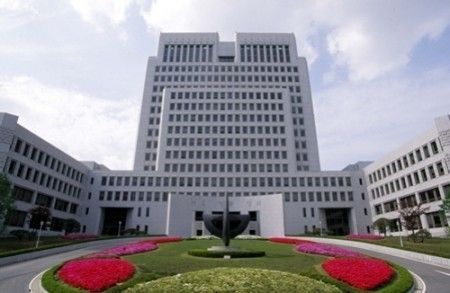
[Asia Economy Reporter Baek Kyunghwan] The Supreme Court has ruled that the state must pay compensation if a prosecutor refuses a suspect's request to remove handcuffs before a prosecution investigation.
On the 8th, the Supreme Court's 3rd Division (Presiding Justice Lee Dongwon) upheld the lower court's ruling in favor of the plaintiff in the appeal of a damages lawsuit filed by detained suspect A and his attorney against the state.
A, who was detained on charges of violating the National Security Act, entered the prosecutor's office with his lawyer after meeting with the lawyer at the Suwon District Prosecutors' Office in May 2015 to undergo questioning. At that time, the correctional officer removed the leg restraints just before A entered, but did not remove the handcuffs.
The lawyer requested the removal of the handcuffs, but the prosecutor proceeded with the interrogation without removing A's handcuffs. The lawyer continued to protest the refusal to remove the handcuffs, but the prosecutor forcibly expelled the lawyer on the grounds of obstruction of investigation.
Subsequently, A and others filed a lawsuit against the state and the prosecutor, claiming that "the refusal to remove protective equipment, the forced expulsion, and the failure to guarantee the right to be investigated with the participation of the lawyer despite B's request constitute illegal acts in the execution of official duties," demanding joint compensation of 25 million won.
The first trial recognized A's claims and ordered the state and the prosecutor to pay 2 million won each to A and his lawyer. The second trial also acknowledged the state's and prosecutor's liability for damages and increased the compensation to 5 million won each for A and his lawyer. The court stated, "The refusal to remove protective equipment constitutes illegal official conduct."
On this day, the Supreme Court dismissed both parties' appeals and finalized the ruling. The court explained, "According to precedent, when a public official causes damage to others through illegal acts during the performance of duties, the state bears compensation responsibility. Additionally, if the public official acted with intent or gross negligence, they are personally liable for damages caused by the illegal act; however, if only ordinary negligence is present, the public official is not personally liable."
It continued, "There are some inappropriate parts in the lower court's reasoning that the prosecutor's gross negligence is not necessarily required to recognize liability for compensation. However, since the lower court's recognition of the prosecutor's liability for damages is sufficient to be considered gross negligence, the lower court's judgment does not violate Supreme Court precedent," thereby confirming the ruling.
© The Asia Business Daily(www.asiae.co.kr). All rights reserved.
![Clutching a Stolen Dior Bag, Saying "I Hate Being Poor but Real"... The Grotesque Con of a "Human Knockoff" [Slate]](https://cwcontent.asiae.co.kr/asiaresize/183/2026021902243444107_1771435474.jpg)















