[Asia Economy Reporter Lee Ji-eun] Following the ruling party's crushing defeat in the April 7 Seoul and Busan by-elections, concerns about a lame-duck period (power drain at the end of a term) for President Moon Jae-in, who has only one year left in office, are growing. The Blue House plans to maintain momentum in national governance during the final year through a cabinet reshuffle after the elections, but if President Moon's authority weakens due to the lame-duck effect, there is a high possibility of a divergence in policy stances between the party and the administration on issues such as prosecutorial reform and real estate.
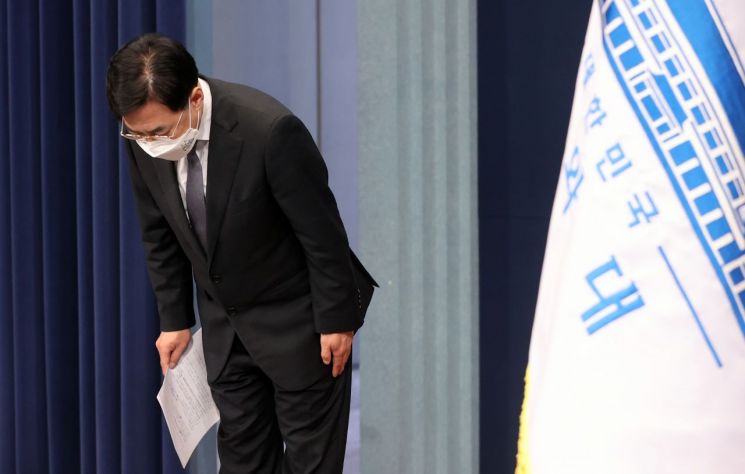
Kang Min-seok, the Blue House spokesperson, stated on the 8th President Moon's position regarding the by-elections, saying, "We will devote ourselves to realizing the people's urgent demands such as overcoming COVID-19, economic recovery, stabilizing livelihoods, and eradicating real estate corruption." This was interpreted as a declaration of intent to continue pursuing existing tasks regardless of the election results.
However, despite this expression of determination, public forecasts are leaning more toward an acceleration of the lame-duck period. Until early last month, President Moon maintained a historically high "40% concrete" approval rating, but recently, his approval rating for national governance has dropped to the low 30% range, raising concerns about a lame-duck period. Moreover, with the opposition party's landslide victory in the by-elections based on the "judgment on the regime" argument, there is a high likelihood that even the 30% approval rating will collapse and fall into the 20% range. Generally, an approval rating in the 20% range is regarded as a signal that a president's lame-duck period is fully underway.
If the lame-duck period intensifies and President Moon's authority weakens, the ruling party and administration's "one team" stance on prosecutorial reform and real estate issues could also be shaken. Signs of this have already appeared. Regarding prosecutorial reform, on February 24, Presidential Chief of Staff Yoo Young-min made a statement implying that "speed adjustment on prosecutorial reform is President Moon's intention," but he reversed this after being criticized by Kim Tae-nyeon, the floor leader of the Democratic Party. Also, concerning real estate issues, the ruling party apologized for policy failures just before the by-elections and began considering deregulation, but the Blue House did not apologize, stating that "consistency must be maintained." Ultimately, the ruling party also aligned their voices by saying, "The real estate policy stance will remain unchanged even after the by-elections," but going forward, there will likely be deeper deliberations within the party and administration on whether to continue or revise existing real estate policies.
Movements among presidential candidates within the party are also drawing attention. In the final year of a regime, the party tends to rally around major presidential candidates, but President Moon's influence remains significant in the Democratic Party primaries. However, with the defeat in this election narrowing the position of former Democratic Party leader and pro-Moon faction member Lee Nak-yeon, Gyeonggi Province Governor Lee Jae-myung, classified as non-pro-Moon, is expected to pursue differentiation to increase his presence.
© The Asia Business Daily(www.asiae.co.kr). All rights reserved.
![Clutching a Stolen Dior Bag, Saying "I Hate Being Poor but Real"... The Grotesque Con of a "Human Knockoff" [Slate]](https://cwcontent.asiae.co.kr/asiaresize/183/2026021902243444107_1771435474.jpg)















