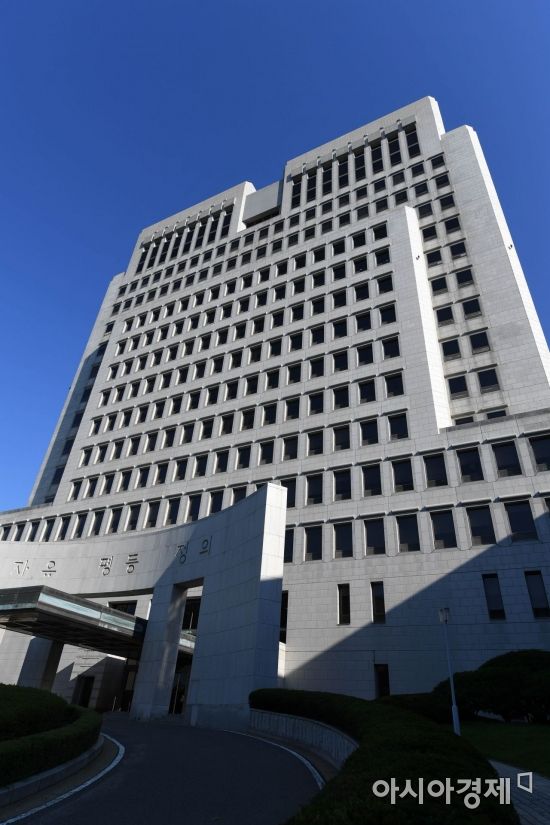
 Supreme Court, Seocho-dong, Seoul. Photo by Moon Honam munonam@
[Asia Economy Reporter Kim Daehyun] The Supreme Court has ruled that applying seniority increment restrictions to administrative assistant staff at some middle and high schools in Gyeonggi-do does not violate the Labor Standards Act.
On the 7th, the Supreme Court's 2nd Division (Presiding Justice Kim Sanghwan) confirmed the lower court's ruling that dismissed the wage claim lawsuit filed by six employees, including Mr. A, from some middle and high schools in Gyeonggi-do against Gyeonggi-do. Mr. A and others originally renewed their employment contracts annually and received wages based on the seniority system under the local government official salary regulations. However, when they were converted to indefinite-term contract workers in 2007 and signed new employment contracts, each school applied a seniority increment restriction rule that prevented further increments once a certain seniority level was reached. Consequently, Mr. A and others filed a wage claim lawsuit against the Gyeonggi-do education authorities. They argued that the change in employment rules violated the Labor Standards Act because it lacked collective consent from the majority of workers and caused discrimination compared to accounting staff at other schools.
Article 94, Paragraph 1 of the current Labor Standards Act stipulates that "Employers must seek the opinion of a labor union organized by the majority of workers (or the majority of workers if there is no union) when drafting or changing employment rules. However, if the employment rules are changed to the disadvantage of workers, their consent must be obtained." Additionally, Article 6 of the same law states that "Employers shall not discriminate against workers based on gender, nationality, religion, or social status in terms of working conditions."
However, the first and second trials dismissed Mr. A's claims. The first trial court pointed out, "According to the employment contracts signed when the plaintiffs were converted to indefinite-term contract workers, there is no provision for automatic annual seniority increments," and "There is no evidence to recognize that the consent of the workers, including the plaintiffs, at the time of signing was not voluntary." Furthermore, it ruled, "The differences in wages among schools cannot be considered as discrimination based on gender, nationality, religion, or social status as defined by the Labor Standards Act."
The Supreme Court also agreed with this judgment. The court stated, "The lower court did not err in its interpretation or application of laws related to discriminatory treatment, the Labor Union and Labor Relations Adjustment Act Article 33, and collective agreements," and dismissed the appeal.
© The Asia Business Daily(www.asiae.co.kr). All rights reserved.
![Clutching a Stolen Dior Bag, Saying "I Hate Being Poor but Real"... The Grotesque Con of a "Human Knockoff" [Slate]](https://cwcontent.asiae.co.kr/asiaresize/183/2026021902243444107_1771435474.jpg)














