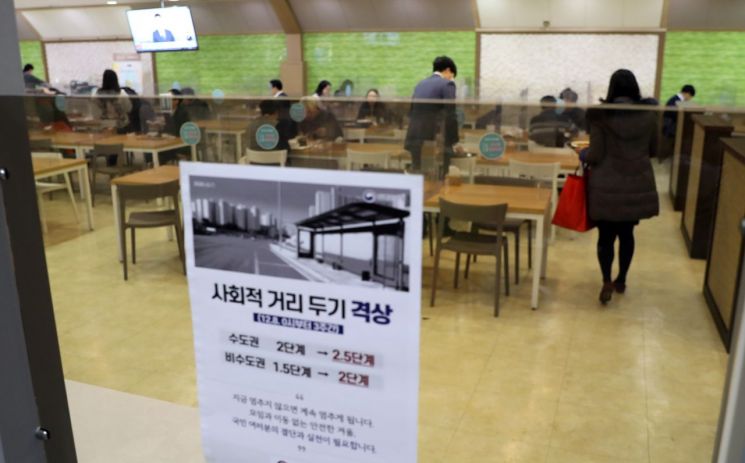
 The photo is not directly related to the article. During lunchtime, government officials are practicing social distancing while eating at the government Seoul office cafeteria. [Image source=Yonhap News]
[Asia Economy Reporter Seungjin Lee] The 1.2 trillion KRW large corporation group meal market is opening up. As the market, which had been monopolized by subsidiaries of large corporations, is being unlocked, fierce competition is expected, leading to mixed reactions among group meal companies.
According to the group meal industry on the 6th, eight major corporations including Samsung, Hyundai Motor, LG, Hyundai Heavy Industries, Shinsegae, CJ, LS, and Hyundai Department Store have agreed to the Fair Trade Commission's proposal to switch the group meal market to competitive bidding. LG will gradually fully open its group meal market, and CJ will convert about 65% of its meal market to competitive bidding and share the workload sequentially.
Currently, the domestic group meal market is an oligopoly where the top five companies?Samsung Welstory, Ourhome, Hyundai Green Food, CJ Freshway, and Shinsegae Food?affiliated with large corporations or related companies, occupy 80% of the total market (4.3 trillion KRW). With this agreement, these companies will not only compete among themselves but also face competition from independent companies that have found it difficult to enter the market until now.
In particular, competition is expected to intensify among Samsung Welstory, Hyundai Green Food, and Ourhome, which are subsidiaries or related companies of Samsung, Hyundai, and LG. These three companies have so far leveraged their manufacturing-based affiliates to maintain market dominance. Since each factory serves tens of thousands of meals, these companies had significant revenue sources, but with the market opening, they face the risk of losing a substantial portion of their sales.
An official from a group meal company explained, "Among group meal companies affiliated with large corporations, fortunes will vary greatly depending on whether the parent company is manufacturing-centered or not. In manufacturing-centered cases, each factory is very large-scale, so companies that have monopolized these workplaces could suffer significant damage, while it could be an opportunity for other companies."
In fact, recently, two cafeterias at Samsung Electronics' Suwon and Giheung plants have begun selecting group meal providers to replace Samsung Welstory, a group affiliate, and it is known that major meal providers affiliated with large corporations have participated in the bidding.
There are also criticisms that this agreement does not align with the original intent of revitalizing small and medium-sized enterprises (SMEs). Another group meal company official said, "Even if the market is opened through this agreement, we need to see whether SMEs can handle the scale. SMEs cannot manage meal services for 20,000 to 30,000 people, so it may ultimately not meet the purpose of market opening."
Meanwhile, due to the impact of COVID-19 last year, with workplaces closing or telecommuting becoming more common, sales in the group meal industry sharply declined. CJ Freshway recorded an operating loss of 3.5 billion KRW last year, down from an operating profit of 58 billion KRW in 2019. Shinsegae Food's operating profit last year was 7.7 billion KRW, a decrease of about 60% compared to the previous year. On the other hand, Samsung Welstory recorded an operating profit of 97 billion KRW last year, growing about 7% compared to the previous year.
© The Asia Business Daily(www.asiae.co.kr). All rights reserved.
![Clutching a Stolen Dior Bag, Saying "I Hate Being Poor but Real"... The Grotesque Con of a "Human Knockoff" [Slate]](https://cwcontent.asiae.co.kr/asiaresize/183/2026021902243444107_1771435474.jpg)











