Electric Vehicles Have 60-70% of the Parts Compared to Internal Combustion Vehicles... Workload Also 70-80%
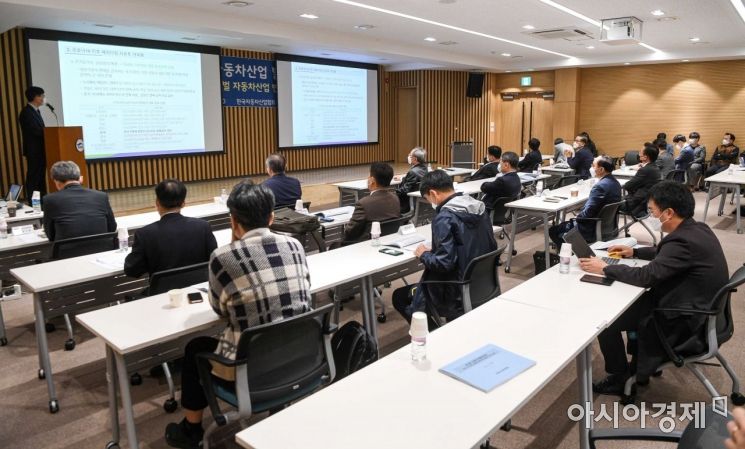 Kim Jun-gyu, Chairman of the Korea Automobile Industry Association Operations Committee, is giving a presentation on the topic "Changes and Development Plans for the Post-Corona Automobile Industry" at the 14th Automobile Industry Development Forum held on the 6th at the Automobile Hall in Seocho-gu, Seoul. Photo by Kang Jin-hyung aymsdream@
[Asia Economy Reporter Yoo Je-hoon] Amid the global trend toward Net Zero (carbon neutrality), with the global automotive industry focusing on ‘future cars,’ an analysis has emerged that for the domestic industry to secure competitiveness, issues such as labor market rigidity relief, the electronic components industry, and talent development must be addressed first.
On the 6th, at the 14th Automotive Industry Development Forum hosted by the Korea Automobile Industry Association (KAIA) at the Automobile Hall in Seocho-gu, Seoul, under the theme ‘Changes in the Global Automotive Industry after COVID-19 and Our Challenges,’ it was pointed out that the issues of ‘excess manpower’ and labor rigidity in the future car era are hindering domestic companies’ preparation for the future.
Typically, electric-powered vehicles require 60% to 80% of the parts compared to conventional internal combustion engine vehicles, and the workload is also about 70% to 80%. According to KAIA’s analysis, the production workforce for pure electric vehicles is within 40% compared to internal combustion vehicles (gasoline cars). In fact, Hyundai Motor Company, which recently launched its first dedicated electric vehicle, the Ioniq 5, also experienced conflicts with the labor union over ‘man-hours (production time).’
Jung Manki, chairman of the Korea Automobile Industry Association, said, “Unlike global automakers who secure flexibility through natural retirement, restructuring, and dispatch, our production workforce is centered on long-term employees, so how to respond to this in the electric vehicle era is also a challenge,” adding, “Even in China, the average age of major electric vehicle companies’ factories such as NIO and BYD is in their 20s, which is more competitive compared to our workforce mainly in their 40s to 60s.”
For this reason, experts pointed out the need for legal and institutional improvements to resolve labor rigidity issues. Professor Lee Jung of Hankuk University of Foreign Studies emphasized the need to expand the application scope of flexible working hours and reform the wage system from seniority-based to job-based pay, stating, “Flexibility in workforce utilization should be enhanced to respond efficiently to economic fluctuations.”
On the other hand, regarding electronic components and vehicle software, which can be considered core competitive factors of future cars, an issue of insufficient manpower is emerging. This is because the domestic automotive industry workforce has yet to move beyond being centered on mechanical engineering engineers.
According to the U.S. Department of Energy, as of 2019, the U.S. had about 250,000 personnel related to eco-friendly vehicles, whereas Korea had only 42,400 as of 2018 (according to Ministry of Trade, Industry and Energy statistics). The workforce related to autonomous driving, a core of future cars, is about 5,000. The global automotive industry is currently focusing on securing related specialists. For example, Ford in the U.S. increased its programmers from 300 in 2019 to over 4,000 last year, and GM Cruise expanded its related personnel from 40 to 2,000.
Researcher Lee said, “There is an absolute shortage of domestic vehicle software development personnel, and large-scale training of multidisciplinary personnel is necessary,” adding, “While training specialists is important, a re-education and training system must also be established to prevent wage gaps caused by digital divides.”
Meanwhile, it was also pointed out that R&D support is important to expand the future car industry ecosystem. As of 2019, Korea’s R&D expenditure related to future cars was about 8.6 trillion won, significantly lagging behind Germany (60 trillion won), Japan (45 trillion won), and the U.S. (23 trillion won).
© The Asia Business Daily(www.asiae.co.kr). All rights reserved.

















