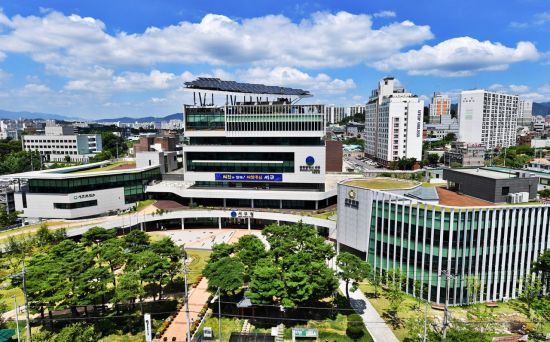
[Asia Economy Honam Reporting Headquarters Reporter Yoon Jamin] Seo-gu, Gwangju Metropolitan City is making every effort to eliminate welfare blind spots.
Seo-gu announced on the 5th that it is operating ‘Hello, Seo-gu Welfare Toktok’ to discover welfare blind spots.
‘Hello, Seo-gu Welfare Toktok’ is a non-face-to-face reporting system that allows anyone to easily and conveniently report neighbors in crisis.
To report, add ‘Hello Seo-gu Welfare Toktok’ as a friend on KakaoTalk and then submit a report.
‘Hello, Seo-gu Welfare Toktok’ is playing its role well by discovering families in crisis and providing help.
In fact, in February, a 1:1 chat request was received through the KakaoTalk Plus Friend Welfare Toktok.
A community leader active in the crisis family discovery group urgently sent a message.
The message was as follows: There is an elderly woman in the neighborhood struggling with daily life, who has overdue utility bills and no dementia medication.
Seo-gu immediately visited the elderly person with the local administrative welfare center and connected her to senior customized care services and continuous health visit counseling.
Along with this, the district has honorary social welfare officers composed of ▲Crisis Family Discovery Group ▲SOS Hope Mobile Unit ▲Shoulder-to-Shoulder Discovery Group ▲Hope Delivery Group, who carefully find and check on families in crisis even in places beyond administrative reach.
The ‘Crisis Family Discovery Group’ currently has about 750 residents active.
In addition, a total of 23 institutions and organizations are active, including the ‘SOS Hope Mobile Unit’ composed of public institution field workers such as meter readers, the ‘Shoulder-to-Shoulder Discovery Group’ consisting of daycare centers and local children’s centers, and the ‘Hope Delivery Group’ which identifies families in crisis during delivery work.
Last winter, the ‘Hodongi’s Angel Mobile Unit’ of the Crisis Family Discovery Group in Geumho 1-dong visited an elderly person’s home.
Upon inspecting the house, the room was full of cobwebs and the refrigerator contained only expired food.
The elderly person, who had hearing difficulties, barely blinked even at loud questions and was reported to be covering only a thin blanket on the cold floor.
After on-site confirmation, the administrative welfare center and Seo-gu Volunteer Center jointly carried out a housing environment improvement project.
Also, the elderly person was selected as a case management target, and their needs were identified to provide a rice cooker through the welfare council project and monthly side dishes.
Earlier, a child attended a local children’s center wearing shorts and a short-sleeved shirt despite early winter. The center director, active in the Shoulder-to-Shoulder Discovery Group, found that the child’s mother was severely depressed, neglecting childcare, and rejecting support from the surroundings.
Through the director’s continuous visits and counseling, the child’s hygiene and nutrition were checked, and emergency living expenses were applied for at the administrative welfare center, along with linking private resources for housing environment improvement and rice support.
A district official said, “The lives of vulnerable groups have become more difficult due to the prolonged COVID-19 pandemic,” adding, “We will do our best to create a Seo-gu without welfare blind spots together with honorary social welfare officers.”
Meanwhile, Seo-gu operates a ‘Welfare Blind Spot Discovery Reward Program’ to encourage more proactive administration and continuous neighborly interest in families in crisis, as well as to prevent greater crises in advance. When a discovered family in crisis applies for public benefits or is selected as an integrated case management target, the honorary social welfare officer who reported it receives an Onnuri gift certificate worth 20,000 won.
© The Asia Business Daily(www.asiae.co.kr). All rights reserved.
![Clutching a Stolen Dior Bag, Saying "I Hate Being Poor but Real"... The Grotesque Con of a "Human Knockoff" [Slate]](https://cwcontent.asiae.co.kr/asiaresize/183/2026021902243444107_1771435474.jpg)















