Democratic Party "Policy to Ease LTV and DTI"
10-Year Government Bond Yield Up 0.026% Points
Principal and Interest Repayment Ratio Over 40% Risk
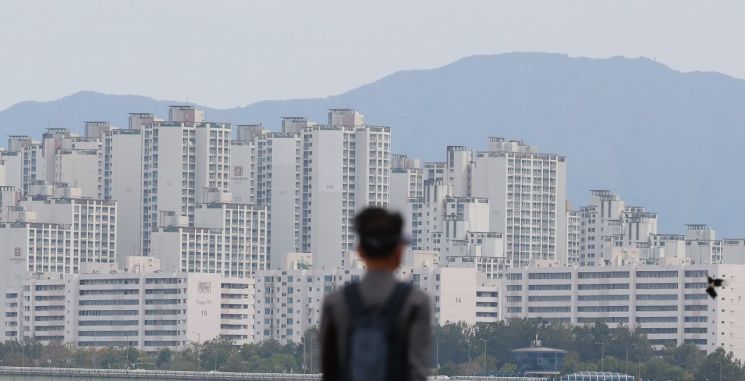
[Asia Economy Reporter Jang Sehee] Concerns over large-scale defaults are growing as household debt has soared to the level of the country's gross domestic product (GDP), coupled with the possibility of interest rate hikes. When interest rates rise, the interest burden increases, negatively affecting households' debt repayment. However, the ruling Democratic Party of Korea is pushing for a relaxation of loan regulations, drawing criticism that it may fuel financial instability.
According to the Korea Financial Investment Association on the 5th, the 10-year government bond yield recorded 2.049% on the 2nd, rising 0.026 percentage points from the previous day. This is because government bond issuance has increased to stimulate the economy, and recovery sentiment has grown, leading to greater interest in risk assets over safe assets. The U.S. Treasury yield recently exceeded 1.7%. Although the central bank's base interest rate has not changed yet, if government bond yields rise, loan interest rates will also increase, inevitably raising the burden on borrowers.
Despite this situation, the Democratic Party is considering easing loan regulations for real demand groups such as young people and the homeless. Hong Ik-pyo, the Democratic Party's Policy Committee Chair, stated, "We will pursue expanding the scope and targets of various benefits currently provided to long-term homeless and first-time homebuyers," adding, "We will raise the loan-to-value ratio (LTV) and debt-to-income ratio (DTI)."
Currently, the LTV and DTI applied when homeless households purchase homes priced under 600 million KRW in speculative or overheated speculation zones are 40%. If the household head is homeless and the combined annual income of the couple is under 80 million KRW (or under 90 million KRW for first-time homebuyers), the LTV and DTI increase to 50%.
Professor Ha Jun-kyung of Hanyang University’s Department of Economics said, "From an individual perspective, the more debt one uses, the greater the risk they must bear when a shock occurs," adding, "It is risky if the ratio of principal and interest repayment to income exceeds 40%."
There are also concerns that easing loan regulations will again trigger a rapid rise in asset prices. Professor Kim Sang-bong of Hansung University’s Department of Economics stated, "If the total household debt increases, it is highly likely to flow into other asset markets such as stocks and coins, besides real estate."
Meanwhile, as of the end of last year, the household credit gap, which indicates the gap between the real economy level and household debt growth, stands at 5.9 percentage points. This is the highest level since the fourth quarter of 2002 (7.4 percentage points), when the credit card crisis occurred.
© The Asia Business Daily(www.asiae.co.kr). All rights reserved.
![Clutching a Stolen Dior Bag, Saying "I Hate Being Poor but Real"... The Grotesque Con of a "Human Knockoff" [Slate]](https://cwcontent.asiae.co.kr/asiaresize/183/2026021902243444107_1771435474.jpg)















