Katherine Tai, US USTR Representative, Discusses China Response with Key Countries Including Japan, UK, Australia, and EU
China Agenda Absent in First Meeting with Trade Negotiation Chief Yoo Myung-hee
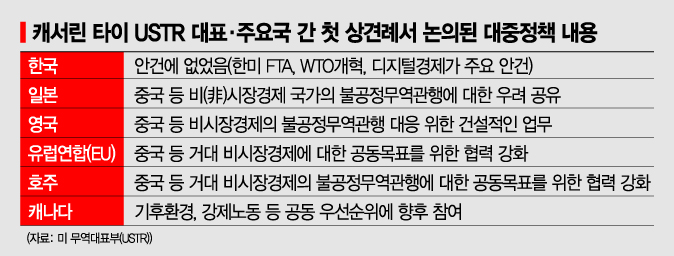
[Sejong=Asia Economy Reporter Kwon Haeyoung] At the first meeting between the Biden administration, which is raising tensions with China, and South Korea's trade authorities, it was reported that the policy to contain China was not included on the agenda. Katherine Tai, the U.S. Trade Representative (USTR), has held trade issue meetings as introductory talks with major countries such as Japan and Canada since taking office, but unlike with other countries, she did not discuss China-related issues with South Korea. This is interpreted as a consideration of South Korea's high economic dependence on China, given that it was the first introductory meeting, but some point out that South Korea's ambiguous stance, balancing between the U.S. and China, has once again been revealed.
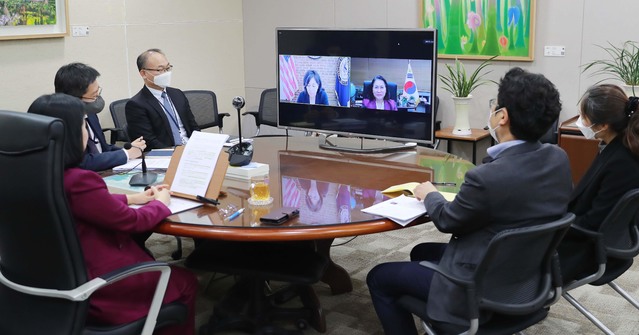
According to government sources on the 31st, Yoo Myung-hee, head of trade negotiations at the Ministry of Trade, Industry and Energy, held the first video conference with the newly appointed USTR Tai last week.
Both sides stated that they exchanged views on World Trade Organization (WTO) reform and the digital economy immediately after the meeting, which were common topics discussed with other countries as well. However, the Biden administration's China containment policy, which was discussed with other countries, was not included on the agenda.
Previously, Representative Tai shared concerns about China and promised to strengthen cooperation during introductory meetings with trade authorities from Japan, the United Kingdom, the European Union (EU), Australia, and Canada. She also indicated that the Biden administration would maintain a tough stance on China by stating that it would not withdraw the tariffs imposed on China during the Trump administration.
According to a press release issued by USTR, Tai shared concerns about "unfair trade practices by non-market economy countries such as China" with Japan and agreed to "strengthen cooperation for common goals regarding large non-market economies such as China" with the EU. With Canada, she announced plans to "participate in joint priority responses to climate/environment and forced labor issues." Although there was no direct mention of "China," this implied that Canada would indirectly join the Biden administration's China containment policy, which targets China's human rights, environment, and labor issues.
Regarding this, a trade expert analyzed, "South Korea likely feared China's reaction, and the U.S. also seemed not to bring up the related agenda with us unnecessarily," adding, "This reveals a facet of South Korea's ambiguous stance between the U.S. and China." He further noted, "If the U.S. raises the level of its China containment policy in the future, South Korea will also face serious pressure to make a choice."
Experts point out that such balancing diplomacy amid escalating U.S.-China conflicts could be highly beneficial. Kang Insu, professor of economics at Sookmyung Women's University, said, "The U.S. will isolate China from the international community and build alliances concerning future leading industries such as 6th generation communication (6G) and artificial intelligence (AI), as well as security and safety. If we anticipate what the future global standards will be, it is clear where we should align ourselves. We should voluntarily align with the U.S. before the U.S. increases pressure on China."
Jung Ingyo, professor of international trade at Inha University, predicted, "If the U.S. isolates China through global value chain restructuring, countries and companies that use China's supply disruptions as business expansion opportunities will face enormous sanctions." He added, "Our government must now move away from strategic ambiguity, clarify its position, and send a clear message to companies."
© The Asia Business Daily(www.asiae.co.kr). All rights reserved.
![Clutching a Stolen Dior Bag, Saying "I Hate Being Poor but Real"... The Grotesque Con of a "Human Knockoff" [Slate]](https://cwcontent.asiae.co.kr/asiaresize/183/2026021902243444107_1771435474.jpg)
















