1622 Employees Borrow a Total of 51.7 Billion Won... 50% Surge in 3 Years
Housing Loans See Sharp Increase with Ultra-Low 1-2% Interest Rates
Overlapping Bank and In-House Loans Possible, "Regulation-Free Zone"
[Asia Economy Reporters Kim Hyo-jin and Song Seung-seop] Last year, the scale of in-house loans managed by financial public enterprises under the Financial Services Commission increased by 17.4 billion KRW over three years, reaching 51.7 billion KRW. In particular, some public enterprises provided loans at ultra-low interest rates in the low 1-2% range, which were lower than those of commercial banks. As financial authorities ordered commercial banks to tighten lending due to risks from COVID-19, a controversy has arisen over fairness between public enterprise employees, who are in a regulatory blind spot, and ordinary citizens whose access to funds has been restricted.
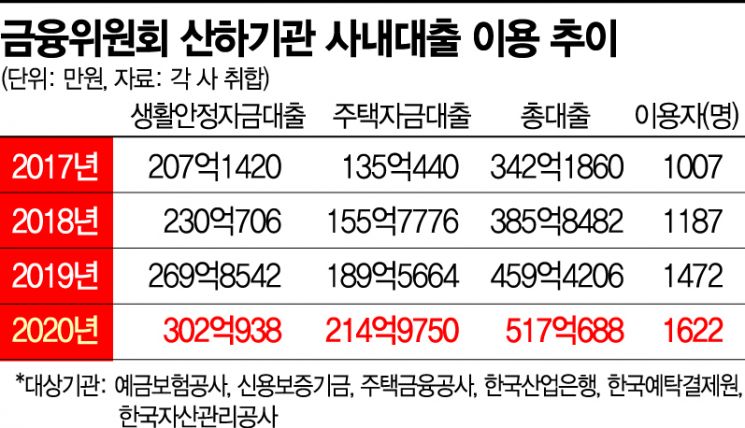
According to welfare expense data submitted on the 29th by six public enterprises under the Financial Services Commission (Deposit Insurance Corporation, Korea Credit Guarantee Fund, Korea Development Bank, Korea Asset Management Corporation (KAMCO), Korea Housing Finance Corporation, and Korea Securities Depository), 1,622 employees of financial public enterprises received a total of 51.7 billion KRW in in-house loans last year. This represents a 12.54% increase from the previous year (45.9 billion KRW) and more than a 50% increase compared to 2017, when 34.2 billion KRW was used.
By product, living stabilization funds amounted to 30.2 billion KRW, an increase of 3.2 billion KRW compared to the same period last year. The number of users also increased by 134 (11.54%) to a total of 1,295. For housing funds, 21.5 billion KRW was disbursed by the six companies, up 2.5 billion KRW from the previous year. Notably, the number of users increased significantly, with 327 employees receiving housing funds, more than four times the 64 users in 2017.
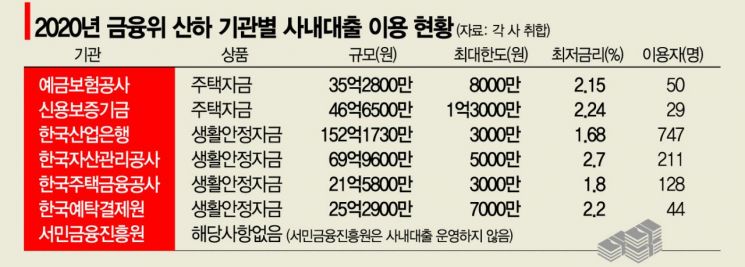
In-house loans increased sharply in companies that lowered interest rates. Korea Development Bank continuously reduced the interest rate on living stabilization fund loans provided to regular employees with more than six months of service. The rate dropped from 2.71% in 2018 to 1.68% at the end of last year. Benefiting from ultra-low interest rates, the number of users surged. The number of borrowers increased by 291 from the previous year to 747, and the loan amount rose by 4.5 billion KRW to 15.2 billion KRW.
The Deposit Insurance Corporation also lowered the interest rates on living and housing fund loans for employees with more than one year of service from 2.45% to 2.15% last year. Particularly, housing fund loans increased by 878 million KRW to 3.5 billion KRW. Considering the maximum housing loan limit of 80 million KRW and 50 users, most borrowers appear to have taken loans up to the maximum limit.
For the Korea Credit Guarantee Fund, when loan interest rates were between 2.41% and 3.41%, only nine employees with dependents used living stabilization fund loans, borrowing a total of 205 million KRW. However, as rates dropped to 2.24%-3.24% in the first half of last year and the minimum rate fell to 1.87% in the second half, the number of borrowers surged more than 14-fold to 129, with the loan amount soaring to 2.88 billion KRW.
The sharp increase in in-house loans by financial public enterprises runs counter to the Financial Services Commission’s efforts to limit total household loans. Early last year, the Commission introduced a new loan-to-deposit ratio calculation method to curb reckless household lending. Recently, it has pressured commercial banks to manage loans more strictly, tightening credit loans and extending restrictions to jeonse (long-term deposit lease) and mortgage loans. Since the ban on high-priced mortgage loans in 2019, a series of stringent housing-related regulations covering sales and jeonse have been implemented.
While Ordinary Citizens Face Tightened Access to Funds, Public Enterprise Employees Engage in Low-Interest 'Yeongkkeul'
As loan regulations have intensified under the pretext of financial difficulties faced by ordinary citizens due to COVID-19 and stabilizing the housing market, the access to funds for genuine borrowers has become increasingly restricted. This raises concerns that public enterprises in the public sector are enjoying privileges in their own 'exclusive league,' as seen in the speculative loan scandal involving employees of Korea Land & Housing Corporation (LH).
Last year, from February when the impact of COVID-19 became serious, large-scale financial support was mobilized across the financial sector, mostly targeting vulnerable groups such as self-employed individuals and ordinary citizens with weak financial capacity. Meanwhile, since September last year, financial authorities have started collecting credit loan growth management targets from major commercial banks, continuously pressuring them to curb lending.
A financial sector official said, "Due to soaring housing prices, young people are rushing to 'Yeongkkeul' (borrowing to the limit, even their soul) to buy homes, while self-employed and other ordinary citizens are knocking on the doors of banks and guarantee institutions to borrow even a few million KRW for living expenses," adding, "In a situation where financial difficulties for ordinary people have grown larger than ever, in-house loans by financial public enterprises may appear as 'privileged loans.'"
The controversy over 'preferential in-house welfare' by financial public enterprises is not new. In particular, there have been consistent criticisms that loan limit regulations applicable to all citizens do not apply to in-house loans at financial public enterprises, creating many loopholes. Avoiding the loan-to-value (LTV) ratio regulation under the guise of in-house welfare is a typical example.
For instance, KAMCO supports guaranteed loans separate from LTV regulations for employees without housing who have worked for more than two years. The Korea Credit Guarantee Fund allows loans up to 70% of the LTV limit regardless of whether the property is in a real estate regulation zone.
In last year’s National Assembly audit, Kang Min-guk, a member of the People Power Party, pointed out these facts and criticized, "Because employees can receive overlapping loans outside of bank loans, a 'regulatory safe zone' is created, which is unfair." Jeong Seong-ho of the Democratic Party also stated, "If public institution in-house loans are perceived as privileges contrary to public sentiment and government policy, they should be improved to a socially acceptable level."
Experts also agree that the current practice of in-house loans at financial public institutions is inappropriate. Professor Kim Sang-bong of Hansung University’s Department of Economics said, "It is not right for public institutions operated with taxpayers’ money to run in-house loans contrary to government policies," adding, "If these loans are used to circumvent government regulations on real estate speculation, it is even more problematic."
© The Asia Business Daily(www.asiae.co.kr). All rights reserved.


















