[Asia Economy Reporter Song Hwajeong] Concerns are growing that the suspension of navigation in the Suez Canal may be prolonged, drawing attention to its impact on shipping stocks.
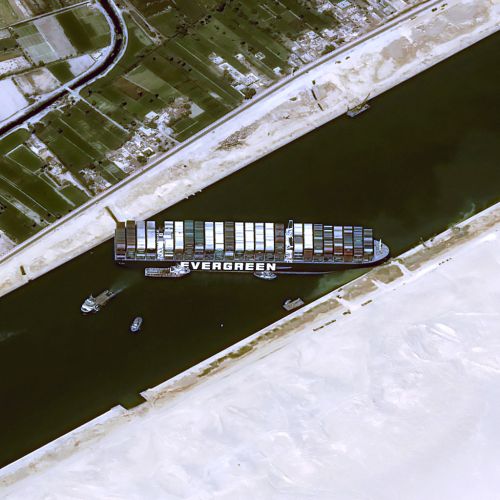
On the 23rd (local time), the ultra-large container ship Ever Given ran aground in the northern part of the Suez Canal, causing the canal to be blocked. The Ever Given, a 20,000 TEU (1 TEU equals one 20-foot container) class vessel, is believed to have deviated from its course due to sudden strong winds, collided with the bottom, and run aground. The timing of recovery is uncertain, raising concerns about a prolonged disruption. Choi Goun, a researcher at Korea Investment & Securities, stated, "The Suez Canal was used by more than 50 ships daily on average last year and handles 12% of global trade volume and 30% of container cargo volume, making it a crucial route. The suspension of navigation this time will inevitably have a significant impact on the global logistics market."
If this situation prolongs, another logistics crisis and sharp rise in freight rates are expected. The global shipping market has been experiencing a supply shortage for nearly half a year. Due to the logistics crisis caused by COVID-19, container shipping freight rates surged to record highs starting from November last year. According to Korea Investment & Securities, the Shanghai Containerized Freight Index (SCFI) doubled from November last year to January. Although it has recently adjusted, it remains close to three times the level of March last year. Researcher Choi said, "Currently, the container market is vulnerable to sudden variables that limit ship supply, and this Suez Canal accident literally blocked the route to Europe, which could trigger a logistics crisis even greater than now."
Demand for air cargo is also expected to increase. Eom Kyunga, a researcher at Shin Young Securities, said, "If the situation prolongs, ultra-large vessels that cannot use the canal will utilize the route around the Cape of Good Hope in South Africa. For urgent lightweight cargo, air cargo substitution can be considered, which will act as a positive factor in the air cargo transport market, where freight rates had not been rising further."
For shipping companies, the rise in freight rates is positive, but cost burdens are expected to increase. Jung Yeonseung, a researcher at NH Investment & Securities, said, "From the shipping companies' perspective, the rise in freight rates is positive, but cargo volume may decrease due to transport disruptions, and using detour routes (via the Cape of Good Hope) will increase sailing distances, leading to higher fuel costs."
There is an opinion that investment decisions on shipping stocks should be made while monitoring the progress of the Suez Canal issue. Researcher Choi explained, "Recently, shipping stocks have surged sharply, and concerns about short-term supply-demand burdens and momentum exhaustion have begun. It will not be too late to change investment decisions after observing how the Suez Canal issue unfolds."
© The Asia Business Daily(www.asiae.co.kr). All rights reserved.
![Clutching a Stolen Dior Bag, Saying "I Hate Being Poor but Real"... The Grotesque Con of a "Human Knockoff" [Slate]](https://cwcontent.asiae.co.kr/asiaresize/183/2026021902243444107_1771435474.jpg)















