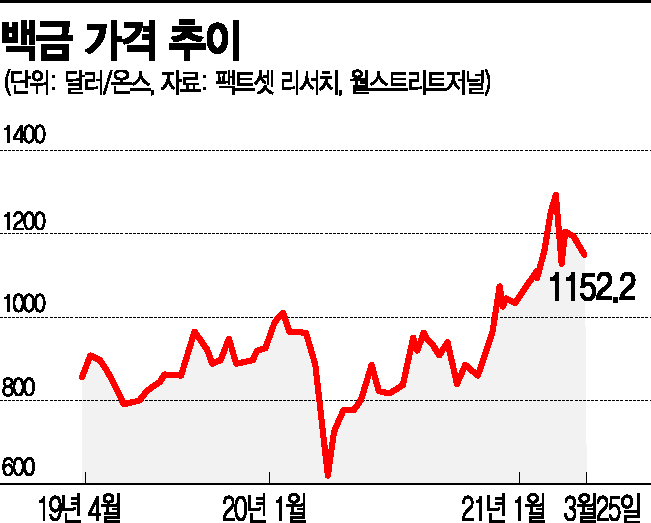
[Asia Economy Reporter Byunghee Park] Platinum prices are on the rise amid growing expectations for increased investment in hydrogen vehicles. According to the Wall Street Journal on the 25th (local time), platinum prices are trading at their highest levels in over six years.
At the beginning of last year, platinum prices exceeded $1,000 per ounce but fell to around $620 per ounce in March last year as COVID-19 spread. However, prices surpassed the $1,000 per ounce mark again earlier this year and surged to around $1,300 per ounce last month. Recently, they have been trading at about $1,150 per ounce.
As calls for global greenhouse gas reduction grow louder, platinum demand is expected to increase significantly if hydrogen vehicle adoption expands. While platinum is not used in electric vehicles like Tesla, it is an essential material for hydrogen fuel cell technology.
Compared to other metals, platinum can withstand higher temperatures and is used as a catalyst in fuel cells to separate hydrogen into protons and electrons. In diesel vehicles, platinum is used along with palladium and rhodium in catalytic converters to reduce toxic gas emissions. However, only platinum can be used as a catalyst in hydrogen vehicle fuel cells. Experts estimate that platinum demand for hydrogen vehicles will be more than four times that of diesel vehicles.
Natasha Viljoen, CEO of Anglo American Platinum, the world's largest platinum refiner, said, "We have significant expectations for the potential of the hydrogen economy," adding, "considerable support is being provided from both public and private sectors."
Plans for investment related to hydrogen vehicles are also being announced one after another. Last month, Japan's Toyota Motor announced the development of a fuel cell system applicable to trucks, buses, trains, ships, and generators. In December last year, Toyota released the second-generation Mirai hydrogen vehicle, six years after launching the first-generation Mirai in 2014.
In November last year, Hyundai Motor signed a memorandum of understanding with UK chemical company INEOS to mutually cooperate on hydrogen electric vehicle development and fuel cell system development. China plans to invest $2.5 billion over the next five years in hydrogen fuel cell technology development.
© The Asia Business Daily(www.asiae.co.kr). All rights reserved.
![Clutching a Stolen Dior Bag, Saying "I Hate Being Poor but Real"... The Grotesque Con of a "Human Knockoff" [Slate]](https://cwcontent.asiae.co.kr/asiaresize/183/2026021902243444107_1771435474.jpg)











