Dating Violence Occurs in 'Close Relationships'
Victims Often Settle Out of Fear of Perpetrator Retaliation
Need for Laws to Address the Specific Nature of Dating Violence
 Dating Violence/Photo by Getty Images Bank
[Asia Economy Reporter Joo-mi Lee] # In 2018, a man in his 30s living in Gwanak-gu, Seoul, murdered his partner. This man had already been investigated by the police four times for continuously assaulting his partner, Ms. A. He was also investigated a month before the murder for assaulting Ms. A and attempting to set fire to their home. The police applied for an arrest warrant for the man, but the court dismissed it, citing reasons such as the victim Ms. A not wanting to press charges. The man was released, and a month later, he stabbed Ms. A with a weapon.
Unlike general violence cases, dating violence occurs in intimate relationships such as between lovers. Even when victims are assaulted, they may be subjected to 'gaslighting' and may seek reconciliation or leniency. Gaslighting is a psychological term referring to a perpetrator's continuous psychological control that makes the victim unable to make rational judgments. In such cases, the perpetrator can continue to assault the victim, which can eventually lead to horrific murders.
Also, because the relationship is intimate, the perpetrator often knows a lot of personal information about the victim, such as their home address, making the victim afraid of retaliation and reluctant to report to the police. Because of this, there are calls for related legal reforms to effectively prevent dating violence and enhance the effectiveness of punishment.
One of the unique characteristics of dating violence that current law (criminal law) cannot address is the 'intimacy between the perpetrator and the victim.' As in the previous case, dating violence is generally prosecuted under assault charges unless in special circumstances. Assault is a 'quasi-offense' crime, meaning that if the victim does not want to press charges, prosecution cannot proceed. From the victim's perspective, because the relationship is intimate or romantic, it is difficult to demand strong punishment, and the released perpetrator may eventually commit even more horrific assaults or murders.
Another issue is that unlike general assault, dating violence involves close relationships where the perpetrator and victim are likely to know each other's homes, workplaces, etc. Because of this, victims often agree to settlements out of fear of retaliation. Ultimately, this leads to perpetrators and victims settling, preventing proper punishment.
An analysis by Jeju KBS of dating violence case verdicts in Jeju from 2016 to 2020 found that about half of the 31 cases involved victims settling with perpetrators. At the time, the director of the Jeju Women's Counseling Center pointed out that "(the perpetrator) knows all the personal information of the victim, causing fear of secondary (victimization)."
 A video captured on November 10, 2020, in Deokcheon Underground Shopping Center, Deokcheon-dong, Buk-gu, Busan, showing a young man kicking a woman who had collapsed. Photo by CCTV footage capture
Because of this, dating violence tends to be repeated against the same victim, accumulating assaults that can lead to greater tragedies such as murder. The 'Three Strikes Out' system for dating violence, introduced in 2018, is a measure to strengthen punishment considering the characteristics of dating violence.
The Three Strikes Out system processes cases on the principle of formal prosecution if the perpetrator commits dating violence against the same victim three or more times, regardless of whether the victim agrees to a settlement.
However, as long as dating violence continues to be handled under current law, there are concerns that the Three Strikes Out system also has limitations in punishment. At the time of its introduction, former Democratic Party lawmaker and former police academy professor Pyo Chang-won pointed out, "The Three Strikes Out system is inevitably a stopgap measure," adding, "Because assault charges must be applied under simple criminal law, there is a limit in that the first offense cannot result in detention or imprisonment due to fairness with similar crimes."
Because there is no separate law for dating violence, both punishment and prevention are difficult. For example, in cases of domestic violence between married couples, which is also an intimate relationship like dating violence, the Special Act on Domestic Violence allows for emergency temporary measures such as restraining orders against the perpetrator. The police can issue restraining orders if they judge there is a risk of recurrence of domestic violence.
However, the Special Act on Domestic Violence only applies to marital relationships and does not cover dating violence. Victims of dating violence can also apply for restraining orders, but since this requires a court decision, it takes at least two months, reducing the effectiveness of prevention.
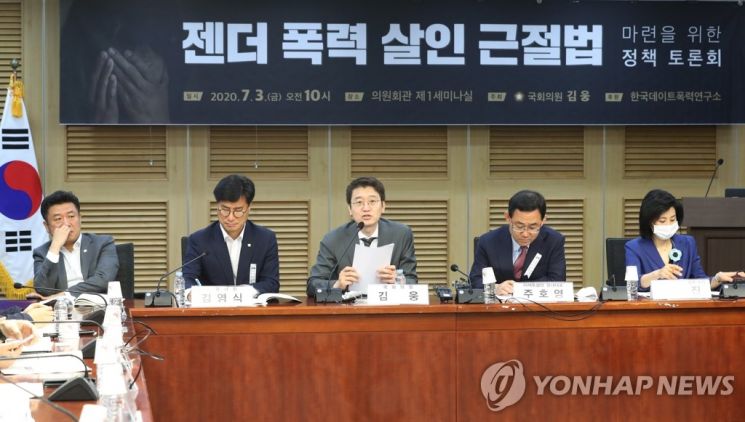 Policy forum held on July 3, 2020, to establish the 'Gender Violence Murder Eradication Act.'
 [Image source=Yonhap News]
At a 'Gender Violence Murder Eradication Law' forum held in July last year, Shim Jae-guk, representative lawyer of the law firm Daeryun, stated, "The unique characteristics of dating violence cannot be accommodated by existing criminal law and the Special Act on Sexual Violence," emphasizing, "Restraining order applications alone take at least two months, so the enactment of a separate law is urgent."
Because of this legal blind spot, victims who have already suffered are exposed to greater risks. In July 2020, Ms. B, who reported her boyfriend for forcing sexual relations and assault and broke up with him, became a victim of retaliatory crime. The perpetrator was taken into police custody but was released after a few hours, and a few days later, he went to Ms. B with a stun gun and a weapon and attacked her with the weapon.
At the time, the victim reportedly expressed frustration that the smart watch given by the police for personal protection was of no help. This highlights the need for effective systems to protect victims from perpetrators.
Experts also emphasize the need for systems that consider the characteristics of dating violence. Jeong Hye-won, head of the Women's Policy Research Team at the Gyeonggi Family and Women Research Institute, suggested, "Currently, the Special Act on Domestic Violence defines family very narrowly," adding, "The scope should be expanded to include dating relationships and lovers so that not only punishment but also victim support can be actively provided."
She also emphasized, "Although many dating violence cases occur, social policies and awareness regarding dating violence are still insufficient," and "Policies that can prevent dating violence from escalating into more serious crimes such as murder should be implemented in parallel."
© The Asia Business Daily(www.asiae.co.kr). All rights reserved.
![Clutching a Stolen Dior Bag, Saying "I Hate Being Poor but Real"... The Grotesque Con of a "Human Knockoff" [Slate]](https://cwcontent.asiae.co.kr/asiaresize/183/2026021902243444107_1771435474.jpg)

















