"Strengthening Eco-Friendly Technology Cooperation with China"
Former Largest Customer US Transforms into Competitor in Chinese Market
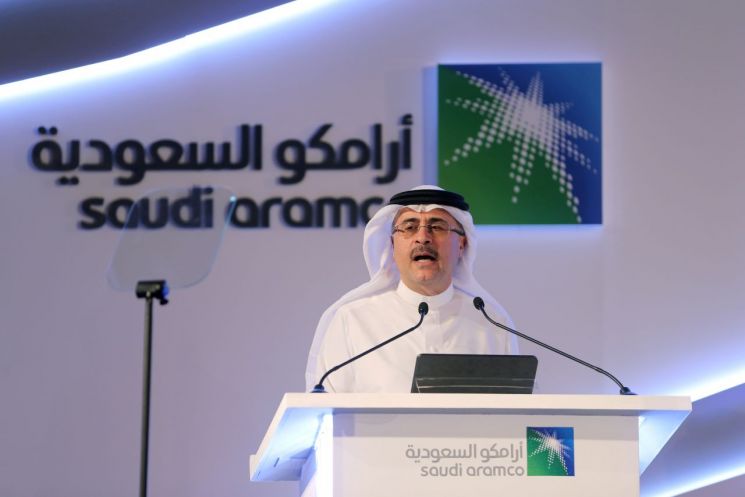
[Asia Economy Reporter Hyunwoo Lee] The CEO of Saudi Arabia's state-owned oil company and the world's largest oil producer, Aramco, announced that prioritizing oil exports to China will be their top focus moving forward. This statement is interpreted as a public demonstration of China's enhanced status in the Middle East. The United States, which was previously the largest customer in the Middle Eastern oil market, has transformed into a net oil exporter due to the surge in shale oil production, and now competes with Saudi Arabia for the Chinese oil export market.
According to foreign media including CNBC on the 21st (local time), Amin Nasser, CEO of Saudi Aramco, stated at the China Development Forum online video conference, "We will maintain energy supply to China as our top priority for the next 50 years," adding, "We will also strive to strengthen research cooperation with China on eco-friendly technologies such as hydrogen energy and carbon capture technology." This remark reemphasizes that China, not the United States, is Saudi Arabia's largest oil export customer, highlighting China's strengthened position in the Middle East.
Since 2015, the volume of Saudi oil imports by the U.S. and China has already reversed, but amid last year's COVID-19 pandemic and the surge in U.S. shale oil production, the import volumes of both sides have significantly diverged. China's daily Saudi oil imports increased by about 2% to 1.88 million barrels compared to the previous year, while U.S. imports dropped to 280,000 barrels in April last year, falling to half the 2019 level. The import volume gap between the two sides has widened to more than six times.
In fact, the U.S. has become one of Saudi Arabia's competitors in oil exports to China. The scale of U.S. oil exports to China doubled compared to previous years to about 380,000 barrels per day in 2019, following the U.S.-China trade agreement, and the share of U.S. oil in the Chinese oil market increased to around 7%. With expectations that China's imports of U.S. shale oil will further increase due to ongoing U.S.-China trade disputes, the U.S. is projected to become Saudi Arabia's biggest competitor rather than its customer.
Prior to the China Development Forum meeting, CEO Nasser emphasized at Aramco's earnings announcement that the surge in Asian imports still brightens the outlook for the oil market. He said, "Long-term strategies to optimize oil and gas sales are on track, and positive signals are emerging worldwide, including increased demand in Asia due to improvements in the macro environment," adding, "Especially, China’s oil demand has already recovered to a level very close to pre-COVID-19 demand."
At the earnings announcement, Aramco reported a net profit of $49 billion last year, a 44.4% decrease compared to $88.9 billion the previous year. However, the company announced it would maintain dividends at $75 billion, the same as the previous year, which caused the stock price to plunge.
© The Asia Business Daily(www.asiae.co.kr). All rights reserved.
![Clutching a Stolen Dior Bag, Saying "I Hate Being Poor but Real"... The Grotesque Con of a "Human Knockoff" [Slate]](https://cwcontent.asiae.co.kr/asiaresize/183/2026021902243444107_1771435474.jpg)















