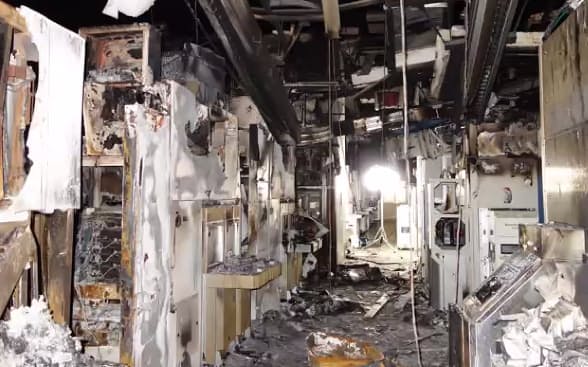
[Asia Economy Reporter Yujin Cho] A fire at a major production plant of Renesas Electronics, Japan's third-largest supplier of automotive semiconductors, has intensified the global semiconductor supply crisis. Following the Texas cold wave in the U.S. and drought in Taiwan, this fire incident has caused continued supply disruptions at key semiconductor production plants, suggesting a prolonged impact on the industry.
According to Bloomberg and Nihon Keizai Shimbun on the 21st (local time), Renesas Electronics held a press conference regarding the fire that occurred on the 19th at its main plant in Naka, Ibaraki Prefecture, stating that it will take at least a month to resume production at the plant. Renesas CEO Hidetoshi Shibata said, "We aim to resume within a month, but uncertainties remain," adding, "(This production halt) could have a significant impact on the global semiconductor supply shortage."
The plant where the fire occurred is a semiconductor wafer production line with a diameter of 300 nanometers (nm), and among the six plants in Japan equipped with this production line, Naka is the only one. Renesas, ranked third worldwide by sales, is a leading company in the microcontroller unit (MCU) sector, holding about a 20% market share in MCUs. Its major customers include Toyota and Nissan Motor.
The Renesas Naka plant affected by the fire also suspended operations for about three months during the 2011 Great East Japan Earthquake, significantly impacting automobile production. Nihon Keizai Shimbun referred to this incident as the "Renesas Shock," warning that if the production halt prolongs, the ongoing global shortage of automotive semiconductors will worsen further.
Senior researcher Sanshiro Fukao of the Itochu Research Institute pointed out, "This fire could affect the supply of automotive semiconductors for about six months." If it takes at least one month to resume production and three months to normalize supply, semiconductor supply disruptions could last up to six months.
A Honda Motor official stated, "It is currently difficult to assess the impact, but if the production halt exceeds one month, inventory will decrease, and the effect on vehicle production could continue beyond April." Toyota is currently assessing the impact, considering possible changes in production models or alternative production options.
The biggest cause of the global semiconductor supply chain crisis is attributed to increased demand. At the beginning of the COVID-19 pandemic, most automakers reduced parts orders to keep inventory low due to concerns about decreased consumption, while at the same time, there was a surge in demand for IT-related semiconductor products benefiting from COVID-19. Additionally, last month, the unusual cold wave in Texas halted semiconductor production at Samsung Electronics and Infineon plants in Austin, and drought caused production disruptions at Taiwan's TSMC, further exacerbating the supply chain crisis.
© The Asia Business Daily(www.asiae.co.kr). All rights reserved.
![Clutching a Stolen Dior Bag, Saying "I Hate Being Poor but Real"... The Grotesque Con of a "Human Knockoff" [Slate]](https://cwcontent.asiae.co.kr/asiaresize/183/2026021902243444107_1771435474.jpg)
















