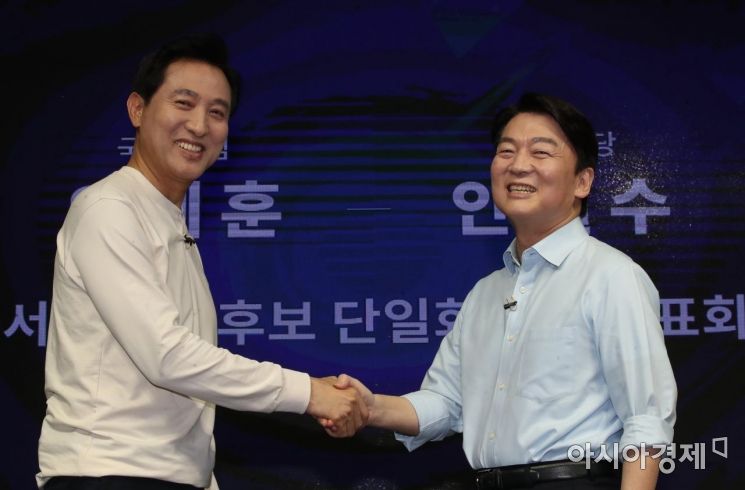
 Seoul mayoral candidates Oh Se-hoon of the People Power Party and Ahn Cheol-soo of the People Party attended the unification vision presentation held at The Plus Studio in Yeongdeungpo, Seoul, on the 15th, greeting each other. Photo by the National Assembly Press Photographers Group
[Asia Economy Reporter Kum Boryeong] As Oh Se-hoon of the People Power Party and Ahn Cheol-soo of the People’s Party have reached a final agreement on the opposition’s unification for the Seoul mayoral by-election, fierce exchanges between the ruling and opposition parties are underway. The ruling party criticized the two candidates’ unification as a 'political collusion,' while the opposition insisted, 'Do not belittle it.'
On the 21st, according to the People Power Party and the People’s Party, the working-level negotiation teams of both sides reached a final agreement on the polling method. Polls will be conducted starting from the 22nd, and the unified candidate is expected to be announced as early as the 23rd.
The Democratic Party criticized the opposition’s unification as 'political collusion.' On the same day, Heo Young, spokesperson for the Democratic Party’s Central Election Countermeasures Committee, stated, "Although it seems like a beautiful concession between the two, Seoul citizens were absent from the unification process. There was no verification of policies and visions, and it was a predictable political show and mere political collusion revealing their ambitions under the guise of concession."
Heo added, "I hope the two candidates reflect on why they ran for Seoul mayor. I hope they reconsider whether they have been consumed by the desire to elevate themselves rather than to elevate the citizens."
In response, Kim Cheol-geun, spokesperson for the People Power Party’s election committee, said, "The Democratic Party should not belittle the Oh Se-hoon?Ahn Cheol-soo unification effort. Historically, significant unifications in Korean politics have been led by the Democratic Party faction: Roh Moo-hyun?Chung Mong-joon in 2002, Yoo Si-min?Kim Jin-pyo in 2010, Park Won-soon?Park Young-sun?Choi Kyu-yeop in 2011, and Moon Jae-in?Ahn Cheol-soo in 2012," emphasizing this point.
Kim also said, "The unification agreed upon today between Oh Se-hoon and Ahn Cheol-soo is in response to the Seoul citizens’ wish and the people’s mandate to judge the Moon Jae-in administration and bring about a regime change starting from Seoul. Is the Democratic Party practicing 'double standards' even with unification? When we do it, it’s 'integration,' but when others do it, it’s 'political collusion'?"
Cho Su-jin, spokesperson for the election committee, said, "The so-called 'second victimization alliance' between Park Young-sun, the Democratic Party candidate, and Kim Jin-ae of the Open Democratic Party is political collusion. Park’s camp was activated by the 'three complainants'?Ko Min-jung, Nam In-soon, and Jin Sun-mi?and she became the party candidate by competing against those who claimed 'Woo Sang-ho is Park Won-soon, and Park Won-soon is Woo Sang-ho.' Later, she united with the ruling party’s secondary candidate who said 'Park Won-soon’s legacy is brilliant.' What else could this be if not 'political collusion'?"
The People’s Party also rebutted the Democratic Party. Ahn Hye-jin, spokesperson for the People’s Party, said, "I can’t help but laugh at the Democratic Party’s empty opposition bashing out of fear. They even call the unification agreement 'political collusion' and use childish, elementary-level rhetoric, while subtly poisoning the opposition as if the serious political decline has nothing to do with them."
Along with this, Ahn criticized, "A group accustomed to hiding their ambition under their nails and playing the victim with zero sincerity in political shows seems to believe that the only way to survive is to poke and twist their opponents to cover their own shame."
© The Asia Business Daily(www.asiae.co.kr). All rights reserved.
![Clutching a Stolen Dior Bag, Saying "I Hate Being Poor but Real"... The Grotesque Con of a "Human Knockoff" [Slate]](https://cwcontent.asiae.co.kr/asiaresize/183/2026021902243444107_1771435474.jpg)
















