Korea Economic Research Institute: "Careful Policies Needed to Minimize Damage to Diligent Workers"
[Asia Economy Reporter Kim Heung-soon] Amid the recent worsening economic situation, a private economic research institute has pointed out that factors making it difficult for diligent workers to live with hope are increasing.
The Korea Economic Research Institute (KERI), under the Federation of Korean Industries, on the 21st identified the five major factors burdening diligent workers as ▲living costs rising faster than wages ▲taxes increasing faster than income ▲expansion of unemployment benefits deficit ▲concerns over the depletion of the National Pension Fund ▲and the rapid rise in housing prices.
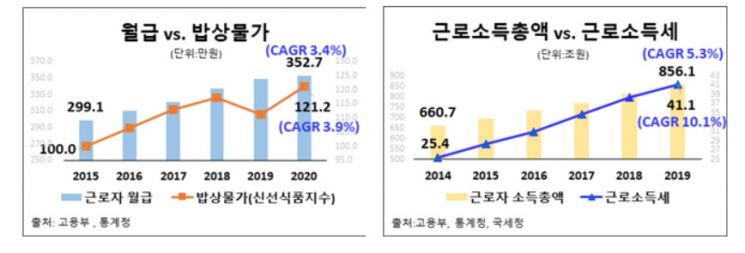
When worker wages rise 3.4%, food prices rise 3.9%
Analyzing data from the Ministry of Employment and Labor (Workforce Survey of Businesses) and Statistics Korea (Consumer Price Survey), KERI found that over the recent five years (2015?2020), workers’ monthly wages increased from 2,991,000 KRW in 2015 to 3,527,000 KRW in 2020, an average annual increase of 3.4%. In contrast, the fresh food index, considered the food prices for ordinary people, rose by a higher 3.9% during the same period.
Wages at businesses with fewer than 300 employees increased by 3.7% during the same period, while the wage increase at businesses with 300 or more employees was relatively lower at 1.6%. Regarding food prices, monthly inflation rates have surged this year, with last month’s consumer prices showing particularly large increases in green onions (227.5%), apples (55.2%), eggs (41.7%), red pepper powder (35.0%), pork (18.0%), and rice (12.9%). KERI pointed out, "If inflation concerns materialize due to rapid economic recovery from COVID-19 vaccine distribution and fiscal expansion in various countries, the burden on workers could increase further."
When total worker income rises 5.3%, earned income tax rises 10.1%
From 2014 to 2019, the determined amount of earned income tax (actual taxes paid) increased from 25.4 trillion KRW in 2014 to 41.1 trillion KRW in 2019, an average annual increase of 10.1%. This is nearly twice the rate of increase compared to workers’ income, which rose from 660.7 trillion KRW in 2014 to 856.1 trillion KRW in 2019, an average annual increase of 5.3%.
KERI evaluated that the government’s changes to the income tax base (maintaining the low-income bracket, increasing taxes on high-income brackets) partially influenced this. The tax bracket for incomes below 88 million KRW has been maintained since 2014, and considering a nominal income increase of 20.2%, this effectively means a tax increase for the middle class. For higher brackets, tax increases were implemented by establishing brackets at 150 million KRW, 300 million KRW, and 500 million KRW.
Expansion of unemployment benefits deficit... freeloading workers also contribute
The rapid deterioration of the unemployment benefits fund, which workers receive when involuntarily unemployed, is also a burden for diligent workers. The employment insurance fund’s unemployment benefits account has been in deficit since 2018 and has recorded deficits for three consecutive years. The deficit widened, reaching approximately 4.7 trillion KRW in 2020.
KERI pointed out that a considerable number of freeloading workers exploit loopholes in the unemployment benefits system to claim benefits. In fact, the number of job seekers who applied for unemployment benefits three or more times over five years increased sharply by 31.0%, from 60,642 in 2017 to 79,454 in 2020.
"Workers aged 32 and under may not receive a single penny from the National Pension"
Concerns about the financial soundness of the National Pension, which workers will receive after retirement, have also become a source of anxiety. The Ministry of Health and Welfare, the competent authority, projected in 2019 that the National Pension Fund would turn to deficit in 2042 and be depleted by 2057. However, the 2020 forecast by the National Assembly Budget Office advanced these dates to 2040 for deficit onset and 2054 for depletion.
Considering the average life expectancy of Koreans is 83.3 years, if the current system remains unchanged, National Pension subscribers aged 50 or younger will receive only partial pensions, and workers aged 32 or younger may not receive any pension at all. KERI pointed out that this situation inevitably leads workers to worry about increased future insurance premiums and reduced pension benefits.
"Saving up wages to buy a house?"
Housing price increase rate averages 7.4% annually... Seoul housing prices rose 12.9%
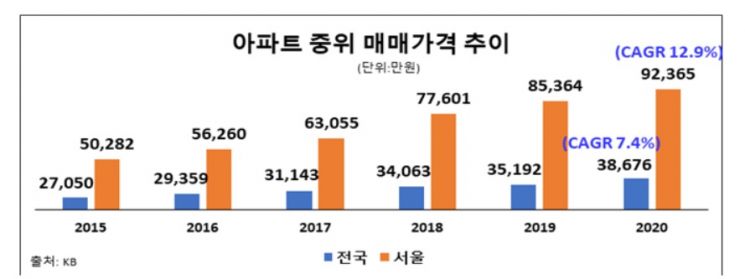
The housing price increase rate also far exceeded wage growth. According to KB Housing Price Trends, over the recent five years (2015?2020), the median apartment sale price nationwide rose by an average of 7.4% annually, with Seoul’s prices rising by 12.9% annually. KERI expressed concern about the decline in motivation among diligent workers without homes, stating, "To purchase a median-priced apartment in Seoul, a worker would have to save their entire monthly wage without spending a single penny for 21.8 years (based on the 2020 worker wage of 3,527,000 KRW)."
Choo Kwang-ho, head of KERI’s Economic Policy Office, emphasized, "Due to recent housing price increases and concerns over National Pension depletion, the burden on diligent workers is growing heavier. The government needs to approach policy implementation carefully to prevent a decline in workers’ motivation and minimize their hardships."
© The Asia Business Daily(www.asiae.co.kr). All rights reserved.
![Clutching a Stolen Dior Bag, Saying "I Hate Being Poor but Real"... The Grotesque Con of a "Human Knockoff" [Slate]](https://cwcontent.asiae.co.kr/asiaresize/183/2026021902243444107_1771435474.jpg)
















