37 Universities Recruit 1,743 Undergraduate Students
2023 Marks the Final Year for PEET
Pharmacy School Admission Competition Rate Unavoidably Increases
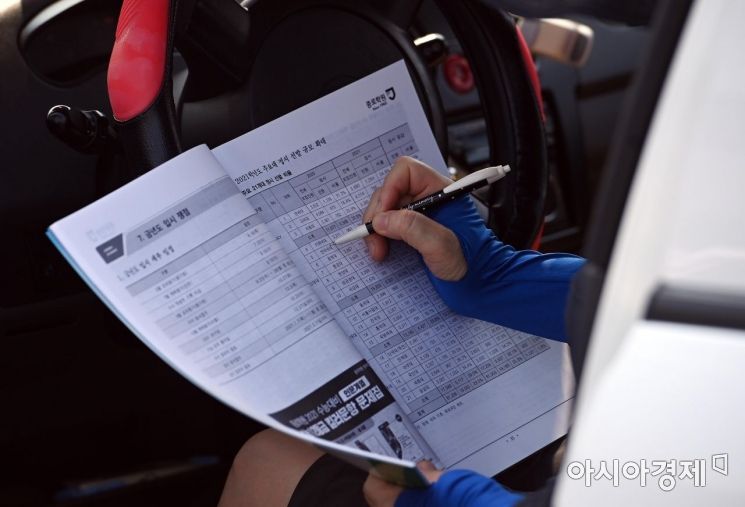 On June 21 last year, a parent participating in the 'Drive-Thru' college entrance briefing session hosted by Jongno Academy at a parking lot in Yangjae-dong, Seocho-gu, Seoul, is reviewing materials. Photo by Hyunmin Kim kimhyun81@
[Asia Economy Reporter Han Jinju] From the 2022 academic year, all pharmacy schools nationwide will switch to an integrated 6-year program. With even pharmacy school repeat applicants deciding that retaking the CSAT is better than taking the PEET (Pharmacy Education Eligibility Test), changes are expected in the competition rates for pharmacy school admissions next year.
According to university sources on the 20th, 37 universities nationwide will recruit 1,743 pharmacy undergraduates in the 2022 academic year. After April, Sookmyung Women’s University, Mokpo National University, Kangwon National University, Chungnam National University, and Pusan National University announced plans to switch to the integrated 6-year system one after another.
PEET will disappear after 2023. Students who entered pharmacy schools last year and this year must take PEET. For the 2022 and 2023 academic years, pharmacy school admissions will temporarily conduct both undergraduate and transfer admissions simultaneously. The undergraduate recruitment is 1,743 students, and the transfer recruitment is 1,753 students.
Examinees view that it is better to retake the exam and enter the 6-year program rather than take PEET. The PEET exam subjects include Chemical Reasoning (General and Organic Chemistry), Physical Reasoning, and Biological Reasoning, and admission decisions are made by combining scores from these subjects with official English test scores, previous university grades, and interview scores.
Lee Manki, director of Uway Education Evaluation Research Institute, explained, "The PEET competition rate is about 8:1, but it is becoming increasingly difficult, and the acceptance rate of prestigious university graduates is high. The cutoff score is 70, but you need to score above 85 to be admitted. Although becoming a pharmacist is the same, since PEET may disappear after next year, there is a preference for the 6-year pharmacy program."
Looking at Pharmacy School Admission Quotas by University
For the 2022 academic year, early admission accounts for 841 students (54.2%), slightly more than regular admission with 712 students (45.8%). The quotas by university are ▲Seoul National University (63 students) ▲Chung-Ang University (120 students) ▲Ewha Womans University (120 students) ▲Sungkyunkwan University (65 students) ▲Yonsei University (30 students) ▲Korea University (Sejong, 30 students) ▲Kyung Hee University (40 students) ▲Sookmyung Women’s University (80 students). Additionally, the four universities that recently finalized plans for the integrated 6-year program have quotas of ▲Mokpo National University (30 students) ▲Kangwon National University (50 students) ▲Chungnam National University (50 students) ▲Pusan National University (60 students), but detailed selection plans have not been announced.
Based on 33 universities that announced their quotas, early admission types include 48.9% (411 students) for student record-based curriculum screening, 44.7% (361 students) for comprehensive student record screening, and 6.4% (54 students) for essay screening. For regular admission, 16 universities including Chung-Ang University recruit 323 students in Group A (45.4% of regular admissions), 12 universities including Seoul National University recruit 329 students in Group B (46.0%), and 6 universities including Ajou University recruit 60 students in Group C (8.4%). Keimyung University recruits 5 students for the pharmaceutical department in Group A and 5 students for the pharmacy department in Group C.
From the 2023 academic year, local medical and pharmacy schools must mandatorily select local talents. In the 2022 academic year, 15 universities will recruit 205 students, about 13% of the total quota, as local talents. Universities located in provincial areas recruit more than 30% of their total quota as local talents (graduates from high schools in the university’s regional jurisdiction). Last month, the 'Local Balanced Talent Development Act' was passed in the National Assembly, strengthening the criteria for local talents. From the 2028 academic year, students who graduate from middle schools outside the metropolitan area and high schools in the university’s regional jurisdiction, and who have resided in the jurisdiction during their school years, will be selected as local talents.
Check Pharmacy School CSAT Minimum Academic Requirements and Subject Choices
For early admission, the CSAT minimum academic requirement for Seoul National University’s regional balanced selection is within grade 2 in at least 3 subjects, and Chung-Ang University’s student record curriculum and essay screening require a total grade of 5 or less across 4 subjects. Gachon University, Catholic University, Kyungpook National University, Kyungsung University, Keimyung University, Korea University (Sejong), Samyook University, Ewha Womans University, and Hanyang University (ERICA) require a total grade of 5 or less across 3 subjects.
For regular admission, most of the 33 universities specify Calculus/Geometry and Science Inquiry as the required subjects. This includes 30 universities such as Seoul National University, Chung-Ang University, Ewha Womans University, and Sungkyunkwan University. Gyeongsang National University and Korea University (Sejong) do not restrict math subject choices but specify science inquiry subjects only. Samyook University and Ewha Womans University (20 students for integrated humanities and natural sciences selection) have no specified subject choices for math or science inquiry. Regarding the number of science inquiry subjects reflected, Daegu Catholic University and Samyook University reflect one subject, while the other 31 universities reflect two subjects.
Woo Yeoncheol, director of Jinhaksa Admission Strategy Research Institute, advised, "The most important factor to challenge pharmacy schools is the CSAT. Although early admission recruits more students, most early admissions set high CSAT minimum academic requirements, so you should not neglect CSAT preparation."
Meanwhile, some universities distinguish between the Department of Pharmacy and the Department of Pharmaceutical Sciences, but there is no difference between the two departments. The same curriculum is offered, and graduates from both departments are qualified to obtain a pharmacist license. Ewha Womans University recruits separately for Pharmacy Major and Future Industrial Pharmacy Major. The latter takes courses related to management, psychology, and marketing in addition to pharmacy major courses, and humanities students can also apply.
Oh Jongwoon, evaluation director at Jongro Academy Haneul Education, explained, "To enter major metropolitan area pharmacy schools through regular admission, you need to be within the top 2.0% in the natural sciences track (science inquiry selection criteria), and even for provincial pharmacy schools, generally within the top 3.0% cumulative ranking is required for admission. Although lower than medical and dental schools, the acceptance line is expected to be maintained at the level of Korean medicine and veterinary schools."
© The Asia Business Daily(www.asiae.co.kr). All rights reserved.

![User Who Sold Erroneously Deposited Bitcoins to Repay Debt and Fund Entertainment... What Did the Supreme Court Decide in 2021? [Legal Issue Check]](https://cwcontent.asiae.co.kr/asiaresize/183/2026020910431234020_1770601391.png)














