Representative Kang Byung-won Introduces Amendment... Higher Sugar Content Means Higher Charges
Food and Beverage Industry: "Labeling Ingredients as Luxury Goods Makes Price Increases Inevitable"
[Asia Economy Reporter Lim Hye-seon] As the National Assembly moves to introduce a ‘sugar tax,’ the food and beverage industry is expressing concerns. They argue that it could narrow consumers' choices and stigmatize ingredients (raw materials) as luxury items.
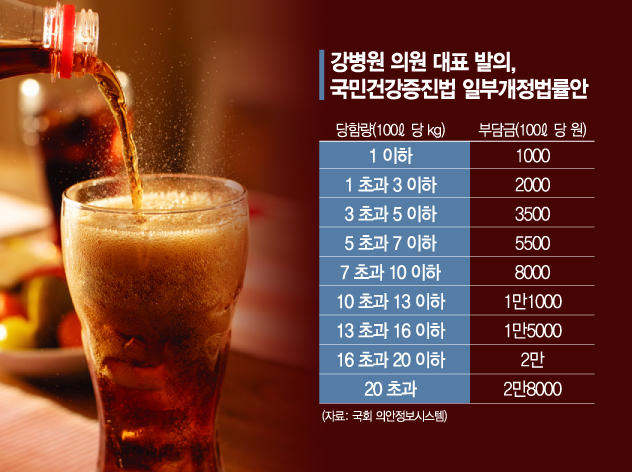
◇If it's made sweet, you have to pay tax= According to the National Assembly’s legislative information system on the 19th, Kang Byung-won, a member of the Democratic Party of Korea, officially proposed the ‘Partial Amendment to the National Health Promotion Act’ last month on the 26th. The bill imposes a National Health Promotion Levy on companies that manufacture and distribute sweetened beverages.
If the sugar content is 10-13 kg per 100 liters, the levy is 11,000 KRW per 100g; if 16-20 kg, 20,000 KRW; and if exceeding 20 kg, 28,000 KRW. The higher the sugar content, the greater the levy. For example, a 250 ml Coca-Cola product contains 27g of sugar per can. 400 cans (100 liters) contain 10.8 kg of sugar. Converted, this means an additional tax of 27 KRW per can.
Rep. Kang explained, "According to data from the Ministry of Food and Drug Safety, when sugar intake from processed foods exceeds 10% of total daily calorie intake, the risk of obesity increases by 39%, hypertension by 66%, and diabetes by 41% compared to those who do not exceed this level." He added, "The World Health Organization (WHO) has recommended in its report that excessive sugar intake is a major cause of obesity, diabetes, and tooth decay, and that fiscal policies such as subsidies should be considered to promote the consumption of healthy foods and beverages." The sugar tax has already been introduced in over 40 countries including Norway, the United Kingdom, France, Finland, Thailand, and Malaysia.
◇Food and beverage industry: "Treating sugar like tobacco"= While agreeing with the intent, the food and beverage industry feels that regulating raw material usage by law is excessive. The industry has already been making efforts to practice ‘low salt and low sugar’ by releasing unsweetened products such as ‘Zero Cola’ and ‘Zero Cider’ across the sector.
An industry official said, "If all food and beverages are regulated by a uniform standard, it could deprive consumers of diverse choices," expressing concern that "if the sugar tax is introduced, fundamental recipes may need to be changed to maintain the current taste." The official explained that price increases are inevitable during the recipe change process, but it is questionable whether consumers will tolerate this.
Another concern is the side effect of stigmatizing ingredients as luxury items. Under current law, the National Health Promotion Levy is only imposed on tobacco. Sugar is a necessary raw material for food production. An industry representative argued, "Applying the National Health Promotion Levy to sugar simply because ‘sugar is harmful to the body’ is inappropriate, just like tobacco." They claimed, "If the amendment passes, sugar will be reduced to a luxury item that costs more to consume."
◇Voices against excessive government market intervention= Some voices suggest that after the sugar tax, a ‘salt tax’ might also be introduced. Since the rationale for the sugar tax is to curb excessive sugar intake and promote public health, sodium could also become a taxable target. In fact, Thailand is currently pushing for a salt tax on salty and fatty foods following the introduction of the sugar tax in 2017. Although collection was scheduled to start this year, the timing was postponed due to economic difficulties following COVID-19.
Song Min-kyung, a legislative researcher at the National Assembly Research Service, pointed out in a research report titled ‘Trends and Analysis of Foreign Legislation’ published in February last year, "There is sharp controversy over the effectiveness of the sugar tax," and emphasized, "When considering the introduction of a sugar tax, it is necessary to go through a sufficient process of gathering opinions from stakeholders, experts, and the public to build consensus on the purpose of the sugar tax and to reach social agreement on how to use the fiscal revenue."
© The Asia Business Daily(www.asiae.co.kr). All rights reserved.