[Asia Economy Reporter Jeong Hyunjin] Korean women in their 30s and 40s experience career interruptions more frequently compared to major countries such as the United States, Japan, the United Kingdom, Germany, and France, leading to calls for the establishment of a flexible working environment to address this issue.
On the 18th, the Korea Economic Research Institute (KERI), under the Federation of Korean Industries, reported that an analysis of the Organization for Economic Cooperation and Development (OECD) female employment indicators showed that as of 2019, the economic activity participation rate and employment rate of Korean women were 60.0% and 57.8%, respectively, ranking 33rd and 31st out of 37 OECD countries, placing Korea in the lower tier.
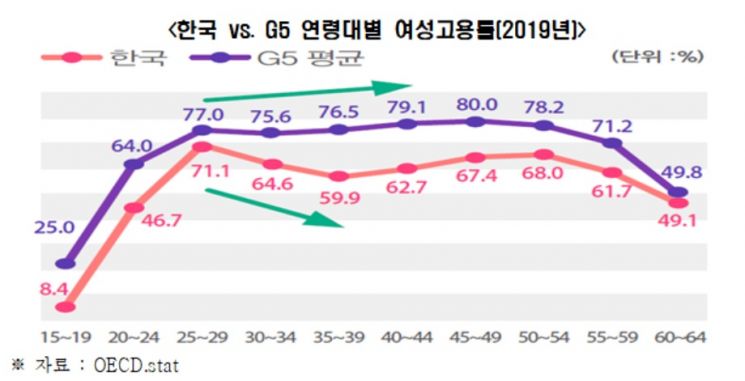
KERI analyzed that the graph of Korea’s female employment rate shows an M-shaped curve, increasing until the 20s, sharply decreasing in the 30s, recovering in the late 40s, and then declining again after the 50s. KERI evaluated that in the case of the five major countries (G5), female employment rates increased from the 20s to 40s and then decreased in the 50s, showing a difference from Korea.
According to KERI’s age-group analysis, Korea’s female employment rate was highest at 71.1% for ages 25?29, then dropped to 64.6% for ages 30?34, and further to 59.9% for ages 35?39. Consequently, the gap in female employment rates between Korea and the G5 widened from 5.9 percentage points at ages 25?29 to 11.0 percentage points at ages 30?34, and 16.6 percentage points at ages 35?39. KERI analyzed that "if Korea’s female employment rate in their 30s were maintained at the 25?29 age level in 2019, it would prevent the loss of 318,000 jobs."
Women with children under 15 years old found it more difficult to be employed in Korea compared to the G5 countries. The employment rate of Korean women with children under 15 was 57.0% in 2019, which was 15.2 percentage points lower than the G5 average. It was also 13.0 percentage points lower than the United States, which had the lowest female employment rate among the G5 at 70.0%.
Regarding reasons why Korean women do not participate in economic activities, 65.0% cited childcare and household burdens. KERI assessed that "in Korea, career interruptions occur as women are pushed out of the labor market due to childcare and household responsibilities." KERI viewed Korea’s female employment as insufficient compared to the G5 in two aspects: "creating a flexible working environment" and "supporting female economic activities."
KERI pointed out the importance of establishing a flexible working environment, such as part-time employment or extending the settlement period for selective working hours systems. The proportion of female part-time employment among total workers in the G5 countries averaged 14.9% in 2019, which was 1.7 times higher than Korea’s 8.9%. Regarding the settlement period for selective working hours systems, which guarantee autonomy in adjusting working hours, all G5 countries except Japan, which limits it to three months, allow the period to be decided by labor-management agreement without restrictions. In contrast, Korea imposes a one-month limit on all jobs except research and development (R&D), which can have up to a three-month period, KERI explained.
Korea’s female economic activity index was also ranked 32nd out of 33 OECD countries, placing it near the bottom. The proportion of public expenditure related to maternity protection relative to gross domestic product (GDP) was 0.4% in Korea, significantly lower than the G5 average of 1.5%. Korea’s gender wage gap was 32.5%, about twice the G5 average of 17.0%.
Choo Kwang-ho, Director of Economic Policy at KERI, said, "In light of the cases of G5 countries, to prevent career interruptions among women, it is particularly necessary to focus on creating a flexible working environment such as promoting part-time work, along with support measures like expanding childcare facilities and activating parental leave."
© The Asia Business Daily(www.asiae.co.kr). All rights reserved.
![Clutching a Stolen Dior Bag, Saying "I Hate Being Poor but Real"... The Grotesque Con of a "Human Knockoff" [Slate]](https://cwcontent.asiae.co.kr/asiaresize/183/2026021902243444107_1771435474.jpg)















