Gwangju Institute of Science and Technology, Completes Development of Related RGB-D Single Sensor on the 17th
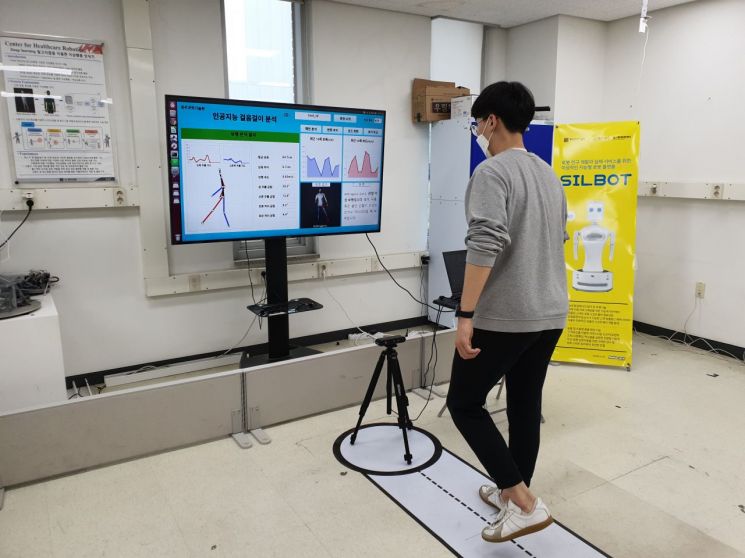
[Asia Economy Reporter Kim Bong-su] An AI-based gait analysis system has been developed that enables elderly individuals who have lost their sense of balance due to dementia or various diseases to walk safely on uneven or pothole-ridden roads.
Gwangju Institute of Science and Technology (GIST) announced on the 17th that a research team led by Professor Kim Moon-sang of the Healthcare Robot Center (School of Convergence Technology) successfully developed this AI-based gait analysis system.
This system uses an RGB-D sensor that emits infrared beams and obtains depth information of the subject by measuring the time it takes for the beams to reflect back. It overcomes the drawbacks of existing shoe sensors, floor pressure sensors, or motion capture systems in terms of cost and accuracy.
The developed AI technology can accurately predict the classification of disease causes and the long-term progression of diseases, and especially can preemptively predict the risk of falls, which is a major concern for the elderly.
The research team achieved over 95% classification accuracy for six types of pathological gait through deep learning-based big data analysis by inputting the acquired 3D skeletal information into a Recurrent Neural Networks algorithm. It was developed as a cutting-edge system that can also be attached to intelligent robots for autonomous service by robots.
While the subject walks naturally along a predetermined path, the RGB-D sensor precisely measures the movements of all parts of the body.
As a result, the research team succeeded in commercializing the system by ultimately replacing the existing system, which used six RGB-D sensors installed and operated at the Gwangju Senior-Friendly Center, with a single sensor through this research.
Since March of this year, the research team has installed this system at Busan Kosin University Hospital and plans to analyze empirical data collected from more than 200 patients with vestibular disorders and orthopedic patients over the next three months. After completion, the technology will be transferred to related companies.
Professor Kim Moon-sang of GIST expressed his thoughts, saying, “We want to contribute to the healthcare R&D sector within the AI industrial complex construction project promoted by Gwangju City by additionally installing the system in local and other regional hospitals.”
This research outcome is the result of a four-year project funded by the Ministry of Trade, Industry and Energy titled ‘Development of Robot Technology for Emotional and Behavioral Stability and Cognitive Function Improvement of Patients with Mild Cognitive Impairment and Dementia.’ Domestic and PCT patents were filed in 2020, and two related SCI papers have been published.
© The Asia Business Daily(www.asiae.co.kr). All rights reserved.