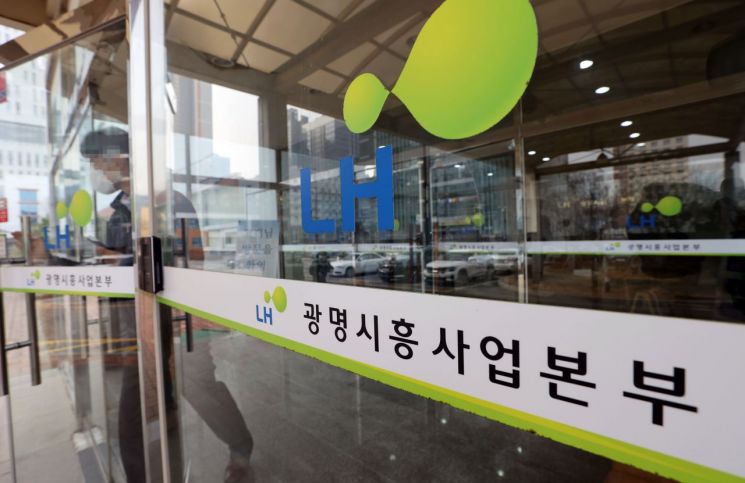
 Gyeonggi Gwangmyeong Korea Land and Housing Corporation (LH) Gwangmyeong Siheung Project Headquarters (Photo by Yonhap News)
[Asia Economy Reporter Kwangho Lee] The financial authorities are expected to include measures to strengthen regulations on non-residential mortgage loans in the "Household Debt Management Plan" to be announced this month. Currently, public anger is spreading like wildfire due to suspicions of land speculation using non-residential mortgage loans by some employees of Korea Land and Housing Corporation (LH), drawing attention to the level of regulatory tightening.
According to the financial authorities on the 14th, the Financial Services Commission and the Financial Supervisory Service are focusing on targeted measures rather than a comprehensive crackdown and are reviewing ways to block blind spots.
The loan-to-value ratio (LTV) recognized as collateral for non-residential mortgage loans from mutual finance institutions such as NongHyup, where LH employees received loans, is between 40% and 70%. This is based on administrative guidance rather than legal regulation.
Commercial banks apply an LTV of around 60% through internal regulations, and their loan screening is considered relatively stringent.
Commercial banks execute loans applying an LTV of 60% through internal regulations, and in some areas, they lend up to 80%, but loan screening is strict as the debt service ratio (DSR) must be considered.
The financial authorities' decision to focus on targeted regulations rather than a broad crackdown is interpreted as a judgment that the scale of non-residential mortgage loans across the entire financial sector has steadily remained at around 220 to 230 trillion won over the past five years, with no signs of price instability.
For now, employees from the Financial Services Commission and the Financial Supervisory Service will be dispatched to the government joint special investigation headquarters to examine whether there were any issues in the loan process involving LH employees.
A financial authority official said, "We are monitoring the LH situation, and if additional problems are revealed, we will consider establishing a legal basis for regulating non-residential mortgage loans."
Financial Services Commission Chairman Eun Sung-soo hinted at the need to strengthen regulations on land-backed loans during a meeting with reporters on the 11th, stating, "We consider this a serious situation."
Chairman Eun said, "Regarding real estate loan regulations, attention has been focused only on housing, with less interest in the secondary financial sector and land sector," adding, "In light of the LH incident, there are calls for regulations related to land loans, so we will look into it."
On the 12th, Deputy Prime Minister and Minister of Economy and Finance Hong Nam-ki emphasized at the 'Real Estate Inspection Ministers' Meeting' that "The LH speculation case was possible because large-scale loans were concentrated collectively at specific bank branches," and stressed the need to check "whether there were any illegal, unfair, or negligent acts during the loan process, and whether there are any blind spots or points needing improvement." He also ordered, "Supervisory agencies such as the Financial Supervisory Service should thoroughly investigate the processes during the loan procedures."
© The Asia Business Daily(www.asiae.co.kr). All rights reserved.
![Clutching a Stolen Dior Bag, Saying "I Hate Being Poor but Real"... The Grotesque Con of a "Human Knockoff" [Slate]](https://cwcontent.asiae.co.kr/asiaresize/183/2026021902243444107_1771435474.jpg)
















