31 Girls' Middle and High Schools in Seoul Regulate 'Underwear' by School Rules
Plain White Underwear Required, Lace Underwear Banned... Penalties for Violations
Netizens Criticize: 'Not Japan, but Seoul?', 'Ridiculous and Pitiful'
Experts: "Outdated Rules Violating Human Rights... Need to Consider Students' Welfare"
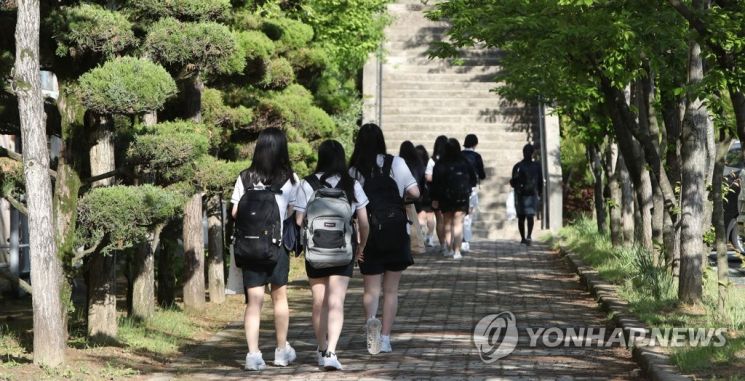 On the 20th of last year, senior high school students at a girls' high school were seen going to school wearing short-sleeved summer uniforms. The photo is not directly related to the article. Photo by Yonhap News
[Asia Economy Reporter Kim Young-eun] Recently, it has been revealed that about 30 girls' middle and high schools in Seoul regulate the wearing, color, and patterns of girls' underwear through school rules, raising ongoing concerns about excessive human rights violations.
According to the office of Moon Jang-gil, Vice Chairman of the Seoul Metropolitan Council's Urban Safety and Construction Committee, a review of school rules in girls' middle and high schools within Seoul showed that among 44 middle schools, 9 schools (20.5%), and among 85 high schools, 22 schools (25.9%) regulate the wearing, color, pattern, and transparency of underwear.
Among these 31 schools, some specify detailed underwear regulations in their school rules, such as "Under the summer uniform blouse, wear plain white underwear without patterns," "Any underwear other than plain white is subject to penalty points," "Wear white or skin-tone underwear that is not visible outside the blouse under the summer uniform top," and "Wearing fancy underwear with lace is prohibited."
Additionally, it was found that some school rules impose penalty points for violating the prescribed underwear regulations.
Such dress code regulations in Seoul's middle and high schools appear to stem from Article 12, Paragraph 2 of the Seoul Student Human Rights Ordinance enacted in 2012, which states that "dress may be restricted by school rules." However, these underwear regulations conflict with the provision that "appearance, including dress and hair, shall not be regulated against the student's will."
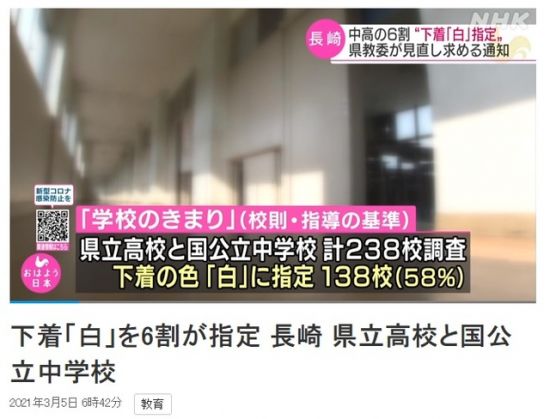 On the 5th, NHK reported that about 60% of public middle and high schools in Nagasaki Prefecture, Japan, designate white as the color for students' underwear, causing controversy. Photo by NHK website capture.
The controversy over students' underwear regulations is also occurring in Japan. According to NHK broadcast on the 5th, among 238 national and public middle and high schools in Nagasaki Prefecture, 138 schools (58%) designate students' underwear color as white and monitor underwear color.
In some schools in Nagasaki Prefecture, actual inspections of underwear have taken place. According to the Yomiuri Shimbun in December last year, in Fukuoka as well, 57 out of 69 middle schools (83%) designate underwear colors such as white.
Following the Japanese cases, when it became known that similar underwear regulations exist in Korean middle and high schools, criticism arose labeling them as "anachronistic ideas." Netizens on online communities responded with comments such as "absurd and strange," "not something to criticize Japan for," and "is it necessary to regulate underwear color and patterns?" They pointed out that these are "remnants of Japan" and represent "excessive human rights violations" against students.
A 24-year-old university student, A, said, "I was shocked to hear about underwear regulations in Japan, but learning that such provisions exist in Seoul, not Japan, is even more shocking. It's unreasonable to regulate underwear, not just school uniforms. I don't know what kind of world we live in."
Experts call these regulations anachronistic and potentially infringing on students' human rights, urging a revision of the rules and more thoughtful consideration for proper youth human rights protection.
Jo Jin-kyung, head of the Teenage Women's Human Rights Center, told Asia Economy in a phone interview, "It's not the early 1900s but the 2020s, and having such regulations is anachronistic. I cannot understand why current educational settings regulate students' private and personal areas through school rules."
Jo added, "Having such regulations in Korea seems somewhat disconnected from the concept of civil society. I hope related regulations are promptly revised and reorganized through more consideration so that schools can properly protect students."
She continued, "Human rights protection means nurturing and safeguarding individuals without objectifying them, allowing them to grow and take responsibility. I hope educational institutions refrain from various regulations that ignore students' autonomy and human rights."
Meanwhile, the Seoul Metropolitan Council deleted the clause restricting school rules on dress in the student human rights ordinance amendment submitted at the 299th extraordinary session plenary meeting held on the 5th. Previously, the "Seoul Student Human Rights Ordinance" stipulated that appearance, including dress and hair, should not be regulated against the student's will, but dress could be restricted by school rules. The amendment completely removed the clause allowing dress restrictions by school rules.
Moon Jang-gil, Vice Chairman of the Seoul Metropolitan Council's Urban Safety and Construction Committee and the bill's proposer, criticized, "It is unbelievable that school rules that should not exist in an era where human rights are paramount are still in operation. Regulating underwear, socks, and stockings' colors and patterns beyond uniform restrictions in some schools is an excessive violation of student human rights."
Accordingly, the Seoul Metropolitan Office of Education plans to officially request schools to revise school rules that impose dress restrictions by sending the amended student human rights ordinance to each school.
© The Asia Business Daily(www.asiae.co.kr). All rights reserved.



















