"Utilizing 659.2 Billion Won from Employment Insurance Fund... Strong Social Insurance Nature Requires Soundness Management"
Rising Government Bond Yield Pressure... Need to Set Interest Payment Period
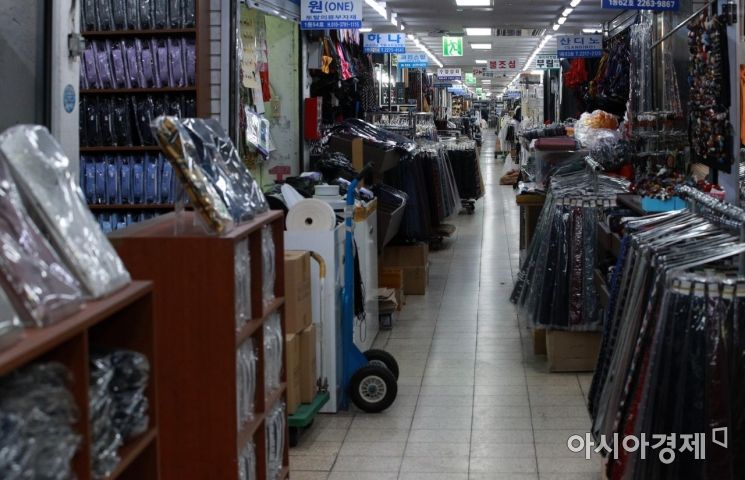 The scene of Dongdaemun Fashion Town shopping district in Seoul, which has been experiencing a recession due to the prolonged impact of COVID-19, on the 19th of last month. Due to the effects of COVID-19, Dongdaemun shopping district, symbolized by fashion accessories, is also becoming vacant. According to the Shopping Mall Information Research Institute, the vacancy rate of medium to large-sized stores in the Dongdaemun commercial area was 10.8% in the second quarter of last year. The vacancy rate in the Dongdaemun commercial area has been continuously rising since the second quarter. Photo by Hyunmin Kim kimhyun81@
[Sejong=Asia Economy reporters Kim Hyunjung and Moon Chaeseok] There has been a call for caution in using the Employment Insurance Fund, which has a strong social insurance nature, as a source for the government's 4th disaster relief fund. Considering recent trends such as the rise in government bond yields, opinions have also been raised that a review of the appropriateness of interest repayment is necessary. The government has decided to raise about 1.7 trillion won from various funds to provide disaster relief payments, which is expected to become a contentious issue during the National Assembly's supplementary budget (supplementary budget) discussions.
On the 8th, the National Assembly Budget Office stated in its report "Analysis of the 1st Supplementary Budget for 2021" that "attention is needed in managing the soundness of the Employment Insurance Fund's finances." The government plans to utilize various funds (1.6795 trillion won) as the source for the 4th disaster relief fund (1st supplementary budget) in response to COVID-19, of which 659.2 billion won will come from the Employment Insurance Fund. The Housing and Urban Fund (1 trillion won), National Property Management Fund (75 billion won), Industrial Accident Compensation and Prevention Fund (70 billion won), and Disabled Employment Promotion and Vocational Rehabilitation Fund (50 billion won) will be raised by depositing surplus funds into the Public Fund Management Fund, while the Employment Insurance Fund will execute supplementary budget projects using its own resources.
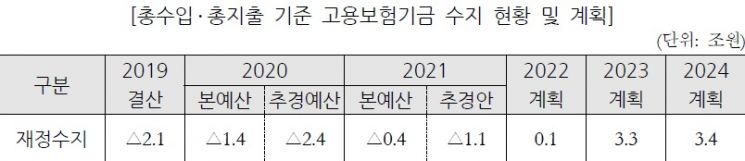
The problem is that unlike other business-type funds, the Employment Insurance Fund is a reserve fund that must be spent on future benefits (insurance payments). The Budget Office pointed out that although the Employment Insurance Fund's financial balance turned to a deficit based on total income and total expenditure from the 2018 settlement, it has been used as supplementary budget resources every year: 220.2 billion won in 2017, 312.6 billion won in 2018, 1.2923 trillion won in 2019, and 1.4752 trillion won in 2020. The Budget Office emphasized, "Considering that the fund was in a deficit of 400 billion won based on the 2021 main budget and that the deficit is expected to increase to 1.1 trillion won with the 1st supplementary budget, caution is needed in managing the financial soundness of the fund."
Along with this, the Budget Office pointed out that since there is pressure for government bond yields to rise, it is necessary to review the setting of the interest payment period and the appropriateness of the interest rate for newly issued government bonds during the supplementary budget review process. This is because the interest on issued government bonds is also paid from the Public Fund Management Fund. On the previous day in the Seoul bond market, the 10-year government bond yield was 2.028%, exceeding 2% for the first time in two years since March 7, 2019 (2.005%) based on the final bid price.
Regarding this, the Budget Office diagnosed, "According to the supplementary budget, the government is applying an interest rate of 2.4%, which was used when the main budget was compiled this year, to calculate interest," adding, "Although the base interest rate is still maintained at a low level, there are upward factors such as expectations for economic recovery and rising U.S. Treasury yields." It further stressed, "If the supplementary budget leads to an increase in newly issued government bonds issued as long-term bonds, the upward factors of long-term government bond yields could affect the coupon rate of government bond issuance, which should be discussed during the review process."
© The Asia Business Daily(www.asiae.co.kr). All rights reserved.
![Clutching a Stolen Dior Bag, Saying "I Hate Being Poor but Real"... The Grotesque Con of a "Human Knockoff" [Slate]](https://cwcontent.asiae.co.kr/asiaresize/183/2026021902243444107_1771435474.jpg)
















