KOSPI Hits 2920 Level Intraday... First Time Since Early Year
KOSDAQ Also Drops About 3% from Previous Day to 870s
US Treasury Yield Surge Directly Hits Korean Stock Market
Domestic Bond Yields and Won-Dollar Exchange Rate Also 'Wobble'
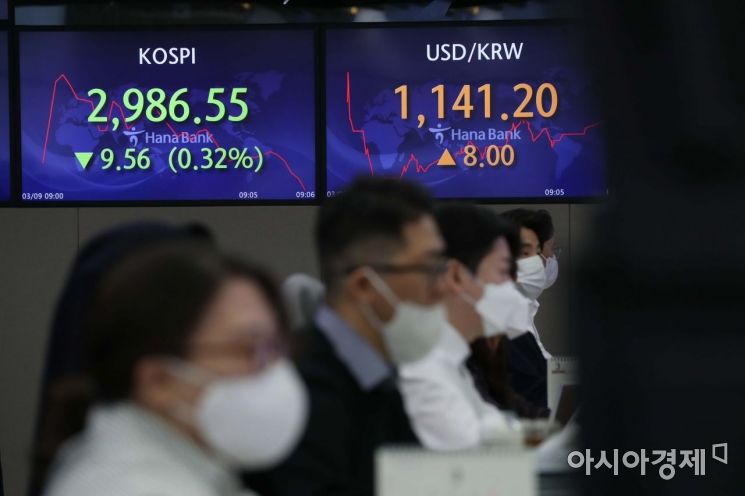
[Asia Economy Reporters Eunbyeol Kim, Minwoo Lee] The KOSPI fell to the 2920 level for the first time since the beginning of the year. Foreign investors unleashed a flood of sell orders due to concerns over the sharp rise in U.S. Treasury yields.
KOSPI Plummets to 2920 Level... KOSDAQ Touches 870
As of 11:01 a.m. on the 9th, the KOSPI recorded 2,929.36, down 2.23% from the previous day. After starting slightly lower at 2,989.96, the decline widened. This is the lowest level since it dropped to 2,921.84 during trading on January 5.
Although institutional investors showed net buying for the first time in a while, it was insufficient to stop the index's decline. Institutions and individuals net bought 200.8 billion KRW and 369.2 billion KRW respectively, but foreigners net sold 562.8 billion KRW.
At the same time, the KOSDAQ fell nearly 3% from the previous day to 877.84. It recorded the 870 level for the first time since November 27 last year. It also started slightly lower at 904.04 but broke below the 900 mark shortly after the opening. Foreigners and individuals net bought 19.8 billion KRW and 67.1 billion KRW respectively, while institutions net sold 67.9 billion KRW.
Analysts say that the rise in the 10-year U.S. Treasury yield caused anxiety that negatively affected the domestic stock market following the U.S. stock market. While the rise in yields itself is not necessarily negative, the rapid pace of increase has heightened concerns.
Lee Kyungsoo, head of the Meritz Securities Research Center, explained, "The overall capital market is showing adjustments due to environmental changes because the rise is happening too quickly for it to adapt," adding, "Since the pace of yield increases is not slowing down, the burden is growing." He further noted, "Next week's Federal Open Market Committee (FOMC) meeting of the U.S. Federal Reserve is expected to be a turning point."
Domestic Bond Yields Also Surge... Won-Dollar Exchange Rate Strengthens
As U.S. Treasury yields rise, domestic bond yields are also surging. Although the Bank of Korea announced it would conduct simple purchases of government bonds to curb the rise in yields, the effect appears limited due to the sharp increase in overseas yields.
As of 11:16 a.m. on the 9th, the 10-year government bond yield stood at 2.042% per annum, up 1.8 basis points (bp, 1bp=0.01 percentage point) from the previous trading day. The 3-year government bond yield also rose 6.0bp to 1.196% per annum. The 5-year government bond, mainly used to determine mortgage loan rates, increased by 8.4bp to 1.576%. As signs of economic recovery in the U.S. emerged and inflationary pressures grew, bond prices fell.
While the issuance of deficit bonds became inevitable due to the execution of the supplementary budget, causing supply-demand pressure and lowering bond prices, the overseas-driven rise in yields is also significantly impacting domestic bond yields. This explains why bond yields are rising despite the Bank of Korea's announcement of simple government bond purchases. The Bank of Korea announced after market close the previous day that it would conduct simple purchases of government bonds totaling 2 trillion KRW. The targeted bonds include five issues: the 3-year benchmark bond 20-8, the 5-year elapsed bond 19-5, and the 10-year elapsed bonds 17-7, 16-8, and 20-4. The inclusion of the 3-year benchmark bond 20-8 in the simple purchase list is interpreted as the Bank of Korea feeling the burden of the recent sharp rise in short-term interest rates.
As government bond yields rise, the dollar linked to them is also strengthening. Earlier this year, the prevailing view was that the U.S. government's liquidity injections would lead to a 'weak dollar.' However, expectations that the U.S. economy will recover faster than other economic zones such as Europe, combined with rising inflation forecasts and higher Treasury yields, have led to a stronger dollar.
The same stimulus package (valued at 1.9 trillion USD) is being interpreted in opposite ways. Earlier this year, it was expected that passing the stimulus package would weaken the dollar, but recently, it is anticipated that the stimulus will accelerate U.S. economic recovery, leading to a stronger dollar.
As of 11:15 a.m. on the same day, the won-dollar exchange rate in the Seoul foreign exchange market was trading at 1,142.15 KRW. After opening at 1,141.5 KRW, up 8.3 KRW from the previous day, it has been moving in the low 1,140 KRW range. It has risen for three consecutive trading days since the 3rd (1,120.3 KRW), increasing by more than 20 KRW.
© The Asia Business Daily(www.asiae.co.kr). All rights reserved.
![Clutching a Stolen Dior Bag, Saying "I Hate Being Poor but Real"... The Grotesque Con of a "Human Knockoff" [Slate]](https://cwcontent.asiae.co.kr/asiaresize/183/2026021902243444107_1771435474.jpg)
















