Professor Jo Byung-kwan's KAIST Team Develops Eco-Friendly C1 Gas Refinery Technology
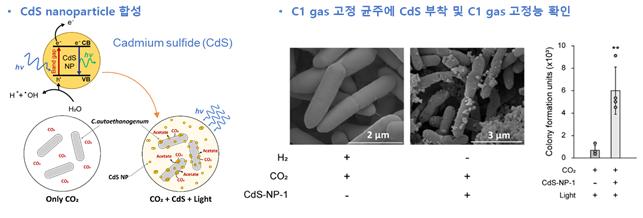 Artificial photosynthesis system with plasmonic nanoparticles attached to the surface. Photo by Korea Advanced Institute of Science and Technology (KAIST).
[Asia Economy Reporter Kim Bong-su] A technology has been developed to convert C1 gases, the main causes of climate change such as carbon dioxide and carbon monoxide, into high value-added bio-chemicals. As the government has declared '2050 Carbon Neutrality' and is actively working to reduce greenhouse gases in preparation for increasingly severe climate change, this technology is attracting attention as a potential solution.
The Korea Advanced Institute of Science and Technology (KAIST) announced on the 9th that a research team led by Professor Byung-Kwan Cho of the Department of Biological Sciences has developed an artificial photosynthesis system combining microorganisms and high-efficiency photo-nanoparticles attached to their surfaces, which utilize electrons emitted by photo-nanoparticles when exposed to light as an energy source. This is an eco-friendly C1 gas refinery technology that uses light as the sole energy source to convert C1 gases into various bio-chemicals through microorganisms.
Until now, attempts have been made to convert C1 gases into acetic acid via the Wood-Ljungdahl pathway using acetogen microorganisms. Acetogen microorganisms metabolize C1 gases into acetic acid by absorbing them through energy obtained from breaking down sugars or hydrogen.
The problem lies in the high cost of energy sources such as sugars or hydrogen used in the reduction process. Moreover, with existing technology, it has been difficult to control the structure and size of photo-nanoparticles synthesized biologically and attached to the cell surface, limiting the efficiency of C1 gas metabolism. This is due to the unique characteristics of photo-nanoparticles, where their photoelectric conductivity performance varies depending on their structure and size.
To overcome this, the research team chemically synthesized high-efficiency photo-nanoparticles with uniform structure and size and excellent photoelectric conductivity, and attached them to the surface of Clostridium autoethanogenum, one of the industrially applicable acetogen microorganisms.
The team confirmed that microorganisms with these attached photo-nanoparticles can produce acetic acid from C1 gases, establishing an eco-friendly artificial photosynthesis system using light. Additionally, transcriptome analysis (a technique analyzing all RNA within cells to determine gene expression) of these artificial photosynthesis system microorganisms identified the electron acceptors responsible for transferring electrons produced by the photo-nanoparticles into the microorganisms.
Professor Byung-Kwan Cho, who led the research, explained, "We replaced sugars or hydrogen used in the C1 gas fixation process with eco-friendly light energy and overcame the limitations of existing artificial photosynthesis systems using microorganism-based biosynthesized photo-nanoparticles. By using high-efficiency photo-nanoparticles, we can increase artificial photosynthesis efficiency and provide a clue for developing artificial microorganisms that can efficiently accept electrons generated from photo-nanoparticles."
© The Asia Business Daily(www.asiae.co.kr). All rights reserved.
![Clutching a Stolen Dior Bag, Saying "I Hate Being Poor but Real"... The Grotesque Con of a "Human Knockoff" [Slate]](https://cwcontent.asiae.co.kr/asiaresize/183/2026021902243444107_1771435474.jpg)















