60 Locations Announced, 13 Closed This Year
22 of Last Year's 30 Global Sites Are Domestic
Sales Plummet Due to Boycott and COVID-19
Employee Anxiety Rises, Turnover Rate Increases
[Asia Economy Reporter Seungjin Lee] As Uniqlo announced plans to close a total of 60 stores worldwide, it is expected that the majority of the stores to be closed will be domestic locations. This follows a sharp decline in sales due to the boycott of Japanese products that emerged in 2019 and the impact of COVID-19.
A total of 13 stores closed just this year
On the 10th, Uniqlo announced on its website the closure of the Art Malling Jang-an store in Dongdaemun-gu, Seoul, and the Wise Park Hongdae store in Mapo-gu. The Jang-an store will operate until the 31st, and the Hongdae store until the 23rd.
The Jang-an store was the only Uniqlo store in the surrounding commercial area and used to be packed during the regular sale period called ‘Gamsaje’ (Thanksgiving Festival). The Hongdae store was mainly where Uniqlo released collaboration products with famous overseas brands, and limited edition products often drew crowds from early morning.
Uniqlo is struggling with deteriorating performance to the extent of closing these two once highly profitable stores. Last month, Uniqlo closed 10 stores, including all locations inside Homeplus stores nationwide. In January, it closed the Myeongdong Central store, the world’s second-largest flagship store.
The fashion industry analyzes that Uniqlo’s store restructuring is just beginning. Uniqlo previously announced plans to close 60 global stores in the 2021 fiscal year. By March this year, 13 stores had closed in Korea alone, while only 3 stores closed overseas. Therefore, most of the remaining 40 or so stores planned for closure are expected to be domestic locations.
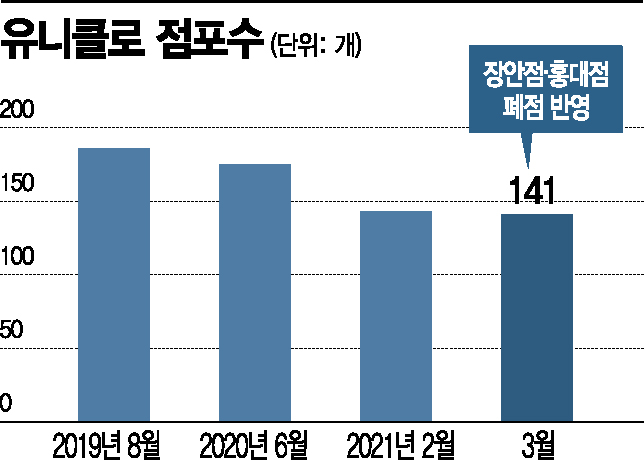
Last year, Uniqlo also announced plans to close about 30 global stores, reducing 22 stores domestically. As the number of stores decreases every year, Uniqlo now operates only 141 stores, down from 191 stores in 2019 before the boycott of Japanese products spread, and 175 stores last year.
Shaken employees
As store restructuring intensifies, employee anxiety is increasing. Some contract workers were notified of contract termination along with store closures, and the number of regular employees leaving the company after being transferred to other stores is rising. The resignation rate among headquarters staff has also recently increased.
An employee A working at Uniqlo said, "Since last year, resignations and transfers among headquarters staff have sharply increased. The glory days when sales soared several times over are gone, and as the company size shrinks, many feel anxious."
Another employee B explained, "There have been so many resignations in the past two years that artificial workforce restructuring is unnecessary. There is also high dissatisfaction internally because business plans are not transparently shared among employees."
The fashion industry expects Uniqlo to accelerate its store closures. A fashion industry insider said, "The current trend in the fashion industry is to reduce offline stores and expand online. Given that Uniqlo’s offline operations have become difficult due to the boycott of Japanese products, it is expected to close stores on a larger scale."
© The Asia Business Daily(www.asiae.co.kr). All rights reserved.


















