[Asia Economy Reporter Changhwan Lee] Last year, the number of workers earning less than the statutory minimum wage (hourly wage of 8,590 won) was the second highest on record.
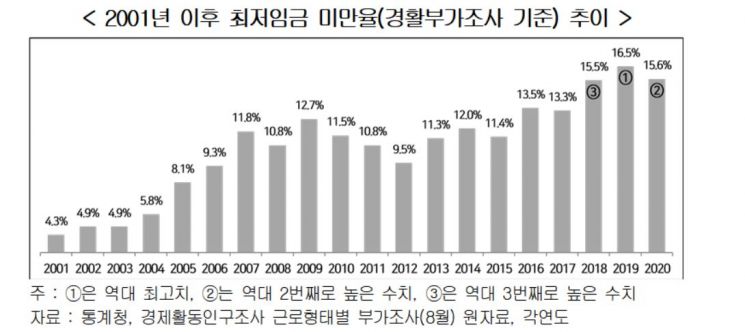
The Korea Employers Federation announced on the 8th the results of the "2020 Minimum Wage Underpayment Rate Analysis," revealing that the number of workers earning less than the minimum wage increased by 2,613,000 (11.3 percentage points) over 20 years, from 577,000 (4.3%) in 2001 to 3.19 million (15.6%) in 2020.
The minimum wage underpayment rate refers to the proportion of wage workers who do not receive the statutory minimum wage. When the minimum wage level becomes too high for employers to comply with, market acceptance decreases, leading to a tendency for the minimum wage underpayment rate to rise.
Last year, the number of workers earning less than the minimum wage was 3.19 million (underpayment rate 15.6%). This figure decreased by 196,000 (0.9 percentage points) compared to the record high of 3.386 million (underpayment rate 16.5%) in 2019, influenced by the relatively low minimum wage increase rate of 2.87% in 2020 compared to 2019.
The second highest minimum wage underpayment rate in history (15.6% in 2020) was mainly attributed to the fact that the relative level of Korea's minimum wage has already reached the top tier globally.
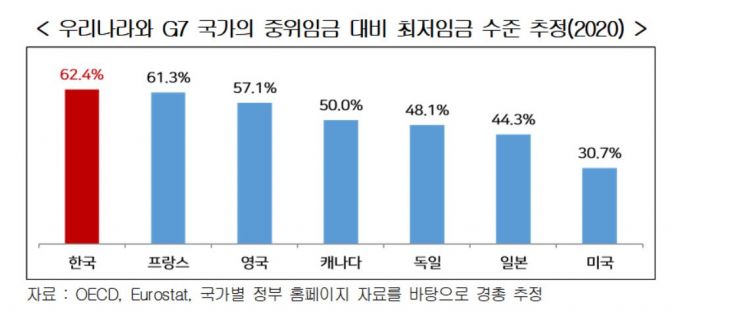
In 2020, Korea's minimum wage was 62.4% of the median wage, ranking among the top in OECD countries (6th out of 29 countries). Over the recent three years (2018?2020), the cumulative increase rate of Korea's minimum wage was 32.8%, approximately 1.4 to 8.2 times higher than that of major countries (G7) with which Korea competes industrially.
Especially, smaller businesses, which are more sensitive to minimum wage increases, showed higher minimum wage underpayment rates. Among 3.648 million workers employed at businesses with fewer than five employees, 1.324 million (36.3%) earned less than the minimum wage, leading the Korea Employers Federation to estimate that the minimum wage is practically difficult to be accepted in businesses of this scale.
By industry, the minimum wage underpayment rate in 2020 was very high in agriculture, forestry, and fisheries (51.3%) and accommodation and food services (42.6%), indicating that the minimum wage is effectively not functioning in some sectors. Furthermore, due to the uniform increase in the minimum wage, the disparity in minimum wage underpayment rates between industries reached a severe level of up to 49.1 percentage points (51.3% in agriculture, forestry, and fisheries vs. 2.2% in information and communications).
Ha Sang-woo, head of the Economic Research Department at the Korea Employers Federation, stated, "Despite the relatively low minimum wage increase rate of 2.87% in 2020, the minimum wage underpayment rate (15.6%) was the second highest ever, indicating that the acceptance of the minimum wage in our labor market has reached its limit." He emphasized, "To improve minimum wage acceptance, the minimum wage should be managed at a level not exceeding 60% of the median wage for a considerable period through stabilization." He also added, "It is necessary to apply differentiated minimum wages considering the vastly different business environments across industries."
© The Asia Business Daily(www.asiae.co.kr). All rights reserved.


















