Report Published by Hana Financial Research Institute
Increasing Proportion of Financial Assets Since COVID-19
[Asia Economy Reporter Kiho Sung] It has been revealed that wealthy individuals in Korea (those holding financial assets of 1 billion KRW or more) and the mass affluent (those holding financial assets between 100 million KRW and less than 1 billion KRW) achieved favorable investment results last year through active asset rebalancing. This year, asset rebalancing showed a tendency to maintain a wait-and-see stance, with a growing preference for financial asset investments, especially stock investments, over real estate.
Hana Financial Management Research Institute announced on the 8th that it published the "2021 Korean Wealth Report: Asset Management Trends of the Wealthy and Mass Affluent" based on an online survey conducted last December targeting wealthy individuals and the mass affluent in Korea.
Last year, wealthy individuals significantly adjusted their financial asset portfolios. The proportion of safe assets such as cash and deposits increased, while stock investments expanded and stock prices rose, leading to an increase in stock holdings. Additionally, due to a decline in trust in private equity fund products, the proportion of funds and trusts decreased, while the share of long-term products such as insurance and pensions increased. Particularly in stock investments, both wealthy individuals and the mass affluent were active; half of them responded that they increased their stock holdings after COVID-19 (53% of the wealthy, 48% of the mass affluent), and a positive outlook prevailed, expecting a moderate rise in the stock market this year.
Thanks to this active asset rebalancing, wealthy individuals and the mass affluent achieved favorable investment returns last year, which were even higher than their initially expected target returns. Those who earned high returns of over 10% on financial assets attributed this to direct stock investments (49%) and equity funds (13%).
Wealthy and Mass Affluent "Negative Economic Outlook for This Year"
The economic outlook perceived by wealthy individuals and the mass affluent was generally negative. Regarding the real economy, 61% of respondents, and regarding the real estate market, 52% responded that conditions would worsen. Based on this negative economic outlook, more than half of the wealthy and mass affluent stated that they would "maintain their current asset composition" this year, indicating a prevailing attitude of "waiting and watching" rather than active asset rebalancing.
Among those planning to change their asset composition, more respondents intended to increase the proportion of financial assets rather than real estate. In particular, 29% of high-net-worth real estate owners (those holding real estate assets worth 5 billion KRW or more) responded that they would reduce their real estate holdings, indicating plans to rebalance from real estate assets to financial assets due to increased tax burdens related to real estate.
Looking at the time series, among the past five years of surveys, the response rate for "maintaining current asset composition" among wealthy individuals was highest this year at 51%, while the proportion of those planning to "expand real estate holdings" was 8%, the lowest in the past five years.
The financial products that wealthy individuals and the mass affluent plan to invest in this year are, in order, short-term financial products, index-linked products, time deposits, direct stock investments, and foreign currency assets (overseas stocks, overseas bonds, dollars, etc.). Safe assets and reserve funds such as short-term financial products and time deposits remain the most preferred products among the wealthy. Although the preference for index-linked products has significantly declined due to various financial accidents, they are still among the prioritized investment options.
Additionally, among wealthy individuals, the preference for both direct stock investments and equity funds sharply increased compared to last year (stocks 12% → 36%, equity funds 14% → 21%, combined responses for 1st, 2nd, and 3rd choices). Interest in foreign currency assets was also high, with a rising intention to invest in overseas stocks rather than foreign currency deposits. Along with a positive outlook on the stock market, the preference for domestic and overseas stocks among wealthy individuals is expected to continue this year.
Researcher Sooyoung Lee of Hana Financial Management Research Institute stated, "While wealthy individuals and the mass affluent tend to maintain a wait-and-see stance on asset rebalancing, there is a trend of shifting interest from real estate to financial assets. They are expected to actively pursue returns through investments in domestic and overseas stocks, index-linked products, and equity funds while maintaining a certain proportion of short-term financial products and deposits."
Real Estate, 'No Purchase Plans' 56%
Due to the rise in real estate asset values last year, the proportion of real estate assets among wealthy individuals increased, with the share of owner-occupied housing significantly rising within the real estate portfolio, surpassing commercial real estate. Owner-occupied housing accounted for 41%, followed by commercial real estate at 34% and investment-purpose housing at 11%.
Regarding future real estate transactions, wealthy individuals showed a high response rate for "maintaining the current state" regardless of policy changes. The proportion responding "no plans to purchase" increased from 43% to 56%, and those responding "maintain current state" for sales increased from 51% to 56%, accounting for more than half. Conversely, responses indicating "decide after observing future policy changes and trends" decreased from 42% to 26% for purchases and from 30% to 21% for sales. This suggests a change in the stance of wealthy individuals following confirmation of the government's strong policy intentions and increased tax burdens related to real estate.
As a response to the increased comprehensive real estate tax burden, wealthy individuals and the mass affluent responded with no clear countermeasures (38%), gifting (31%), and sales (26%) in that order. The preference for gifting sharply increased over sales as the value of held real estate assets rose.
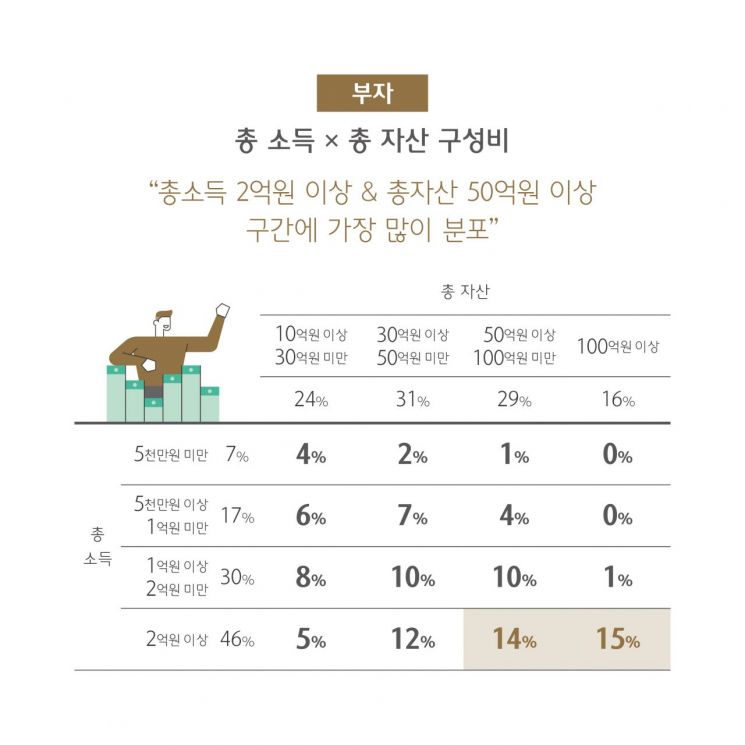
The total assets held by wealthy individuals are distributed with 31% holding between 3 billion KRW and less than 5 billion KRW, and 29% holding between 5 billion KRW and less than 10 billion KRW, with 53% of total assets reported as real estate assets. In contrast, about half of the mass affluent are distributed in the total asset bracket below 1 billion KRW, with real estate assets accounting for 76% of their asset portfolios.
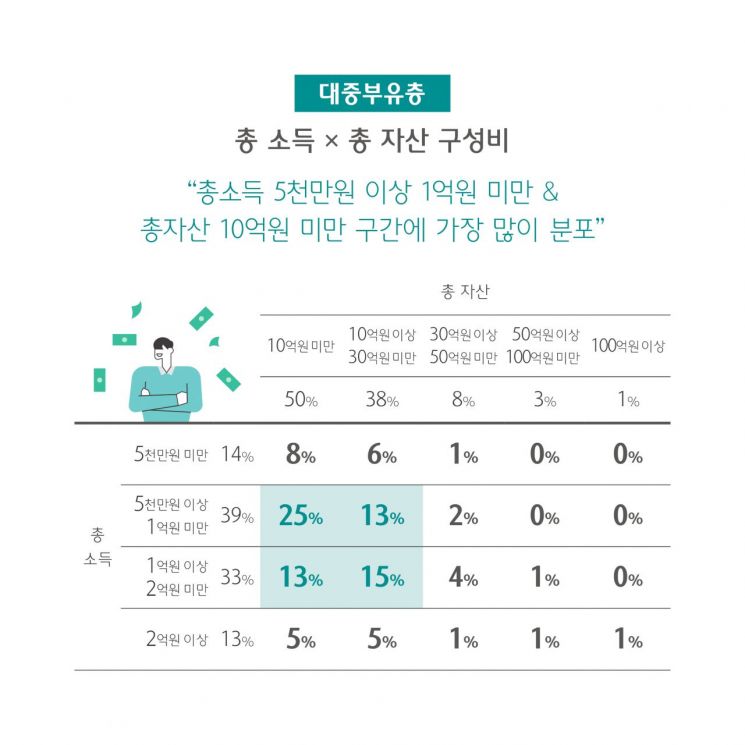
Regarding household annual income, 46% of wealthy individuals earned 200 million KRW or more, with business income at 34%, earned income at 33%, and property income at 21% within the 200 million KRW or more income bracket. Conversely, the mass affluent had 39% in the 50 million KRW to less than 100 million KRW income bracket and 33% in the 100 million KRW to less than 200 million KRW bracket, with earned income being the highest proportion across all income brackets.
Meanwhile, wealthy individuals and the mass affluent plan to cover approximately 39% and 44%, respectively, of their expected post-retirement living expenses (804,000 KRW per month for the wealthy, 420,000 KRW per month for the mass affluent) through pensions. Wealthy individuals prepare for retirement through various means such as savings, insurance, and real estate.
© The Asia Business Daily(www.asiae.co.kr). All rights reserved.
![Clutching a Stolen Dior Bag, Saying "I Hate Being Poor but Real"... The Grotesque Con of a "Human Knockoff" [Slate]](https://cwcontent.asiae.co.kr/asiaresize/183/2026021902243444107_1771435474.jpg)
















