OECD January CPI 1.5%... Increase Margin Expanded by 0.3%P
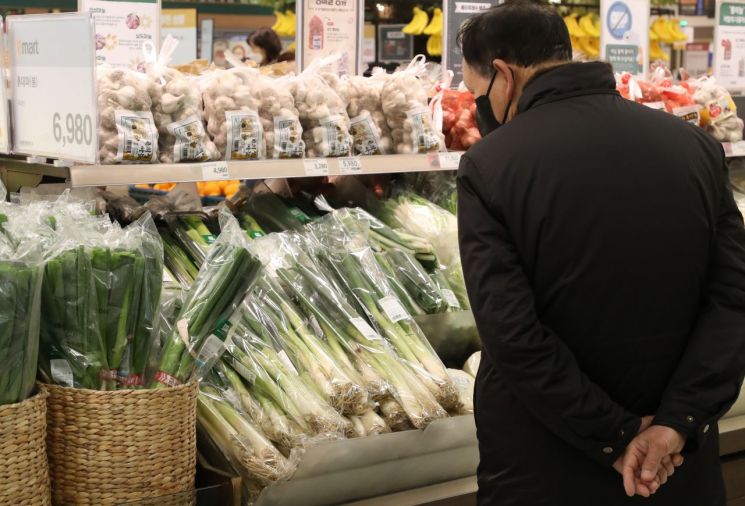
[Asia Economy Reporter Kim Eunbyeol] Amid the overlapping impact of the avian influenza (AI) outbreak and increased demand during the holiday season, prices of agricultural, livestock, and marine products have surged sharply, with South Korea's dining table price inflation ranking 4th among the member countries of the Organisation for Economic Co-operation and Development (OECD).
According to the OECD and Statistics Korea on the 8th, South Korea's food and non-alcoholic beverage prices rose by 6.5% in January compared to the previous year. This is more than double the OECD average of 3.1%, ranking 4th highest among 37 member countries, following Turkey (18.1%), Chile (7.8%), and Iceland (6.7%).
South Korea's food price inflation rate (year-on-year) remained in the 1% range until January last year (1.8%) but began to rise sharply in the second half of the year, reaching 4.3% in July. Since then, food prices have continued to soar, recording 6.6% in August, 8.3% in September, 8.2% in October, 6.9% in November, and 6.2% in December.
The situation in February is even more severe. The food price inflation rate in February was 9.7%, marking the highest level in 9 years and 6 months since August 2011 (11.2%).
Since most countries have not yet released their February food price data, comparisons with other countries are difficult. However, considering that Iceland, which ranked 3rd in January, had a 6.4% increase, it is highly likely that South Korea's food price inflation ranking rose further last month.
Recently, prices of agricultural, livestock, and marine products have surged sharply compared to a year ago across various items. Last month, the price of green onions jumped 227.5% compared to the previous year, marking the highest increase in 26 years and 9 months since May 1994 (291.4%). Egg prices rose by 41.7%, the highest in 3 years and 6 months since August 2017 (53.3%). Prices of apples (55.2%), red pepper powder (35.0%), and pork (18.0%) also saw significant increases.
As a result, the consumer price index last month rose by 1.1% compared to a year ago, showing the highest increase in one year.
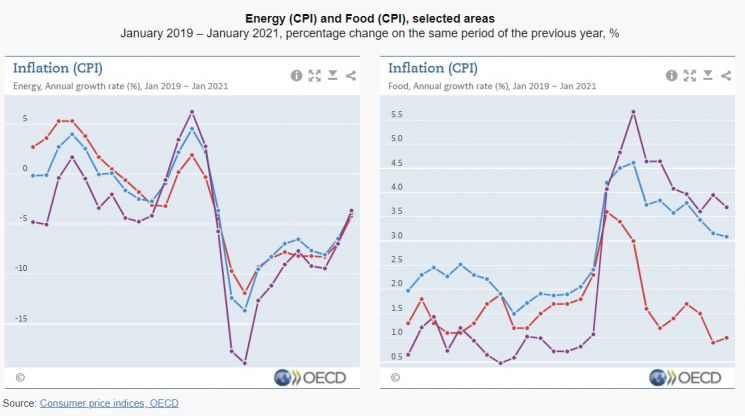
This year, the overall inflation trend among OECD member countries has also accelerated. The consumer price index (CPI) for OECD member countries in January this year rose by 1.5% compared to the same month last year. This is a larger increase than the 1.2% recorded in December last year. The consumer price inflation rate among OECD member countries fell from 2.4% in January last year to 0.7% in May but rose again to the 1% range, remaining at 1.2% for three consecutive months in the fourth quarter of last year. The CPI excluding food and energy also increased from 1.6% in December last year to 1.7% in January this year.
Looking at consumer price inflation rates by major countries, Germany showed a decline of -0.3% in December last year but jumped to 1.0% in January. France (0.0%→0.6%) and Italy (-0.2%→0.4%) also showed steep upward trends during the same period. The United States maintained a 1.4% increase for two consecutive months, and Japan's (-1.2%→-0.6%) decline narrowed. The OECD also analyzed that the consumer price index for the Group of 20 (G20) major countries rose from 2.0% in December last year to 2.2% in January this year.
With the distribution of COVID-19 vaccines and economic stimulus measures in major countries, expectations for economic recovery have increased, leading to heightened caution about inflation in recent financial markets.
However, experts believe that the inflationary trend is unlikely to exceed an appropriate level and cause inflation. Eo Unseon, Director of Economic Trends at Statistics Korea, said at the consumer price trend briefing in February, "While it is possible to predict that the upward trend will continue due to price increase factors on both supply and demand sides, the situation is not one that warrants concern about inflation."
The government plans to closely monitor the prices and supply conditions of key agricultural and livestock products such as eggs and vegetables, and focus on stabilizing prices by releasing government stockpiles and expanding imports, especially for items with sustained price strength.
© The Asia Business Daily(www.asiae.co.kr). All rights reserved.
![Clutching a Stolen Dior Bag, Saying "I Hate Being Poor but Real"... The Grotesque Con of a "Human Knockoff" [Slate]](https://cwcontent.asiae.co.kr/asiaresize/183/2026021902243444107_1771435474.jpg)
















