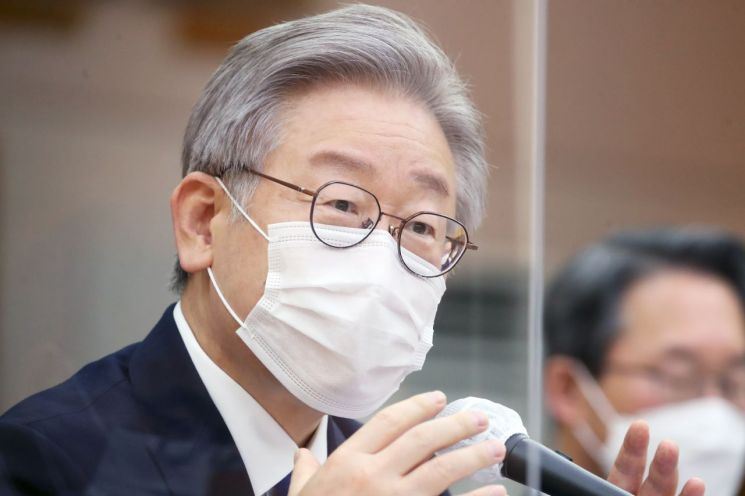
[Asia Economy (Suwon) = Reporter Lee Young-gyu] Lee Jae-myung, Governor of Gyeonggi Province, expressed the view that the introduction of a 'basic income earmarked tax' is necessary to revive the economy and expand welfare.
He predicted that if the basic income earmarked tax is introduced and used for household support and consumption, it will create a virtuous economic cycle of increased production, investment, and employment through demand stimulation, enabling sustainable growth. However, Lee emphasized that since the basic income earmarked tax is also a form of tax increase, it is necessary to introduce it step-by-step to eliminate initial resistance.
In a lengthy post titled "From Start to Finish: Pursuing Sustainable Growth with a Basic Income Earmarked Tax, Not Traditional Tax Increases" posted on Facebook on the 7th, Lee argued, "While tax increases are necessary, they should be implemented sequentially under a long-term plan as a basic income earmarked tax that promotes sustainable growth and alleviates polarization, rather than general tax increases."
Regarding whether tax increases are necessary, he diagnosed, "Compared to the OECD (Organisation for Economic Co-operation and Development) average, South Korea's social welfare expenditure is only half, and the tax burden rate is significantly low, making it a low-burden, low-welfare country. To move through a medium-burden, medium-welfare stage to a high-burden, high-welfare country like the Nordic countries, tax increases are inevitable."
He particularly stressed, "If tax increases are merely to cover national management costs, they should be minimized, but if they help revive the economy, expand welfare, and benefit taxpayers, there is no reason to avoid them, nor should they be avoided."
On whether tax increases are feasible in the current situation, he explained, "If a basic income (earmarked tax) is introduced and 'all increased taxes are distributed equally to the people,' the overwhelming majority of citizens dissatisfied with the 9:1 income inequality will receive more income than the taxes they pay, reducing distrust and resistance to tax increases and making it easier to gain national consensus."
He continued, "In the current situation where the share of labor (income) in production costs is decreasing due to technological revolution, and economic growth is hampered by insufficient household consumption and total demand, if the increased taxes are used for household support and consumption, it will stimulate demand, leading to increased production, investment, and employment, creating a virtuous economic cycle and enabling sustainable growth." He emphasized, "If paid with 'time-limited local currency,' it will be entirely spent in neighborhood markets, alleviating sales polarization and enabling sustainable growth."
In this case, since the entire tax is spent on consumption and the economy is revitalized, Lee argued that the opposition to tax increases from high-income taxpayers, who mainly enjoy the fruits of growth, will also weaken.
Regarding the introduction of tax increases, Lee said, "To succeed in tax increases by gaining the consent of citizens who perceive tax increases as 'taking away' and distrust even desirable tax increases, it is necessary to prepare tax increases meticulously over the long term, step-by-step, so that the overwhelming majority of citizens feel that 'tax increases are beneficial.'" He added, "In the short term, it is necessary to let people experience the welfare economic effects of basic income by providing about 500,000 won per person annually (250,000 won twice a year) in local currency without tax increases through general budget cuts."
He further stated, "In the medium term, by gradually reducing tax exemptions amounting to 50 to 60 trillion won annually and implementing an additional basic income of 500,000 won per year, people will realize that the benefits of basic income outweigh the burdens from reduced exemptions. Then, in the long term, new basic income earmarked taxes such as carbon tax (environmental tax), data tax (digital tax), robot tax, and land unearned income tax should be introduced or added to existing tax items, starting small and gradually increasing."
Moreover, he assessed, "The inevitability of tax increases is both a crisis and an opportunity to introduce new tax income policies. Nordic countries with high existing welfare spending and tax burdens must either increase taxes or replace existing welfare to introduce basic income, but both tax increases and welfare cuts are difficult. However, since we must increase both taxes and welfare simultaneously, we can expand welfare and implement basic income through tax increases."
Lee concluded, "To become a leading country, we must take paths others have not taken. Now, South Korea must become a frontrunner rather than a follower and lead the world economically. While administration is about following existing paths well, politicians create new paths, and we can certainly do it."
© The Asia Business Daily(www.asiae.co.kr). All rights reserved.

















