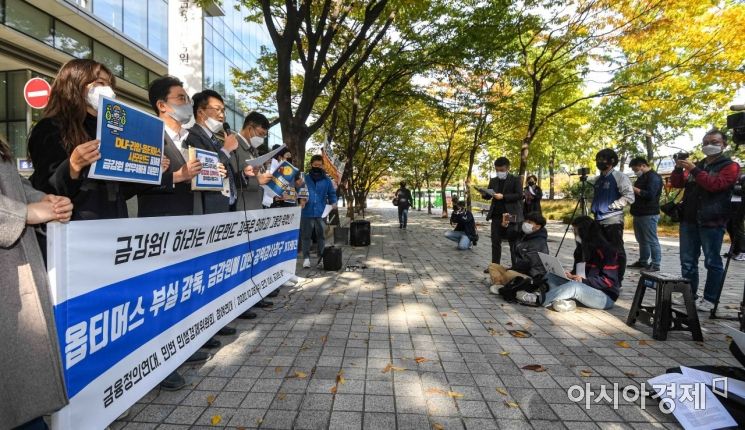
 On the 28th, members of the People's Solidarity for Participatory Democracy held a press conference in front of the Financial Supervisory Service in Yeouido, Seoul, requesting a public audit regarding the Financial Supervisory Service's supervisory negligence in the Optimus Fund fraud case. Photo by Jin-Hyung Kang aymsdream@
[Asia Economy Reporter Ji Yeon-jin] Financial authorities are reportedly recommending full compensation to victims by the sales companies of the Optimus fund, which experienced a large-scale suspension of redemptions.
According to financial authorities and the financial investment industry on the 7th, the Financial Supervisory Service (FSS) has mostly completed verifying the authenticity of the public institution accounts receivable, which was the main investment target presented by the Optimus fund, and is expected to hold a dispute mediation committee meeting in early next month to propose such a dispute mediation plan. An FSS official said, "Since the final decision will be made by the dispute mediation committee, it is not yet confirmed, but based on the investigation, we plan to create a dispute mediation plan in the direction of full compensation."
The FSS plans to apply "contract cancellation due to mistake," judging that the public institution accounts receivable presented as an investment target by the Optimus fund did not exist. "Contract cancellation due to mistake" is a clause that allows the contract to be canceled if important matters that would have prevented the contract from being concluded in the first place were not properly disclosed. In this case, the fund sales companies must return 100% of the principal to investors.
The FSS inquired with five entities mentioned in the Optimus investment proposal, including Korea Expressway Corporation, Korea Land and Housing Corporation (LH), Korea National Railway Corporation, Chuncheon City, and Gyeonggi Provincial Office of Education, and received official responses indicating that "the accounts receivable targeted by Optimus are fundamentally impossible structures."
Previously, Optimus had attracted investors by stating plans to invest more than 95% of the fund's capital in accounts receivable related to construction projects ordered by these public institutions and local governments.
For public institution accounts receivable to arise, public institutions such as LH must contract construction work with private companies and promise to pay the amount (accounts receivable) after a certain period, and the construction companies must issue receivables based on future incoming payments.
However, these public institutions and local governments reportedly responded that payments related to construction are made according to legally prescribed deadlines and methods, so the accounts receivable presented by Optimus could not have existed in the first place. The National Contract Act stipulates that public institutions must pay private companies within 5 days or every 30 days according to construction progress, but Optimus presented the maturity of public institution accounts receivable as 3 to 9 months.
The FSS also confirmed that even if private companies hold accounts receivable for construction ordered by public institutions, the structure of transferring these to Optimus Asset Management and others is impossible. When a company contracted with a public institution transfers accounts receivable arising from the contract, approval from the public institution is required by regulation, but it is known that these institutions have never approved such transfers.
The FSS is also checking whether any of the 330 asset management companies have incorporated confirmed public institution accounts receivable into fund assets, and about half of those who have responded so far have answered "not applicable."
This legal principle was first applied in the financial investment dispute mediation for some Lime Asset Management trade finance funds, making the Optimus fund the second case.
However, it is uncertain whether NH Investment & Securities, the largest sales company, will accept this "full compensation" dispute mediation plan. The dispute mediation committee's decision is only advisory, and it takes effect only if both the complainants (investors) and the financial companies agree. Among the 46 funds managed by Optimus, 515.1 billion KRW have been suspended or are difficult to redeem, of which NH Investment & Securities' sales amount is 432.7 billion KRW, accounting for 84% of the total.
Previously, sales companies of Lime trade finance funds, which were recommended for 100% compensation, all accepted the dispute mediation results. However, Hana Bank (36.4 billion KRW), Woori Bank (65 billion KRW), Shinhan Investment Corp. (42.5 billion KRW), and Mirae Asset Daewoo (9.1 billion KRW) had smaller sales amounts compared to NH Investment & Securities, thus bearing less burden.
© The Asia Business Daily(www.asiae.co.kr). All rights reserved.
![Clutching a Stolen Dior Bag, Saying "I Hate Being Poor but Real"... The Grotesque Con of a "Human Knockoff" [Slate]](https://cwcontent.asiae.co.kr/asiaresize/183/2026021902243444107_1771435474.jpg)















