Expanded to 3,664 Reporting Institutions... Suspicious Transaction Reporting Rate Tripled
"We Will Develop a More Sophisticated and Intelligent System"
[Asia Economy Reporter Kwangho Lee] The 'Next-Generation Anti-Money Laundering System,' which was fully operational at the end of last year, is achieving results by detecting and addressing initial errors through an emergency response system with related agencies.
The Financial Intelligence Unit of the Financial Services Commission announced on the 7th that, after analyzing the operational status for two months since the launch of the next-generation system, it confirmed achievements related to the project's goals: streamlining the suspicious transaction reporting system, enhancing review and analysis capabilities, and strengthening information security.
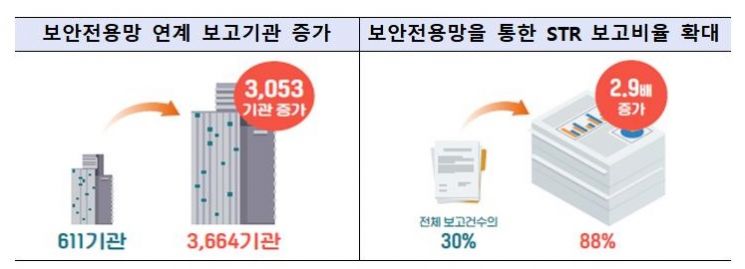
First, to ensure that suspicious transaction information from reporting institutions is transmitted quickly and securely, the number of reporting institutions connected to the next-generation system via a dedicated security network was significantly expanded from 611 to 3,664. As a result, the proportion of suspicious transaction reports sent through the dedicated security network also increased approximately threefold (30% → 88%).
In particular, to process suspicious transaction information sent by about 6,000 reporting institutions without delay, a multi-distributed processing method was applied, reducing the processing time per suspicious transaction report by more than 10 seconds (from 13.3 seconds to 2.9 seconds).
Additionally, tasks that were simple, repetitive, and required manual work in the current review and analysis process?such as preparing various reports and obtaining administrative data?were computerized and automated in a user-friendly manner, improving work productivity.
Furthermore, by newly adding administrative information necessary for analysis, enhancing information search functions, advancing strategic analysis, and introducing dedicated programs for account, individual, and statistical analysis, detailed and precise money laundering analysis became possible, significantly improving the quality of review and analysis.
All equipment for the next-generation system is installed at the National Information Resources Service, an agency under the Ministry of the Interior and Safety, to strengthen the system's security level and operational capabilities.
In addition, by adopting the verified e-Government standard framework and efficiently integrating computing resources such as servers, the processing performance of the next-generation system was increased more than ninefold.
A Financial Intelligence Unit official stated, "We will continuously monitor the achievements of the next-generation system's overhaul, identify and improve areas for enhancement, and strengthen user education and training. We will also develop the system into a sophisticated and intelligent platform capable of effectively responding to increasingly diverse and complex money laundering crimes, including those involving virtual assets and the introduction of new digital technologies."
© The Asia Business Daily(www.asiae.co.kr). All rights reserved.
![Clutching a Stolen Dior Bag, Saying "I Hate Being Poor but Real"... The Grotesque Con of a "Human Knockoff" [Slate]](https://cwcontent.asiae.co.kr/asiaresize/183/2026021902243444107_1771435474.jpg)















